|
Journal Articles: Hinduism OCRT: Hinduism Buy CD-ROM Buy books about Hinduism
The VedasThere are four Vedas, the Rig Veda, Sama Veda, Yajur Veda and Atharva Veda. The Vedas are the primary texts of Hinduism. They also had a vast influence on Buddhism, Jainism, and Sikhism. Traditionally the text of the Vedas was coeval with the universe. Scholars have determined that the Rig Veda, the oldest of the four Vedas, was composed about 1500 B.C., and codified about 600 B.C. It is unknown when it was finally committed to writing, but this probably was at some point after 300 B.C. The Vedas contain hymns, incantations, and rituals from ancient India. Along with the Book of the Dead, the Enuma Elish, the I Ching, and the Avesta, they are among the most ancient religious texts still in existence. Besides their spiritual value, they also give a unique view of everyday life in India four thousand years ago. The Vedas are also the most ancient extensive texts in an Indo-European language, and as such are invaluable in the study of comparative linguistics. Rig Veda
 Vedic Hymns, Part I (SBE 32)
Hymns to the Maruts, Rudra, Vâyu and Vâta, tr. by F. Max Müller [1891] A masterpiece of linguistics and comparative mythology: translations and deep analysis of the Vedic Hymns to the Storm Gods.
Vedic Hymns, Part II (SBE 46)Hymns to Agni, tr. by Hermann Oldenberg [1897] The Vedic Hymns to Agni.
Sama Veda
Yajur Veda
Atharva VedaThe Atharva Veda also contains material from the Rig Veda, but of interest are the numerous incantations and metaphysical texts, which this anthology (part of the Sacred Books of the East series) collects and categorizes. The Atharva Veda was written down much later than the rest of the Vedas, about 200 B.C.; it may have been composed about 1000 B.C.
The Hymns of the Atharvavedatranslated by Ralph T.H. Griffith [1895-6] The unabridged Atharva Veda translation by Ralph Griffith.
The Atharva-Vedatranslated by Maurice Bloomfield [1897] (Sacred Books of the East, Vol. 42) The Sacred Books of the East translation of the Atharva-veda. Selected hymns from the Atharva-veda. UpanishadsThe Upanishads are a continuation of the Vedic philosophy, and were written between 800 and 400 B.C. They elaborate on how the soul (Atman) can be united with the ultimate truth (Brahman) through contemplation and mediation, as well as the doctrine of Karma-- the cumulative effects of a persons' actions.
PuranasThe Puranas are post-Vedic texts which typically contain a complete narrative of the history of the Universe from creation to destruction, genealogies of the kings, heroes and demigods, and descriptions of Hindu cosmology and geography. There are 17 or 18 canonical Puranas, divided into three categories, each named after a deity: Brahma, Vishnu and Shiva. There are also many other works termed Purana, known as 'Upapuranas.'
Other Primary Texts
The Grihya Sutras, Part 1 (SBE 29)Hermann Oldenberg, tr. [1886]
The Grihya Sutras, Part 2 (SBE 30)Hermann Oldenberg, tr. [1892] Ancient Hindu household rites, including fertility, marriage, purity, initiations, and funerals. The EpicsThe Mahabharata and Ramayana are the national epics of India. They are probably the longest poems in any language. The Mahabharata, attributed to the sage Vyasa, was written down from 540 to 300 B.C. The Mahabharata tells the legends of the Bharatas, a Vedic Aryan group. The Ramayana, attributed to the poet Valmiki, was written down during the first century A.D., although it is based on oral traditions that go back six or seven centuries earlier. The Ramayana is a moving love story with moral and spiritual themes that has deep appeal in India to this day. In addition, a key Hindu sacred text, the Bhagavad Gita, is embedded in Book Six of the Mahabharata. Mahabharata
The Mahabharatatranslated by Kisari Mohan Ganguli [1883-1896] Digitizing this unabridged translation of the Mahabharata was a joint venture between sacred-texts and Project Gutenberg.
The Ramayana
Abridged Versions
Bhagavad GitaThe Bhagavad Gita, usually considered part of the sixth book of the Mahabharata (dating from about 400 or 300 B.C.), is a central text of Hinduism, a philosphical dialog between the god Krishna and the warrior Arjuna. This is one of the most popular and accessible of all Hindu scriptures, required reading for anyone interested in Hinduism. The Gita discusses selflessness, duty, devotion, and meditation, integrating many different threads of Hindu philosophy.
The Bhagavad Gita
Vedanta
Later Texts
Modern Books
Hindu Mysticismby S.N. Dasgupta [1927]
Kali the Motherby Sister Nivedita (Margaret E. Noble) [1900] Sister Nivedita's devotional writings to the Mother goddess Kali.
The Web of Indian Lifeby Sister Nivedita (Margaret E. Noble) [1904]
Studies from an Eastern Homeby Sister Nivedita (Margaret E. Noble) [1913]
Gitanjali [1913]
Saddhana, The Realisation of Life [1915]
The Crescent Moon [1916]
Fruit-Gathering [1916]
Stray Birds [1916]
The Home and the World [1915]
Thought Relics [1921]
Songs of Kabîr [1915]
Also of Interest
LinksAutobiography of a Yogi by Paramhansa Yogananda [1946] [External Site] |


 |
Hold the world's wisdom in the palm of your hand. Over 1700 books. |
| On Twitter, follow 'sacredtexts.' |
| Sacred-texts on Facebook |

|
search powered by |
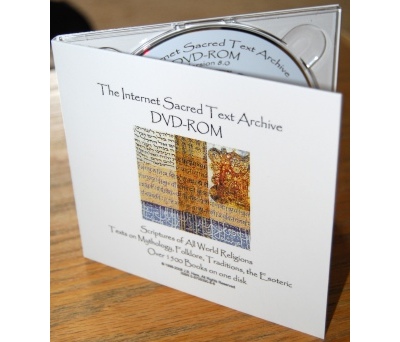 Buy a DVD or USB 1700+ books. Support this site. |