
The Rosetta Stone
8 chapters English Public domain
About this book
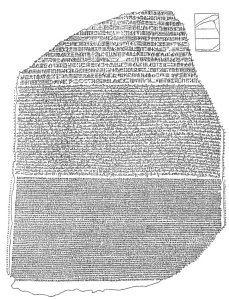
This is a collection of two articles by E.A. Wallis Budge on the famous Rosetta Stone, which was the key to the modern decipherment of the Ancient Egyptian writing system. The first article is an essay from Budge's 1893 anthology The Mummy, which discusses the stone, ancient and medieval writings about hieroglyphics, and the competition between Young and Champollion, the two 19th century scholars who eventually cracked the code. He explains how the stone was used to piece together the Egyptian alphabetic signs, the key to the rest of the hieroglyphics. The second article is his 1905 translation of the text of the stone, which turns out to be a fairly unremarkable Ptolemaic era decree.
Table of contents
8 chapters
Audiobook
Listen to this edition
Audiobooks are coming soon
Narrated editions will appear here when they are ready to listen.
Membership
Support the archive
$10 / month
Ad-free reading experience
1,000 Credits monthly for Search usage
Unlimited bookmarks
Unlimited highlights & annotations
Helps fund new texts & growth
Cancel anytime. Helps us pay the bills.
Discussion
Community conversation
Discussions are coming soon
Join conversations around this text and its interpretations.
The Rosetta Stone
8 chapters English Public domain
About this book
This is a collection of two articles by E.A. Wallis Budge on the famous Rosetta Stone, which was the key to the modern decipherment of the Ancient Egyptian writing system. The first article is an essay from Budge's 1893 anthology The Mummy, which discusses the stone, ancient and medieval writings about hieroglyphics, and the competition between Young and Champollion, the two 19th century scholars who eventually cracked the code. He explains how the stone was used to piece together the Egyptian alphabetic signs, the key to the rest of the hieroglyphics. The second article is his 1905 translation of the text of the stone, which turns out to be a fairly unremarkable Ptolemaic era decree.
Table of contents
8 chapters
Audiobook
Listen to this edition
Audiobooks are coming soon
Narrated editions will appear here when they are ready to listen.
Membership
Support the archive
$10 / month
Ad-free reading experience
1,000 Credits monthly for Search usage
Unlimited bookmarks
Unlimited highlights & annotations
Helps fund new texts & growth
Cancel anytime. Helps us pay the bills.
Discussion
Community conversation
Discussions are coming soon
Join conversations around this text and its interpretations.

The archive, offline Own the Wisdom of the Ages Every text in the library on a single USB drive. Read offline, cite freely, keep forever. No subscription required.
Get the drive $127.00
The Rosetta Stone
8 chapters English Public domain
About this book
This is a collection of two articles by E.A. Wallis Budge on the famous Rosetta Stone, which was the key to the modern decipherment of the Ancient Egyptian writing system. The first article is an essay from Budge's 1893 anthology The Mummy, which discusses the stone, ancient and medieval writings about hieroglyphics, and the competition between Young and Champollion, the two 19th century scholars who eventually cracked the code. He explains how the stone was used to piece together the Egyptian alphabetic signs, the key to the rest of the hieroglyphics. The second article is his 1905 translation of the text of the stone, which turns out to be a fairly unremarkable Ptolemaic era decree.
Table of contents
8 chapters
Audiobook
Listen to this edition
Audiobooks are coming soon
Narrated editions will appear here when they are ready to listen.
Membership
Support the archive
$10 / month
Ad-free reading experience
1,000 Credits monthly for Search usage
Unlimited bookmarks
Unlimited highlights & annotations
Helps fund new texts & growth
Cancel anytime. Helps us pay the bills.
Discussion
Community conversation
Discussions are coming soon
Join conversations around this text and its interpretations.