
Sacred Texts Native American Navajo Index Previous Next
Now a certain group of people had already built their houses of stone. They were known as the Blue Bird Clan People. The person at the head of this clan was a woman.[86] She had in her keeping the rock with the 12 months and the seasons marked on it. This rock had been given to her; and by it she was able to know the seasons, the months and the days of the year. Having this rock gave her the knowledge of what is beyond the blue sky, what is under the earth, and what is in the air and the water.
First Man spoke to this woman to whom had been given the Calendar Stone. "I shall go now," he said, "but my work is not yet finished. You will hear of me later." He was thinking that later he would form another tribe which would be called the Dîné.
At this time all the people lived in peace; and all the work that First Man had done was good. He told the different peoples to go over the world and to live as each had been directed. Then he left them.
So it came about that people, human beings, went to the mesa country and built their homes in the caves in the cliffs. They grew to a great number. These people knew how to plant and to care for corn. They learned how to build great houses. They had all that they wanted on the earth. There was plenty, and there was no need to travel afar. It was because of this that they built their houses of stone.
At this time they grew in great numbers and they became a very strong people. But many of them practiced black magic; when they left their homes they traveled in the forms of the coyote, the bird, or the wildcat. It was while in these forms that they began to kill each other. Evil grew among them. They planned to kill First Man.
They learned to build ceremonial rooms, round in form and covered, with the entrance in the roof. They made a ventilator shaft to admit air. These round rooms or kivas were their meeting places, their places of prayer, and also, where some practiced black magic. They set a time when they would go into the kivas and hold meetings. This was the plan of First Man, but they did not know it. Now many of these people did not practice black magic; they were good people. These good men gathered together and formed a plan. They ground
[86. Informant's note: Esdzan at' a' was the medicine woman who was his Hopi ancestor. She belonged to the Blue Bird Clan. Her people lived in Blue House. Other people lived across the river. The mesa above the ruin of Blue House is today forbidden country for the Navaho. Ki'ndot liz is the name of Blue House.]
a lot of chili,[87] and they dried and ground bile from eagles, hawks, mountain sheep, and mountain lions. This they mixed together to use as a poison. When the time came to go into the kivas, they, the good people, threw the mixture into the fire, and their relatives closed the smoke hole outside. The bad people were killed and the good ones remained unharmed. Now when the relatives of the bad people found what had happened they turned against First Man. They said that it had been his plan. "Now kill us," they said, "for we have lost our brothers and sisters." First Man heard them and he sent diseases which killed still more of the wicked ones. After the fourth plague was sent among them almost all who practiced black magic were destroyed.[88] The good people went south and grew their corn in other canyons; but after these evil things passed away many of the good people returned to the mesas to live.
It was at this time that they first played the game of the kicking of the stick. The people of the canyon came to play against the mesa people. The mesa people cleared a track on which they were to hold the stick races.[90] There were eight men from the mesa and eight men from the canyons; young men, and good runners all. Each team had four sticks, about a finger-length long and rubbed very smooth, which they kicked. There was always heavy betting. They bet arrows, corn, pottery, turquoise, shell and stone beads, arrow points, and, in fact, everything they owned. First the runners were barefoot; but one cheated and got the stick between his toes and kept running. After that the runners had to wear sandals. The soles of these sandals were of woven yucca fiber and the tops were of buckskin. They covered the soles with a kind of pitch. These running sandals were the first moccasins.
One time the chief medicine woman, or her successor, looked at the Calendar Stone and told them what she had seen. She said that
[87. Informant's note: chili, aze di chi lichi igi, the red, sharp medicine.
88. Informant's note: First and second occupation of Mesa Verde. Also, destruction of a culture, see Lummis, 1910, Pecos myth, p. 137-146, note p. 137: "It was, indeed, the largest pueblo In New Mexico, having at one time a population of about 2000."
89. Stevenson, M. C. (1904, p. 318).
90. Informant's note: The race track was north of Spruce Tree Camp, Mesa Verde, Colo. And the winning house was one of the Per View Group of Ruins.
91. Recorder's note: The spring after these myths were recorded, Sam Ahkeah, the interpreter, and my son Deric O'Bryan, traced this track north from Far View House. Knowing what to look for, it was quite clear to follow. Also, some years before, Dr. J. Walter Fewkes, who excavated Far View House Ruin, said that the site must have belonged to a rich people, as there was so much turquoise, etc., found there.
92. Recorder's note: For further data on prayer or medicine sticks, see page 141, this bulletin.]
the people were to have prayer sticks. She showed them how they should be "dressed". She said the people must use them when they prayed. They should use them when they prayed for rain; they should plant them near springs and in their corn fields. Prayer sticks should be used with the sacred corn pollen. They were both holy.
After the medicine woman told the people about the prayersticks she told them that there was a place in the underworld where two rivers crossed.[93] It was called ni tqin'kae tsosi, fine fiber cotton (Indian hemp).[94] There were two persons who brought the seed of that plant, they were spiders. They said that the people were to use the plant instead of skins for their clothing. So this seed was planted in the earth.
When the seeds were planted, the plant ripe, and the cotton gathered, the people shaped a little wheel, 3 or 4 inches in diameter, and they put a slender stick through it. This was used in the spinning of cotton. When they began spinning they pushed away from the body toward the knee. Then the chief medicine woman said: "You must spin towards your person, as you wish to have the beautiful goods come to you; do not spin away from you." For it was in their minds to make cloth which they could trade for shell and turquoise beads and she know their thoughts. She said: "You must spin towards you, or the beautiful goods will depart from you."
There were two names given to the spindle, yudi yilt ya'hote, meaning, turning or shooting around with the beautiful goods. This the Spider Man suggested; but his wife said: "It shall be called by another name, ntl is yilt ya'hote, turning with the mixed chips."
After they had spun the thread they rolled it into good-sized balls. They brought straight poles and laid them down; one down, one opposite. They tied two other poles at the ends, making a rectangular frame. They rolled or wound the thread on two of the poles as the sun travels, east to West, over and under the poles. The Spider Man said that the ball of thread should be called, yudi yilt nasmas agha, rolling with the beautiful goods. His wife said: "No, it shall be called ntsli yilt nasmas agha, rolling with the mixed chips."
[92. Matthews (1884, pp. 371-391); Lummis. (1910, p. 125); Amsden (1934, pp. 154-175).
Recorder's note: Matthews (1884), Whitman (1925), Parsons (1923), Lummis (1910), all refer to the Spider Woman.
93. Informant's notes: See page 4. The Third World, Tqo alnaosdli, the Crossing of the Waters.
94. Recorder's note: "Cotton" used as a name for all. fibrous plants.]
After the loom was finished the cross poles were erected and other poles placed on the ground to hold the loom frame solidly, and the loom was stretched and lifted into place. Then the Spider Man said: "It shall be called yata ilth na dai'di, raising with the beautiful goods." His wife said: "It shall be called nil tliz na dai'di, raising with the mixed chips."
There is a notched stick running across, with a notch holding every other thread. The Spider Man said: "It will be called yote biltz nes thon, looping with the beautiful goods." His wife said: "From henceforth it shall be called nil tliz biltz nes thon, looping with mixed chips." Then they used a narrow stick about two and a half feet long, and they wound the yarn or thread over it, and where there is no design they ran it along. That was given the same name as the ball of thread. The Spider Man held that it should have the same name as the ball; but his wife said: "No, it shall be called nil tliz nasmas agha."[95]
Then they used the wide flat stick for tapping down the thread. The Spider Man said: "It shall be called nil tliz na'ygolte"; but his wife said: "It shall be called nil tliz na'ygolte, twining with the mixed chips". When they got this far with the weaving, the threads of the warp mixed together and were too near or too far apart. So another kind of stick was used. It had long, narrow teeth. It was also used for the purpose of tapping down the thread. The Spider Man said: "It shall be called yote yo'golte, hoeing with the beautiful goods." His wife said: "It shall be called nil iltz yo'golte."
The Spider Man said: "Now you know all that I have named for you. It is yours to work with and to use following your own wishes. But from now on when a baby girl is born to your tribe you shall go and find a spider web which is woven at the mouth of some hole; you must take it and rub it on the baby's hand and arm. Thus, when she grows up she will weave, and her fingers and arms will not tire from the weaving." To this day that is done to all baby girls.
The weaving progressed, and they made all kinds of articles. They used cotton and yucca fiber and Indian hemp. These were the thread. They raised turkeys, and they used the feathers for feather blankets. They ate the turkey flesh for their meat. They killed rabbits and cut the fur into strips, and they made fur blankets. They wove different kinds of grass into mats for their floors, and also, to hang in front of the openings of their houses. There were many kinds of weaving. The people lived peacefully and were happy in working out designs in the new art. They raised great quantities of corn. All this made them grow in number; they became a very strong people and their past troubles were forgotten; but this was not to last.
[95. Interpreter's note: Nil tliz means mixed chips of all stones, beads, etc. Yote means all goods in a home, skins, blankets, etc.]
About this time the people learned that two strange babies were born of separate mothers. They grew more rapidly than any baby they had ever seen, for they were giants. They were great, clumsy babies; their hair stuck out roughly; they were dirty and lazy and they acted like half wits. They were called de baya yid etso. When they were fully grown they began to eat human beings. In fact, wherever they found people they picked them up, carried them to their home, and ate them.
Then there were two more strange babies born. They were like birds. These babies had yellowish eyes; their bills were yellow, as were their fingers; they grew to great size and their wingspread was enormous. They were male and female; and they, also, had separate mothers.
There was another baby born after that. It was like a ball. Actually it was a living rock. It had eyes, a mouth, a nose and ears. It grew to a great size and rolled over the earth. It was harmful to human beings, for it rolled over anyone who came near it.
Now the people remembered their own sins. First Woman had told her maidens what to use when they were without men. Plants were the fathers of the giants, turkey wings were the fathers of the great birds; and stones were represented in the great living rock. These were the fruits of their sins.
The giants made their home on the east end of Top Mesa." The great birds made their home on a peak beyond La Plata Mountains.[91] The rolling rock made its home beyond the Carrizos.[98]
In times past I lived long. Naye'nez ghani (the Elder Brother) made it.
In times past I lived long. Naye'nez ghani made it.
From the blue sky he sends the water which I put on the soles of your feet.
He made the pollen which is feared by all evils.
The most High Power Whose Ways Are Fearful, he made the medicine.
In times past I lived long.
Spring Boy, Tqo ba jish chini, made the medicine.
In times past I lived long.
He made a Water Woman.
The dew from the Water Woman I put on your heart.
The pollen he made is feared by all evils.
The Most High Power Whose Ways Are Fearful, he made the medicine.
[16 Interpreter's note: Yei tso, the Great Giant, whose father was the Sun, and whose home was on Red Mesa, near Farmington.
17. Interpreter's note: The Giant Birds home was not Shiprock but on a peak beyond La Plata Mountains. The place is called Tse'ten iss ka.
18. Interpreter's note: The Rolling Rock made Its home at a place called Knol ghi nee, beyond the Carrizos Mountains.
Recorder's note: The Arrow Ceremony, with its chants and sand paintings, comes here. Certain medicine men know this ceremony.]
In times past I lived long.
The boy who was the grandchild of the old woman, Sani natle, made it.
In times past he lived long.
The Mist Woman he made whose dew I put on the palms of your hands.
The pollen he made is feared by all evils.
The Most High Power Whose Ways Are Fearful made the medicine.
In times past he lived long.
The young man, the brother of the Maiden who was turned Into a Bear,
Tla'y ya ne ana, from the north, he made the medicine.
In times past he lived long.
The Mountain Woman he made, whose dew I put on the top of your hand.
The pollen he made is feared by all evils.
The Most High Power Whose Ways Are Fearful made the medicine.
(The fifth verse is the same as the first.)
After the first loom was made the people lived peacefully for about half a century. Then these strange creatures that were born began to eat the people. There is a little hill called tqnts'i'se ko just across the Mancos Canyon, which used to be a house. It was the home of 12 brothers. (On the top of this hill you can see a ruin.) The brothers were great hunters and hunted all over the mesas. They had one sister. The girl grew to be a beautiful maiden, and the holy men came from far and wide to ask her to marry them.
The maiden's name was Ataed'diy ini. When her brothers were away hunting she stayed at home alone. Now the Coyote came to the brothers and called out: "Brothers-in-law." He wanted this maiden to become his wife. Ataed'diy ini told him "No," for only the one who killed the giant would become her husband. The Coyote sat there with his head down for a moment, then he said: "Very well." He left her and went to the home of the giant.
When he saw the giant he said: "Brother, why do people outrun you? Now if you want me to, I can make you run as fast as I can. I have no trouble getting meat. I know of herbs[100] that will clean your system; and I will show you the medicine which I use on my legs to make me run fast."
Now this giant was very clumsy; he just walked along slowly and when people saw him they became so frightened that they were unable
[99. Informant's note: "A strong story from here on." Also, it is at this place in the story that the Dead Spirit Arrow Ceremony should come.
Matthews (1897, pp. 92-99).
Informant's note: There is a sand painting here. There are the chants of The Great Fearful Beings, The Holy Young Man, The Chasing of Evils, and The Traveling Darkness Chant.
100. Recorder's note: Thistle family, Babia woodhousi Gray. After a hot tea of the above is drunk, copious vomiting follows. Another emetic: Cone flower, Ratibida columnaris Don; and Ximenosia exauriculata Rydb.]
to run away. Because of this he could pick them up and put them in his big basket. The giant was, however, interested in the Coyote's plan.
The Coyote told the giant to build a sweat house; and while the giant was doing this the Coyote gathered the herbs. He also got a fresh leg of deer. When the sweat house was built and the hot stones placed inside they both entered it. Each took a good drink of the herb infusion the Coyote prepared. Now the drink made them nauseated and they vomited into the bowls each had taken into the sweat house. In the Coyote's bowl were found grasshoppers and lizards; the giant had vomited fat meat; but the Coyote hastily changed the bowls, and pulling aside the door covering and letting in the light, he showed them to the giant and said: "Look what you vomited. These things keep you from running swiftly". The giant said: "I see." They left the sweat house to get cool.
"Now," said the Coyote, "I will give you the medicine for your legs so that you will run swiftly." It was well with the giant. They returned to the sweat house; and the Coyote secretly took the deer's leg with him. The Coyote said: "Now comes the last step. This is very powerful medicine that I use." In the darkness he laid the deer's leg over his own leg and cut it in two. He put the giant's hand over the severed leg and showed him that it was indeed in two pieces. The giant said: "I see." The Coyote then quickly put the pieces of the deer's leg back of himself. He commenced spitting on his own leg and said: "Now get well, get well." After this he made the giant feel his perfect leg. The Coyote told the giant that now all the bad food was out of his stomach, and all the bad blood was out of his leg, and that he could outrun anything he saw. The giant said again, "I see."
After this the Coyote got out his knife and said that he would do the same thing for the giant's leg. He out off one of them, and the giant groaned with great pain. The giant began to spit on the two parts. He tried to make them grow together. But the Coyote grabbed the giant's severed leg and ran away with it, saying: "I never heard of a bone growing together in a day."
The Coyote took the giant's leg to the maiden and told her that he had killed the giant. But the maiden said that before she would marry him she would have to kill him; and if he could return to life, then he could be her husband. The Coyote hung his head and covered his eyes with his hand for a moment. "Very well," he said, and he went away.
He went a short distance to the east side of the dwelling, and there he formed a little black mountain. He put a tunnel through the mountain, and he traveled still farther to the east. He then took out
his lungs and heart and wrapped them in the Black Wind. He returned through the tunnel to the maiden's home. He said: "Now you can do as you wish with me." She got a club and killed him and threw his body on the ash dump. She went into her house, but he followed her. "Are you my wife now?" he asked her. But she said: "I have to kill you twice." So he left her and traveled to the south, and there be built a blue mountain, and he carved a tunnel through it. To the south be took out his heart and his lungs and he wrapped them in the Blue Wind. Only his body returned to the maiden's dwelling. He said: "Now do whatever you wish with me." So she killed him and cut him into pieces and threw them. on the ash heap. But he followed her into her house and asked: "Are you my wife now?" But she said: "No, I must kill you three times." He left her and went out to the west, and there be built a yellow mountain; and he cut a tunnel through it; and in the west he left his heart and lungs wrapped in the Yellow Wind. He returned to the maiden and spoke to her as before. But again she killed him and ground the carcass with earth and threw it out. She returned to the house but he followed her. He said: "Are you my wife now?" But she answered: "No, four times I must kill you." This time the Coyote went to the north and built a white mountain. He cut a tunnel, as before. At its end he left his heart and lungs wrapped in the White Wind. His body returned to the maiden. "Now do with me whatever you wish," he said. This time, after she killed him, she cut him into pieces, ground the pieces with earth and threw it in all directions. Satisfied, she returned to her home; but after a little while the Coyote came in and said: "Now are you my wife?" The maiden asked him how he could do these things. He told her that after she became his wife he would show her his magic. She let the Coyote come. He became her husband and she became his wife. Then he took her to the east and showed her the mountain and the tunnel that he had made. And he took her to the south, and west, and north. She learned to do what the Coyote had done. He taught her his ways.
And now she was called Jikai'naazi'li, Tingling Maiden.
After a time they saw the brothers returning. The two were frightened and did not know what to do. The Coyote jumped over a pile of goods (blankets) and his wife covered him. When the brothers entered the house the fire was out, and the girl sat there looking strangely. She was not the same. The eldest brother asked in surprise: "Why is the fire out? Why is there nothing cooking? Why is the home not in order?"
The eldest brother told the others to get wood. The brothers did this and built a fire of cedar wood. When the fire was burning the
odor of coyote was strong inside the house. The eldest brother told the others to throw out the wood and to bring fresh wood. A second fire was built of fresh wood, but still they smelled coyote. They threw the firewood out again and they gathered the branches of trees, but it did no good; they gathered the topmost branches, but still the odor of coyote was strong in the dwelling. The eldest brother then cursed the coyote. "The Coyote with his ugly odor is everywhere," he said. Just then the Coyote threw the cover off and came out, saying: "What is the trouble, my brothers-in-law?"
Now the brothers did not know what to say. They sat around the fire with their heads down. In a short time they went out and built themselves a little shelter, and they camped there that night. The house they left for the Coyote and his wife.
The following morning when the brothers went out to hunt, the Coyote said that he would go with them. The eldest brother told the others that from then on they could only expect trouble. "But it is our duty to hunt," he said, "and we must go and hunt today."
Now in those days all was sacred and holy. There was a rainbow, formed like a young man, lying by the canyon's edge. They threw him over the canyon and crossed on him. After the brothers had crossed the canyon they heard the Coyote calling far behind them. The eldest brother said: "I guess that we had better bring him across before he does something worse than howling." So they went back and brought him over the rainbow.
They were on a mesa north of the Mancos Canyon when the Coyote came chasing a big ram. (There were many mountain sheep there at that time.) One of the brothers pulled his bow and aimed his arrow at the ram. He shot the arrow and killed the ram. Now in those days the horn of the mountain sheep was filled with fat, delicious marrow; and all the hunters prized it as their favorite fat. Whoever killed a sheep, to him went the horns. When the Coyote saw that the ram he had been chasing had been killed by one of the brothers he claimed the horns. The brother spoke to the Coyote and told him to behave like a man once in a while. "There was a rule that whoever kills a sheep gets the horns." With this the brother began to cut the pair of horns. The Coyote stood to one side and whispered: "Turn to bone. Turn to bone." The brother cut and cut, but the horn had turned to solid bone. And where he had tried to cut it ridges formed. That is why there, are rings on mountain sheep horns today.'
The brothers dressed the sheep and rolled the meat into a little ball. They told the Coyote to take the meat to his wife and to tell her to
[1. Recorder's note: in another version of this story, heard some years earlier, It is exact up to the point of the mountain sheep horn. In that respect it was like Matthew's version. The horn was split and the marrow in it was eaten. The Coyote tried to do this but failed. The horn became hard and corrugated. In anger he beat the ground with it, thus forming the many canyons of Mesa Verde.]
have it ready for them when they returned. One of the brothers took the Coyote across the canyon. He warned him by no means to put the meat ball down on the way. But no sooner had the brother departed than he put down the meat ball. Immediately it turned into the big pile of meat. The Coyote thought that he could do what the brothers had done. He tried to roll it into a little ball again; but he could not do it. He walked over to the canyon's edge and he saw that way down in the bottom of the canyon a big game was going on. There were people in the canyon playing this game. They were the Swallow People or cliff dwellers. The Coyote called down to them; he said that they were certainly an ugly people--the men and their wives alike. He said that his wife was beautiful and light of skin.
All this made the cliff people very angry, and they decided to get rid of him, to kill him. While the Coyote sat up there calling out insults, two young spider men climbed up the wall of the canyon; and from the cliff's edge they spun a long, high fence strong as woven mats. It was very high and very strong, and it extended for a long way back of the Coyote. After the two young men had finished they returned to the bottom of the canyon. Then all the cliff people went after the Coyote who was still sitting there on the rim mocking them. He insulted them and he kicked at them and he said that not one in all that crowd could catch him. Just as they reached the rim of the canyon, away he went as fast as he could run. But he came up against the spider men's fence and it threw him back, He tried to jump over it but failed. Now the cliff people were very near. He tried and tried to jump over the fence, and the fourth time he fell back among the cliff people. They caught him and killed him. They cut his hide into strips and made headbands of the fur. That is why swallows have a little ring around their heads. They have worn these little light bands ever since they made them out of the Coyote's hide.[2]
When the brothers returned that night they entered the house. Not seeing the Coyote among them their sister went out to look for him; not finding him she asked her eldest brother what they had done with her husband. The eldest brother said: "We sent him back with the meat a long time ago. We thought that you would have the meat cooked for us by now." The woman looked straight at her brothers and told them that they had killed the Coyote. The brothers said: "No, sister, we have told you the truth. We sent him back with the meat early in the day." But she accused them four times of
[2. Recorder's note: There is a pictograph in Navaho canyon, mesa Verde. It is believed to be the place where the Swallow People killed him.
3. Matthews (1897, pp. 90-103); Lummis (1910, p. 200).]
killing her husband. Four times they gave the same answer. Then she went to the rainbow path and there she found the meat. From there she tracked the Coyote to the canyon's edge and she found where he had been killed by the Swallow People.
After the woman left her brothers to go look for the Coyote the eldest brother said: "Listen now to my words: our sister is about to do something still more evil."
When the woman returned to the house she told her brothers that the people in the canyon had killed her husband. She would not sit down in the home. She prepared herself to go against the cliff people. First, she took her sewing awls and sharpened them; then she hid her heart and lungs as the Coyote had taught her, and turned herself into a great bear with sharp teeth and claws, and she went forth against the people of the canyon.[4] When she came among them they shot at her with their arrows, but they did not harm her. When she returned home she turned back into her woman form. But every night she went out in her bear form and killed the cliff people with her teeth and claws; however, she did not eat them as a wolf or bear would have done.
It was then that the people moved into the caves in the cliff walls. The Rainbow's strength was their strength. The people, in those days, used a rainbow for their ladder as well as for their bridge. They used it and it was not difficult for them to carry up their goods and to build houses in the caves. For a long time the people abandoned their homes on the floor of the canyon; but the bear woman followed them. She would dig up through the earth and kill them. After that they built their homes of rock in the caves.
Always when she returned to her brothers she was in her woman form. But her name was now Esdza'shash nadle, the Woman who Became a Bear.
Soon she went out even during the day to kill people. She became so terrible that the Spider People, the Lizard People, and the Swallow People built high in the sides of the canyons where she could not reach them. After a time the brothers became frightened. They did not know what to do. But they knew that their turn would come; that she would kill them too. The eldest brother had a plan. He, together with the other brothers, pushed the ashes of the fire to one side and they dug a hole under the fireplace. They hid the youngest brother in this hole which had four sides to hold back the earth. They covered the hole with a slab over which they put earth; they then raked the ashes over it and built a fire. Then they went to the east of their dwelling.
[4. Interpreter's note: The pictograph In the Mancos Canyon, Mesa Verde, tells the story.]
When the Bear Woman returned no one was in the house. She went to relieve herself and said: "Whichever way the water runs, that is the direction my brothers have taken." It showed east; so she followed in her bear form. She tracked them and she killed the 11 brothers. She saw that the youngest was missing. She returned to the house. Again she went to relieve herself, and she said: "Whichever way it flows there my brother is." But it neither flowed nor fell. So she went into the house and tore the rocks out. She found her youngest brother under the firestone.
The Bear Woman spoke kind words to him. "Come out, my brother," she said, "your hair looks dirty; it needs washing and dressing; let me care for it." The little breeze whispered in the boy's ear: "She has killed your 11 brothers, and now she wants your life." The little breeze stayed on the boy's ear and told him to have weapons ready when she began to comb his hair. It told him also, to loosen the string ties of his loin cloth. "She will place you facing the sun when she starts to comb your hair; but you must sit so that. you can see her shadow." The woman made her brother sit facing the sun; but be said: "Sister, the sun is too bright for my eyes." After four times she agreed to let him sit where he chose. He sat where he could watch her shadow. She got the grass brush, which they used for the hair, and she brushed his hair once or twice; and out grew her lips to the shape of a bear's mouth with long teeth. The boy turned and said: "What is it, sister?" She said: "Oh, I am just sleepy." The breeze was now busy in the boy's ear telling him what would happen and what he should do. He was to be saved; but the price paid was the lives of his 11 brothers.
The boy was told that the fourth time that he caught her changing into the form of a bear he must jump up and run as fast as he could to the place where she had hidden her heart and lungs. "About the moment when she is about to catch you, you will jump over a big cactus. She will have to go around it and you will gain ground. The second time you will jump over a big growth of yucca; the third time, over a log; and the fourth time you will jump over a big boulder."
Now the boy watched her shadow, and each time that he caught her changing into the bear form he turned and looked at her and she became the woman. After the fourth time he had his muscles set, and jumped away from her. Sure enough she grabbed his belt; but the tie loosened. She was near him when he reached the cactus. He jumped over it; she ran around it. The second time she was near him he jumped over the yucca; the third time he jumped over the fallen log; and the fourth time, over the great boulder. Then her heart became nervous, and the chipmunk who was guarding it screamed. The heart and the lungs were beating up and down just
ahead of the boy. They were covered with oak leaves.[5] The Bear Woman cried out: "Oh, brother, brother, stop! There are my heart and my lungs. There is my life."
Now when the boy saw the leaves beating up and down in fright he jumped over them, and he shot his arrow into them. The Bear Woman fell, and the blood gushed out of her mouth and nostrils. The boy returned near her, and the little breeze told him to stop the blood. It must not flow, for if it met the blood from her heart she would become whole again. So the boy pulled the Bear Woman's carcass away. He was angry. He spread her legs and cut out her sex organs. He said: "You have the sex organs of a woman, and great trouble has come of it." He tossed it to the top of a tree and said: "The people of the earth shall use you henceforth." It became the pitch[6] that is found on cedar and pinon trees. Then he cut off her breasts and said: "You have a woman's breasts and still you have caused great trouble." He tossed them to the top of a tree and said: "The people of the earth shall use you." And they became pinon nuts.[7]
After these things happened many people planned to leave the mesas. They were afraid of the Woman who became a bear. They buried the Calendar Stone; they wrapped their dead; and leaving their belongings,. they went away. But before they left they drew pictures on the rocks of all the things that trouble came from.
Now only the Swallow People and the Lizard, Snake, and Spider People remained. All the others said that they would never return to make the mesa country their home. They moved into Montezuma Valley and built their homes around Ute Mountain. Their main dwellings were Yucca House and a place near a spring east of Ute Mountain. They multiplied and their homes covered quite a lot of territory. They moved to places where they found good water, good building material, and where their plants would grow. But always they came to where their chief person lived. This was a place west of Dolores called Sage Brush Spring.[8] They moved their chief, or
[5. Franciscan Fathers (1912, p. 71).
Matthews (1886, p.p. 767-777): Oak, Quercus undulata Torrey, order Cupuliferae. Tseh chel, or chet chel, is oak. Also, tseh chel ink lizi is hard oak; tseh chel inglizi baka is male oak.
6. Informant's note: There is a chant here. There is also a chant at the place where Coyote hides his heart and lungs. The words are the story. They sing this chant in the Fire Ceremony.
Matthews (1886, pp.. 767-777): Juniperus virginiana L., kat nee ay li, is strained juniper; Kat is Junipersus communis L. Kat dil tah'li is cracked juniper, Juniperus pachyphrea Torrey.
Informant's note: Pinon is called cha'ol. The pinon nut is called neschi, or nechi bina.
Informant's note: Here is the list of the names of the places where the people of the mesas moved to: Mesa. Verde, the great center; Moki Springs ruin, about 2 miles west of Towoac; Yucca House, about 3 miles cast of Towoac; McElmo Canyon; Sage Brush Springs, near Dolores;: near the foot of Elk Mountain; peak above Hesperus; Aztec ruin; Blue House, above Farmington; ruin under cliff southeast of Farmington; Pueblo Bonito; ruin in canyon due east of Bonito; from there the Jemez people branched off, they moved {footnote p. 48} to Pecos; reoccupation of Bonito; below Shiprock on mesa; south of Little Shiprock; In canyon south of Carrizos; Navaho Mountain; Keetseel; Begashibito; Hopi Villages. This list was checked by the interpreter.]
head person of their tribe, there. This person was considered sacred, and kept away from the sun and the light all of the time. Where he lived sacred stones were placed at his feet, at his out-stretched arms and head. Prayer sticks guarded his body. Then bluebird feathers were set around him.[9] Whatever he said was done. They lived for a time at Sage Brush Spring; but corn did not grow well there; living was difficult. They moved to the foot of Elk Mountain.
The giants and the monsters were still in the country when the people built their homes near Elk Mountain. Because of this they were not contented; they planned to travel to the place where they had emerged from the underworld and build their dwellings there. Now, as before, some of the people remained; but the chief and the main body moved on. They built Kin ty eli, Aztec, a great dwelling. But after some time they heard of a land of little snow and plenty of seeds that could be used as food, so the main body of the people moved again and built Kin dotl'ish, Blue House, so called because of its bluish color. It is above Farmington on the San Juan.[11] They built again under a cliff which is opposite the town of Farmington. Then the main body of people moved to the Chaco Canyon and built Tse be'an y i, the Place Where There Are Poles that Hold Up the Rock, Pueblo Bonito, and many other dwellings.
They built Tse be'an y i for their chief who never stepped out into the sunlight. They had plenty of seeds and they grew good crops there. All the beads and the turquoise and the beautiful goods that they got below, where the Two Rivers Cross, they held sacred with their chief.
The Sun seeing this became jealous of this chief whom he had never seen. He wanted to own the beads that belonged to this person, even though he had the perfect turquoise--for he was the Turquoise Boy.
At this time there was a very poor woman living near Tse be' na y i called As san' no ho tlo dei, She Goes Around Gathering Seeds. Another name for her was the Rock Woman. She belonged to the
[9. Martin (1936, pp. 46-55). Recorder's note: Fewkes told me that when excavating the ruin called New Fire House, Mesa Verde, Colo., he found the remains of a young girl wrapped in a robe made of bluebird feathers.
10. Matthews (1889, pp. 89-94): The Great Gambler, Noqoilpi; The Navaho Gambling Songs. Matthews (1897, pp. 82-87: Noqoilpi, He Who Wins Men. Wetherill and Cummings (1922, vol. 14, pp. 132-136). Whitman (1925, pp. 103-117); Noqoilpi, the Winner of Men, of the Great Gambler. Cushing (1923, pp. 163-170).
Informant's note: The Great Gambler became the Mexican, and this explains his calling out "Adios" when he left.
11. Informant's note: The people of Blue House came to gamble with Noqoilpi. They had two great shells.]
clan Hada'ho ni gee, Banded Rock or Rock with Rings. After her there were no more descendants of the clan. Now the Sun secretly visited this woman; and when the people noticed that she was with child, the men joked among themselves. They said: "That is going to be my baby." "No, it will be mine. I visited her first." Or: "She is related to me. I want a gift. What will you give me?" "After the gift is made to me, the child can be yours." And when she brought forth a baby boy the men continued to tease each other; they did not know that the child's father was the Sun.
As the boy grew his mother taught him to run a great distance each morning. When he reached young manhood he was beautiful and tall; but his mother being poor, he was poor also; and when he went about the people laughed at him, and the men still said: "No, he is not your son, I was there first."
There was a holy flylike insect called Dotso, whose face was white, and body hairy. One day this fly asked the boy: "Why don't you go to the home of your father?" Now this fly was all-wise and knew everything.[12] And one day the Sun lowered the rainbow to where this young man stood. The youth stepped on the rainbow and was raised to the home of his father.
Now the Sun, who was the young man's father, had a great plan. He wanted to get hold of all the beads belonging to the people, together with their chief, whom he had never seen. First he gave his son two big, perfect turquoises, the shape and the size of a dollar, for his earrings. Then the Sun began to teach this young man all the gambling songs and chants, and also the chant with which to draw people to himself.
The Sun taught his son also, all the games.[13] In the seven sticks,[14] a game like dice, two sides were black and two sides were white. The young man had two sets of these sticks, one set was all white and the other set was all black. If they turned white it was he who won; if black, they won. He was to use these.
There was the game of rolling the ring.[15] The players threw a ring and ran after it, casting their sticks. The stick closest to the ring won. This was for him also.
Another game was played with a stick the shape of the rainbow. When it fell one way, one side won; and the opposite. It was like matching coins.
[12. Informant's note: In the Hand Shaking ceremony they use the pollen that has been placed on the fly, Dotso, when they want to find the cause of the illness or trouble.
13. Culin (1907, pp. 92-97, note 9, pp. 346-349, 385-386, 457-460; note 10, pp. 623-624, 668).
Stevenson, M. C. (1904, pp. 317-849); Franciscan Fathers (1910, pp. 478-389).
14. Whitman (1925, p. 108) follows Matthews. He calls the First Game "thirteen chips."
15. Informant's note: This game is called nanzoz. There are two long poles, one red, one black, and a single hoop. A many-tailed string, called turkey claw, is attached to the end of each pole. The winner of this game to the one who entangles the rolling hoop In his turkey claw. (See pp. 56, 57, this bulletin.)]
The fourth game was that of kicking the stick.[16] There were to be two tracks made, like the tracks on Chapin Mesa (Mesa Verde). One of these was to be for the Gambler; and the other was to be for the people.
The fifth game was that of hitting a ball against a pole,[17] a good-sized pole.
The sixth game was the guessing game.
The seventh game was that of the two planted sticks.[18] Where one stick was planted solidly the other was loose. Two runners run to the sticks and grab the one they think is loose.
The eighth game was the foot race.
When the young man had learned all these games the Sun sent him back to Tse be'na y i. At once he started to gamble. For a time the people tried to buy his turquoise earrings, they were so pretty. But he would always say: "If you can win them you can have them." When he chanted the people came to him. Soon he was called the Great Gambler, for he won all their corn and goods. He even won the children and the women and the men for his slaves. They worked for him and they built a great house for him.[19] He had a great many wives and the men built homes for them also. Everyone worked for him. He, won the Male Rain, the Female Rain, the Rainbow, the rivers, the mountains, and all the earth. The rest of the land went dry for it only rained where he lived. He had good corn and beautiful flowers. He even won the wife of the chief and the chief himself, together with his prayer sticks and his beads. There was also a big, round turquoise[20] that stood as high as a man, and it had 12 feathers standing around it. The Sun told his son that when he should win the great turquoise it should be his. It was the most precious of all. It was the last thing that the Gambler won from the people.
Then the Sun came down, and he said: "My son, this is what I want. This is the only thing that I want. Now give it to me." But the Gambler had grown to be a very strong man, and instead of turning the great turquoise over to his father, he said: "You will be the next I will gamble with. Come on."
The Sun was very angry. He said no word, but returned to his home. After he arrived at his home he was still very angry with Nilth wilth dine, the winner of Men, because he had not succeeded in getting the great, perfect turquoise.
[16. See pp. 59-60, this bulletin.
17. Informant's note: This ball game may be played In the ball courts.
18. Informant's note: This game is called Push-on the Wood, or Planted Sticks.
19. Informant's note: This is Pueblo Bonito.
20. Recorder's note: Certain medicine men say two giant, spiral shells; and that the Gambler won these from Blue House and Broad House.
Boekelman (1936, p. 27); Matthews (1897, pp. 195-208).]
Now over on a mesa near Farmington there lived another people called Hada hun estqin, the Mirage People. There was a woman there, one of the Mirage People, whom the Sun visited. Nine days after he visited her she gave birth to a baby boy. (Later the days became months, and women gave birth to children at the end of 9 months.) This boy grew to be a young man at the end of 15 days. (Later the days became years, and boys begin their manhood at 15 years.)
(Sandoval, the informant, said that chants are sung at this point in the story.)
Now this boy was born because the Sun had another plan. He wished this son to win back all that the Great Gambler had won. After this boy grew to young manhood he was told that his father wished him to come to his home. So the young man went to the home of his father, the Sun. He found his sister there. She shaped him to the perfect form of a man, in fact the perfect image, or twin, of the Great Gambler. (Even today there is a saying: "I come. Will my sister shape me with her bread?" And the answer is: "Have you some pack rat's meat?" (In other words, Do you bring a small gift?)
The Sun made his young son six sticks. They had instead of a white face like the first set, a black face. The seventh stick was red and black. The Sun said: "Now my son, you shall use these against the Gambler. But first, before you begin to gamble, you must make me an offering which shall be a white shell basket with mixed chips of stone inside it. Place it where the bunch grass grows. Place it in the center of a bunch of this grass, and then say a prayer." The Sun taught him the prayer. After that the Sun told him to whom to offer gifts.
The young man was to take the skin of a baby buffalo to the bat as his gift. That is why the bat still wears a furry coat. The young man was to use the bat in the first game to be played with the Gambler.
Next he was to give a present to the Big Snake. His gift was to be a precious red stone. That is why the snake wears the red stone on his forehead, and the female snake, on the ears. The snake which the boy was to use in the ring game, was to take the place of the willow ring generally used. He had buckskin wrapped around him, with two little openings for his eyes. They were to throw the rings and to race after them, stick in hand, so that when the rings were about to stop rolling, they could cast their sticks at them. The snake was to roll over the boy's stick. But the boy must be quick to grab the ring or the Gambler, in anger, would throw it onto the rocks in the canyon. The boy must follow these instructions carefully so that no harm would come to the snake. When the Gambler casts his stick, the boy must cast his stick farther on and say: "Bit ade, bit ade. I will win, I will win." Since that time all gamblers say that when they cast their sticks.
The shape of the stick used in the third game is shown in figure 4. It is called wo nal'gili. The Gambler had weighted one side of his stick so that he would always win. The next step was for the young man to take black jet and present it to the measuring worm, wo'shiyishi. He was to go into the young man's stick and fall opposite the Gambler's side. It is because of the gift of the jet that the measuring worm's head is black.
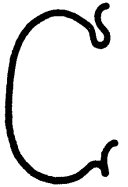
FIGURE 4.--The stick used in the Third Game.
Next the young man was to take white shell to na'at e'e, the brown rat. This rat was to enter the youth's ball used in the fourth game, so that the ball would roll into the hole. The youth was told not to hit the ball, but just behind it; then the ball would roll into the hole, and he would win.
The sign the Gambler used in the guessing game is shown in figure 5. It was a picture of one of the chief sacred beings that the Gambler had won. Ash'ke chili was his name.21 He had a bill like a crow, and in his hands he held pretty flowers, four in each. The first four circles are the water jars--the black, the blue, the yellow, and the white. They contain the Male Rain. The next four contain the
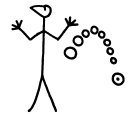
FIGURE 5.--The sign the great Gambler used In the Guessing Game.
[21. Interpreter's note: Ash'ke chili, the Guard of the water jars, is the Zuni God of Dew.]
vapors--black, blue, yellow, and white. They were the Female Rain. The ninth jar contained all the bad medicine that the Gambler used, his black magic.
Now the Gambler used such a picture for the guessing game. Here the young man was told to make an offering to the little breeze so that he would sit on his right ear, and help him guess all that the Gambler put before him. The gift to the little breeze was the mixed chips of stone.
The next game was that of the planted sticks (fig. 6). The youth was to present the woodpecker, tsil kal'i, a precious red stone, which he still carries with him. He was to be used in this game. Now the cutworm, nada'bich osh, was to dig down and cut loose the roots of the young man's stick, the planted part of the solid stick; and the Black Wind, nich i dilqil, was to enter the Gambler's stick, the loosened one, and blow and blow until the roots fastened firmly into the ground. A piece of jet was given to the cutworm for his trouble; and to this day he carries a black spot on his head.
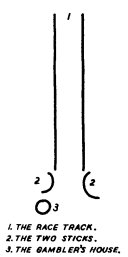
FIGURE 6.--The game of the Planted Sticks.
Now all was ready, all that was to be used by the young man.
By this time the people of the whole country were the slave's of the Gambler; they lived in a great community. They got together all the sacred beings, the Sun as the chief, and they planned to move against the Gambler.
The young man was to have two beautiful maidens to use to bet against the Gambler. They were the daughters of Hasjelti and Hasjohon. These two Yei gave their daughters in the Sun's plan; but they would not consent to do so for a long time. After they agreed they sent the Black Wind to the home of the Gambler to see how he
was dressed. They dressed the young man like the Gambler. The young man had already been shaped like the Gambler in the house of the Sun so that he could win the world. Now the Yei dressed the young man like the Gambler from feet to headdress.
The people thought of the rolling ring game. They went to Hasjelti, and they asked him for his ring; but he refused to let them have it. "No," he said, "the Gambler would not look at mine; he has his own rings." But he told them to go to Hasjelbai, also called Tqo'neinili, the Water Sprinkler, who is the Delight Maker or Sacred Clown. He has these two names. He could be found at the end of the trail; and he would have his rings with him. When the messengers found him he was humming: "Han'y ogana, han'y ogana" (All alone, all alone). Away he went after his ring; he cast his stick, and then sat down. He crossed his leg over his knee and put his hand over his mouth. Now he had his rings well soaked, and they were quite wet. He gathered up his rings and gave them to the messengers. When they returned to Hasjelti he said: "The Gambler will not look at these rings; he has his own."
Now everything was ready and they set out for the Gambler's home.
They sent the bat ahead. He was to hide in the home of the Gambler. In the first game he was to catch the Gambler's sticks with one wing and drop the young man's sticks from the other wing. So to be ready for his part, the bat flew out in the night to hide in the Gambler's home.
They were all ready to be on their way when someone came. He was the mountain rat. He said: "I am still here. Why have you kept this secret from me?" They gave him white beads so that he would not feel badly for having been neglected. They were about to start off again when an owl hooted just ahead. He was offended because he had not been included in their plan. They gave him also white beads. All gamblers do this today. They place white beads in rats' nests and in owls' nests. This is to assure them luck when they want to gamble.
They started out again; but one said: "Wait a minute, the Gambler has many spies working for him." They took mixed chips of stone and presented them to the Black Wind. He was to blow dust into the eyes of the spies so that the people could go on their way without being seen.
Now it was the turn of the young man who was shaped and dressed like the Gambler to act. Each morning at dawn the Gambler's head wife came to the spring with her water jar. When the spies, eyes were full of dust the young man passed them, and hid in the spring and waited for the woman. She came to the spring and went down to the water. He followed her. He said: "Give me some water."
She reached down and gave him a gourd full of water, for she took him to be her husband. He sipped some of the water, and then threw the rest over her, over her clothing. She shook the water from her clothing and said: "This is one of your wicked deeds." She took him to be her own husband, and she went and lay down with him. The young man did this to "split the mind" of the Gambler.
When the woman carried the water home she found her husband asleep in their house. She said: "You naughty thing! You made fast time in returning." He jumped up and said: "Someone has been with my wife. Who is he?" She answered: "Someone like you came. I saw him, that is all." "No," he said, "someone has visited you." Now each day that the Gambler gambled he won many men; so he said: "Well, I may find him today. Then I will have him in my power."
When the young man returned to the people the little breeze, which is our life breath today, sat behind his ear, for the Sun had told his son that he would be with him in everything that happened.
They watched until they saw a big dust storm coming. The spies' eyes were filled with dust and they could see nothing. And there was a great crowd at the entrance of the Gambler's dwelling before he knew it.[22]
The young man stepped inside the home of the Gambler. When he entered, the wife of the Gambler, whom he had been with that morning, was grinding corn. Just then she looked up and smiled. The breeze said: "She smiles because she knows that you are the man she met in the early morning." The breeze continued: "The Gambler saw this smile and he is getting up. He is jealous. He thinks that you are the man who was with his wife at the spring." The young man stepped up to the Gambler and said: "My Brother, I came for that big piece of turquoise called ha da thee." Now this was the most precious and the last thing that the Gambler had won, the turquoise that the Sun wanted. The Sun had told the young man that, when he won it, it was to be his.
When the Gambler got to his feet he saw the crowd of people. He said: "Where are those ugly things, the spies, that I placed around this dwelling?" He called them; and when they came to him they said that the dust storm was dreadful. They had seen no one pass.
The Gambler then turned to the young man and said: "Very well. It shall be as you wish; you are the one I will gamble with." With that he brought forth his basket and shook his sticks in it.
[22. Informant's note: Different chants are sung at this part In the story. Chants are also used when they dress the young man.]
"Now," said the Gambler, seeing the two beautiful maidens that the young man had with him, "we shall bet our wives." He bet all his wives and servants against the two maidens. The young man bet the two maidens and the whole crowd that came with him. After the bets were made the young man said: "Very well. I am willing to lose; but you shall have to throw the sticks as high as the roof beams. You can not throw the sticks knee high, or shoulder high, or as high as a man can reach, but to the roof beams. The Gambler looked up and around and said: "All right, I will throw the sticks up to the roof beams." "Then," said the young man, "we must both look down on the ground, to be able to see the sticks as soon as they fall." The Gambler looked around and then said: "All right. That goes."
The Gambler shook his basket and said: "Mine is white, mine is white." And up he threw his sticks to the roof beam. The bat caught the Gambler's sticks and dropped the young man's sticks. The Gambler grabbed the sticks and swore and said: "This time mine is black, mine is black." The young man called out: "Very well. Mine is white, mine is white." The Gambler threw the sticks a second time; and the bat caught the young man's sticks and threw down the Gambler's sticks. The young man grabbed the white sticks as they landed and said: "You are the loser. You are the loser; and it is by your own sticks that you lose." The Gambler said: "I lost! I lost!"
The young man's stick is called the turkey feet[24] (fig. 7, upper). The name of the Gambler's stick is dot'tloie, meaning hairy (fig. 7, lower).
To continue: the young man picked up his stick. The snake was in his ring. The Gambler got his own ring; but the young man said: "No. This time you will use my ring." So the Gambler cast his ring to one side and said: "Very well."
Men the Gambler picked up his stick he went around exercising his arms and legs; and all during this time he chanted in a whisper:
I am walking amid all the beautiful goods.
A white bead gambling stick is in my hand.
It is tied with the white bead string.
I am walking amid all the beautiful goods,
With the white bead stick in my hand.
The white bead ring is on top of the stick.
Today luck is on my side.
[23. Culin (1907, pp. 457-460), hoop and pole.
24. Franciscan Fathers (1910, pp. 482-484).]
Then he reached out and turned just as the sun travels; he motioned to all that he saw and he drew it to his body.[25]
After this the Gambler bet against the young man all that he had won, all that he had. Just the one bet. All was ready for the game. The two men were standing at the race track, eager to roll the ring. The young man threw his ring and away they raced after it. The Gambler was in the lead and he cast his stick. The young man cast his stick ahead of the Gambler's stick. The ring rolled over the Gambler's stick and landed on the young man's stick, on the very center of it. Now after the sticks are cast the racers stop and watch the ring. So when the ring turned over the young man's stick, he ran and
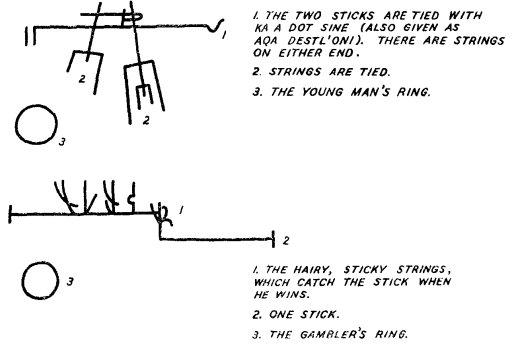
FIGURE 7.--The sticks used in the game of the Rolling Ring: upper, young man's stick; lower, Gambler's stick.
grabbed it. The Gambler was very angry. He made for the ring; but the young man held it behind him with his left hand and pushed the Gambler back with his right elbow. He said: "Wait a minute, Brother, what are you going to do with my ring? All the losers that came up against you did not do this. When they lost, you got them. They were game." So all that the Gambler said was: "All right. We will go inside now."
They started for the house of the Gambler. He had lost twice now. Once inside he bet that he would recover all that he had lost and all that the young man possessed in goods and friends. When the bet was settled they entered a room where the Gambler brought
[25. Interpreter's note: A splendid example of sympathetic magic.]
out the bent stick which he used. But the young man said: "Wait a minute, Brother, it is my stick that we will use today, not yours." The Gambler tossed his stick to one side; and the young man took out his stick with the measuring worm inside it. This stick was made so that when it was tossed up it would hit the ground in an upright position, then fall to one side or the other. When all was in readiness the young man tossed his stick into the air; when it struck the ground it stood up. The Gambler saw this and he was angry, furious, in fact. He jumped for the stick, and was about to seize it, when the young man hit his hand aside with his right hand and picked up the stick with his left. He said: "Brother, this is my gambling stick, not yours." The Gambler was wet with sweat; he had lost three times.
The Gambler bet again to recover all that he had lost and all the friends of the young man. When they finished arranging the bets he said: "Now we will go outside." This was the game of the ball that had two tabs like ears; the stick used was curved like a hockey stick. Then the young man brought forth the ball that contained the brown rat. He stood ready with stick in hand, aiming to drive the ball through the hole, which was a house. If the young man made the hole, the Gambler lost; if he missed the hole, the Gambler won. The young man stood exercising his arms as if ready to strike. He said: "My ball, do not miss the hole. Go straight for the hole." The Gambler said: "Miss the hole. Miss the hole." The young man hit the ground just back of the ball; but the ball bounced out and jumped through the hole. The Gambler was very angry. He rushed after the ball; but the young man grabbed him, saying: "Wait a minute, Brother, this is your loss, but my ball." The Gambler cursed the ball and said: "The ball can go to the home of the dead!" The Gambler had lost four times.
They made their bets for the fifth game; and they covered all that the Gambler had lost and all that the young man had had from the first. When the betting was over they said: "Now we will go inside the dwelling again." This time the Gambler showed the young man the picture of Ash'ke chili on the wall. This was the guessing game. And it was the picture that the Sun had shown the young man. The Gambler said: "Now, young man, you can guess the meaning of this picture that I have drawn." The young man
[26. Recorder's note: This game of Hitting the Ball comes as number five in the first list of games given.
Culin (1907, pp. 623-624), Shinny.
27. Recorder's note: This is number six in first list, p. 50.]
said: "That is the picture of Ash'ke chili. He has the beautiful flowers in both hands." The Gambler said: "It is correct, my friend." Then he pointed to the picture of the first black jar. "Now, my friend, can you guess what this is?" The youth said: "That is the black water jar. It contains the black cloud which brings the male rain." "That is it, my friend," said the Gambler. Then he pointed to the picture of the next jar and said: "Can you guess what this is?" The Gambler chuckled after showing the young man each new object. The young man answered: "That is the blue water jar, and it contains the blue cloud that brings the male rain." The Gambler said: "Oh, my friend, you are a good guesser. It is correct." Next came the yellow water jar. The Gambler asked the same question as before, and the young man said: "That is the yellow water jar, and it contains the yellow cloud that brings the male rain." "That is it," said the Gambler. He pointed to the white water jar and said: "Can you guess this?" The young man said: "That is the white water jar that contains the white cloud that brings the male rain." "Correct, my friend," said the Gambler, and he pointed to another black object: "Can you guess what this is?" The youth said: "That is the black water jar which contains the black vapor which brings the female rain." And the Gambler said: "That is it, my friend." And the same questions were asked for the blue and the yellow water jars.
"Oh, my friend, you are guessing all correctly." Then the Gambler pointed to a white object on the wall and said: "Now guess what this is?" "That is the white water jar, and it contains not only the white vapor that brings the female rain but all the beautiful flowers and their pollens included." The Gambler did not laugh now, he just said: "That is it, my friend." There was the last picture, that of a great water jar, on the wall. The Gambler said: "Now, my friend, what is this great jar and what is in it?" The young man said: "That is the gray water jar, and it contains . . ." Then, just then, up jumped the bird which guarded the Gambler's medicine, and out it flew. The Gambler sat with his head down. The young man said: "Well, my Brother, you are the loser. I have won from you." And the Gambler said: "I know. I am the loser." His body was very wet with sweat and he was tiring. He got to his feet and walked round and round.
The Gambler covered all that he had lost and all that the young man possessed. This time they went outside for the game of the kicked stick.
Everyone went outside. Four lines were drawn across the track far enough apart so that a good runner could kick the stick from one
[28. Recorder's note: The game of the Kicked Stick is number four in the first list.]
line to the other. The Gambler placed these marks on his track. The young man was to kick the stick to the first line, from the first to the second line, from the second to the third, and from the third clean over the house. When all was ready the young man kicked his stick and it reached the first line, for the woodpecker was in the stick. He kicked it again and it reached the second line. The third time he kicked it, it reached the third line. And the fourth time he kicked it, over the house it flew. The Gambler said: "I lose, I lose."
The Gambler bet again against the young man. He covered everything that he had lost and all the young man had won. This was the game of the planted sticks.
The sticks were planted at the end of the race track. Both men got ready to run. The young man got there first and pulled his stick out first. The Gambler reached for his stick; he tried to pull it out, but it pulled him back. He tried to force it out. The young man returned to the Gambler and pulled at his clothing. "My friend," he said, "you are the loser. Why stay with this stick?" So the Gambler said: "I know that I am the loser."
(Fig. 8)
This was the last bet. They bet everything, the Rain, the Holy Beings, the Sacred Turquoise which the Gambler had won. The Gambler said: "Now we will run a, foot race. If I lose again, my life is included. Kill me. If I win and you lose, your life is included and I will kill you." The young man said: "Very well. I agree."
They circled around a little hill with a ruin on it first, and then they entered the home stretch.
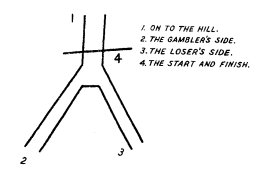
FIGURE 8.--The start and the finish of the foot race that circled the little hill.
As the race track formed a circle the two started from the place where they were to finish. They were to go around the hill and return. Four times the Gambler was in the lead; but the fifth time that the young man caught up and passed the little breeze whispered in his ear: "Jump high, be is going to shoot." The young man jumped high and the arrow went under him. He picked it up. The next time the little breeze whispered: "He is shooting high. Lay flat." The young man lay flat on the ground and the arrow passed over him. He jumped up, ran on and picked it up. Then the little breeze said: "He aims at your heart. Lie down." The young man did this and the arrow passed above him. He recovered the third arrow. The fourth time the little breeze said: "He aims at your head. Press the earth." Again the arrow passed over the young man; and the little breeze said: "He has no more arrows. Now let him get ahead of you; and you must do the same to him that he did to you." When the Gambler passed him the young man took aim and shot him in the leg, just below the knee. The next time he shot him halfway up the body. The third arrow he shot between the shoulders. The fourth arrow he sent behind the head. Then the little breeze said: "Do not run near him. If he catches you he will be whole again, and he will beat you." So the young man circled around the Gambler and ran on ahead.
At the finish line there is a little raised knoll. The young man ran up on the Gambler's or winner's side. The crowd of people cheered and blew their flutes. After the young man had regained his breath up came the Gambler. The young man said: "My friend, you are the loser." The Gambler said: "You are right. I lose. I lose all, even my life. My life is yours." The Gambler entered his house and brought out an ax and laid it on the ground; and he told the young man to kill him while he was still warm. He threw himself on the ground broken-hearted.
Now just as the young man was about to strike the Gambler with the ax the Sun spoke: "Wait a minute, do not kill him, he is your elder brother. Why kill him when he has nothing but his life on the earth." The Sun laid the Black Bow down and told the young man to stand the Gambler on the top of it, and to stretch the cord and let go. It threw the Gambler up into the air. He went up a little way and called out: "Long ago I died in the center of the earth." He went up still farther and called down: "Long ago I died in the center of the earth. My spirit will want to return there. My spirit will want to return to the center of the earth." He went still farther up in the p. 62 sky and all that they heard was: "Adios."[29] He was gone. He went to the upper worlds.
After the Gambler ascended to the upper worlds the young man said: "My Father, there is the Sacred Turquoise that you wanted. There it is. It is yours." And the Sun said: "Thank you, my son. I thank you." He raised the great turquoise and breathed the breath four times. Then the Sun turned to the Yei Hasjohon and said: "Let us send our two children together to Dzil na'odili. They shall go above the eight rings of the mountain where there is a changeable house. That shall be the home of our children, for that mountain is the earth's heart." So they sent the young man and the maiden, the daughter of Hasjohon, his wife, there. It was to be their home forever. The Sun said: "My son, you know our plan." And the Sun returned to his home.
But before he left the young man went into the Gambler's dwelling and pointed to the jars in the picture on the wall. He commanded them to move back to all parts of the world. "From you the people of the earth will have rain and clouds and vapor." When he left the house he found the people, the Gambler's friends, weeping for they did not know what was to become of them, as they had been the Gambler's slaves. The young man turned to the people and told them to be cheerful; it was because of the Gambler, not himself, that they were gathered there. He told them that he was a different. kind of person; and that he would send them back to their own countries, or to whatever country they wished. Then the people came forward and thanked the young man. "These are the kindest words that we have heard in a long time," they said. Each took his turn and thanked the young man. Some said: "We will return to our old homes." Others said: "We have always wanted to go to a new country. We know of one. We will go there." That day all the people moved away (from Chaco Canyon)[30] to whatever place they had chosen for their home.
[29. Matthews (1897, pp. 82-87). Matthews (1889 b, pp. 89-94): "The Great Gambler went to the Moon and said: 'I am very poor!' The Moon gave him domestic animals, sheep, horses, pigs, goats, and chickens. He gave him beautiful goods, more beautiful than those of Bonito. He gave him a new people--the Mexicans--and then he sent him back to the earth. (And that is why he said 'Adios' when he left the earth.) He is now the god of the Mexicans. It may be that he was the Sun's favorite son." "He went to Bekolcice, the god who carries the moon. . . . he descended far to the south of his former abode and reached the earth In Old Mexico. Naqoilpi's people increased greatly in Mexico and after a while they began to move towards the north and build towns along the Rio Grande."
Tozzer (1908, p. 32) gives Orion as the Great Gambler; Rigel as his left hand, and Betelgeuse as his right foot.
30. Interpreter's note: I went to Chaco Canyon to check the ruins and the race track and to see the pictographs.]
(Fig. 9)
The Blue Bird Clan people[31] and the people called mai desh kzish ni moved up the canyon and built a house which they called Ken tiel.[32] The rest of the people went in different directions and built new homes. There was another place east of Ken tiel called Sis kit. Above them there is a place called Hada'na y be', the house made of banded rock. The people living there were visited by a giant. He was also the Sun's son.
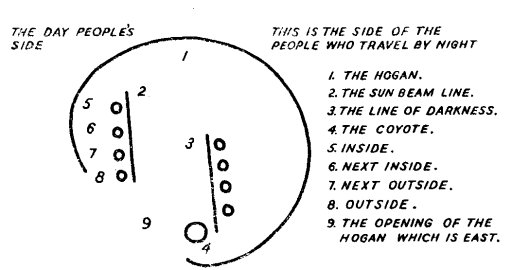
FIGURE 9.--The chart of the Moccasin Game.
This giant spoke to the people there. "My grandchildren," he said, "let us play the Moccasin Game." They said: "We do not know that game." So he went away; but the next day he returned and said: "My grandchildren, I would like to play the Moccasin Game with you." They told him: "Grandfather, we do not know this game." Again he left them, but on the third day he returned. "My grandchildren, I have come to play the Moccasin Game with you." But their answer was the same. Now after he had left them the third time there came a certain bird called nat tsile gine who said: "This person is called One Walking Giant. When he asks for the game again tell him that we will play the game at a place called a Red Rock where the Big Snake lives.[33] All the sacred People will gather there."[34]
The giant came for the fourth time and said: "My grandchildren, I have come to play the Moccasin Game with you." They said: "All is well, Grandfather; we will hold the game over in Red Canyon
[31. Informant's note: The Blue Bird Clan People were his ancestors.
32. Franciscan Fathers (1912, p. 228): Wide Ruin, Kin tqel.
33. Informant's note: I saw this place In 1896. Today there is still to be seen the large cave with the Big Snake painted above it. The little ball that the giant used is there, as also the stick for pounding the moccasins. It is a sacred place. The little ball and the pounding stick look very old, and again, very new. The black earth is where they built their fire.
34. Culin (1907. pp. 346-349): Hidden Ball. Franciscan Fathers, (1910, pp. 485-487).]
where the Big Snake lives.[35] The Giant was greatly pleased. "Oh, my children, that is well; that is what I came for." They told him that they would send word to all the sacred people in the world, that in 4 days they would gather in Red Canyon. The Giant was delighted with the plan. And on the fourth day all the people from the clans and the rocks gathered there.[36]
When the holy people from the sacred places came together in Red Canyon they did not know that the Sun had another great plan in which he figured that he would get even for all the mistakes he had made through the Gambler.
At the end of the fourth day, at twilight, the Giant came. Now he had a feather from under the wing of an eagle which be kept laying against the palm of his hand. From the feather in the Giant's hand to the moccasin where the little ball was hidden shone a faint, gray ray of light like an almost invisible rainbow. This would help him win. He had the counting sticks with him, the little ball and the small, curved tapping stick. He brought them all to the Red Canyon of the Big Snake. The counting sticks were 102 in number. The Giant got them from the Sun's 102 trails.
The Coyote came to Red Canyon. He said that as long as he traveled both by night and by day he would be on the winning side, whichever it might be.
All was in readiness. The Giant entered the cave (hogan) and the guessing began.
This is the game:
There are 102 counting sticks in the game. The sticks are tied in a bundle; they are used as counters to pay the points back and forth. When one side wins 102 points they have won the game. Now this game determined the value of everything, all goods and possessions were assessed by this game. If the ball is placed or "buried" in the
[35. Interpreter's note: Tse'gie hachee, Red Rock, south of Beautiful mountain. There is a pictograph of the Snake on the cliff, also of the ball and stick. The cave is in the head of the canyon.
36. Informant's note: Ten different stories are told here--
(1) The Sun's Plan to Have Night and Day, or the Moccasin Game.
(2) The Finding of the White Bead Baby Girl.
(3) How the White Bead Woman Came to This Country.
(4) The Twins, or the Destroying of the Monsters.
(5) How the White Bead Woman Returned to Form Another People.
(6) The Coming of the Dîné
(7) How the White Bead Woman Told Them About the Most-High-Power-Whose-Ways-Are-Beautiful.
(8) The Story of How First Man and First Woman Left the Earth.
(9) How the Rainbow Trail Was Taken Away, or the Coming of the Horses.
(10) The Beggar's Son.
Then comes the story of the game being taken to the mountain near Zuni, To'waya'lane or Tse'hogan. This is the Hunters' Story. There are chants here, and sometimes other stories are told. After this, strong medicine was taken, and men became as they are today. They must work for their living, and there is much suffering.]
next outside moccasin the count is four. It can be four of anything bet, four "bits," four dollars, etc. If the ball is next outside, and the guesser guesses outside, the count is six. It costs the guesser six points. If the ball is inside, and the guesser guesses next inside, it costs him four points. If the ball is next inside and the guess is inside, the cost is six. Now if the guesser taps more than once on a moccasin and the ball happens to be in it, it costs him ten points. One tap means "in there." More than one tap means nothing in the moccasin. If the ball is in the moccasin when he taps once he takes it out and throws it to his friends. It is then their turn to bury the ball.[37]
The Giant explained the manner of betting and showed them the way to play the game. He said: "Now this is not going to be a free game. All those of you who travel at night will bet the night against the day. If I lose there will be darkness always." (Later it was learned that because the Giant's father was the Sun he was sure of winning. And besides the feather he was to carry in his hand, the Giant was given a sunbeam to wrap around the ball. With this he was sure to win.)
The moccasins of the bear and the porcupine were placed on the side of darkness. The moccasins of the gopher and the badger were used for the day peoples' side.
The Giant took a cornhusk, thin as paper and out at both ends, which had been painted black on one side to represent darkness, and white on the other side to represent day. They were to toss this cornhusk in the air, and when it fell to the earth whichever side showing would have the first chance to bury the ball.
The Giant stood and called out: "All the day people will say 'gray, gray,' and the night people will say 'dark, dark' and I will let the cornhusk fall." He let the cornhusk fall and the, white side was up. There was great shouting from the day people.
The antelope had the ball. He sang out: "Gray, gray, gray," and everyone could see him. Now as each animal took the ball he sang. The song is repeated over and over if the opposite party misses the guess.[38]
[37. Informant's note: The counting was explained a second time: If the guesser hits a moccasin once, any moccasin, and the ball is in the second one from it, it costs him ten points. If he hits once outside, and the ball is Inside, it costs him four. If the guesser taps outside more than once, and there is no ball, and he goes to the next outside and taps more than once on one and two, and he is wrong on three, It costs him four. If he taps, or "kills", more than once on one, two and three and the ball is in three, it costs him six points.
Stevenson (1904, p. 318) recording the games of the Zuni, gives i'yankolo'we as hidden ball game.
Recorder's note: The songs collected by the interpreter are on pp. 66-69.
28. Informant's note: The songs of the different animals are used in the Moccasin Game.]
The big being called the Giant
is trying his luck
To get the ball,
Crying as he says:
Please place the ball
In the same moccasin next time.
I follow the river
In quest of a young beaver.
Up the river I go Through the cut willow path I go
In quest of a young beaver.
Traveling Rock,
Traveling Rock,
The ball is just beyond
Where you last hit the moccasin.
The crow is a boy
Who got blackened by soot,
And he can not guess
In which moccasin
The ball is placed.
Whom do we hear saying?
Whom do we hear saying:
My friends, my friends,
What fools you are?
I still have the ball in my own moccasin.
The crowd goes to the hill.
The crowd goes to the hill.
What fools!
With foolishness like a little child's.
The badger is lying down.
The badger is lying down,
Growling as he is lying down.
Pretty white stripes on his forehead,
Growling as he is lying down.
His legs have darkish ends,
And the badger is lying down.
The locust, the locust,
He came up through the earth.
He came up through the earth.
The locust, the locust.
Wosh, wosh!
Adopted, adopted.
The red moccasin is adopted.
The slick head is adopted,
The pretty spot on the body is adopted.
The magpie, the magpie.
The white feather is for the dawn.
The ball is right down in here.
Now it is dawn, now it is dawn.
A foot,
A foot with toes,
A foot with toes came.
He came with a foot with toes.
Aging as he came with a foot with toes.
He is one who has to do with the grass seeds.
He is one who has to do with the grass seeds.
Now put the ball in the moccasin.
Now put the ball in the moccasin.
Gray, gray,
Just in plain sight,
There the antelope stands.
The old man owl,
The old man owl.
He is jealous of me
Because I am the only one
Who brings home a rabbit,
Which causes "pain in my neck."
I am the owl.
I sit on the spruce tree.
My coat is gray.
I have big eyes.
My head has two points.
The white smoke from my tobacco can be seen
As I sit on the spruce tree.
The little rabbit comes in sight,
Nearby where I sit on the spruce tree.
I think soon my claws will get into its back,
As I sit on the spruce tree.
Now it is dawn, now it is dawn.
The old man owl's head has two points.
He has big, yellowish eyes.
We see white smoke from his tobacco.
Ho, ho! Ho, ho! Ho, ho!
Chipmunk, chipmunk,
Chipmunk standing.
Pretty and short as he is standing.
His body is striped as he is standing.
Slim of form is his body standing.
I can't drag him,
I can't drag him.
His body and his liver together
I can not drag.
His body and all his insides
I can not drag.
The bobcat,
The bobcat has a sore foot.
The bobcat has a sore foot.
Bobcat is walking,
Bobcat is walking.
He walks and he walks and he walks.
He runs down and up the hill,
And then he growls.
I met a bobcat hunting.
I met a bobcat hunting.
And all he was carrying home was his hide.
The gopher sees the ball in the moccasin.
The gopher sees the ball in the moccasin.
He says: Young Brother,
Keep hidden the moccasin,
Keep hidden the moccasin
Until you get the ball,
Until you get the ball.
The one who has the turkey for a pet,
The one who has the turkey for a pet,
Down at the foot of the mountain,
Down at the foot of the mountain.
Through the green meadow
He is carrying a load of roseberries,
And a lot of noise he is making.
The big turkey gobbler has the ball.
The big turkey gobbler has the ball.
With the help of his wattle he has the ball.
The big turkey gobbler has the ball.
Oh, see what I have killed,
Oh, see what I have killed.
Standing here looking at it,
I place the ball in the same moccasin for you,
In the same moccasin for you.
It is in the same moccasin, the same moccasin.
No, it is in a different moccasin.
The one who carries back the ball
Now places it in another moccasin, an outside moccasin.
The one who carries back the ball
Now places it in another moccasin, an outside moccasin.
A certain bird who had bright eyes rose and suddenly struck the moccasin in which the ball was hidden. He took it and tossed it to the night people. The owl caught the ball and said: "Old man, old man is jealous of me because I am the only one who carries home the rabbit." He sang as he buried the ball. After the owl buried the ball out came the Giant. He wrung his hand and with two fingers pointed down to the moccasins. The gray streak of light shone and he grabbed the ball and tossed it back to his friends.
First one side then the other won until the night was half over. At this time the owl kept the ball in his hand instead of placing it in a moccasin and the Giant missed his guess. Soon the Giant had tears in his eyes and they ran down his cheeks. The owl saw this and said: "Old man called Giant is weeping over his poor guessing, weeping and saying 'Bury the ball where I guess for once.'" The Giant was losing the game. Now the day people had lost one hundred points and there were only two points left. They took hold of the Giant and told him to sit down. They asked the locust to dig into the earth and to go to the moccasins and see where the ball was hidden. The locust agreed. He left his shell there for all to see and he dug down into the earth and when he returned to his shell he said: "There is no ball in the moccasins." (That is why the locust leaves his shell and goes into the earth.) Next the gopher went to the moccasins and found no ball. Then one of the day birds went forward and "killed" a moccasin. No ball was in it. He pretended to strike a moccasin when the owl went for it, but the bird hesitated and said: "Wait a minute, grandfather, keep your hand away." And each time that the bird struck a moccasin the owl tried to reach the next one but his hand was held. At last the guesser hit the owl's hand and out rolled the ball.
It was towards dawn by that time and they heard a curious noise outside. They sent the two Yei, Hasjelti and Hasjohon to see what was happening. They returned and said: "The sound is coming nearer." The people told the two Yei to sit out there, side by side,
and to wait and see what this strange thing could be. In the distance the Yei saw two skulls approaching. They were the skulls of two people who had died and returned to the Yellow World. Now they were coming and they intended to harm someone of the assembly. They were given presents and sent away.[39]
Now when the owl dropped the ball all the birds and animals chose whatever designs and colors they wished to wear in the future, The crow and the bear had been asleep. When the crow heard what was happening, in a great hurry he dipped himself in charcoal and went off to his home. They slapped the bear and said: "Wake up. It is day." The bear jumped up and reached for his moccasins, and he made off just as fast as he could go to the mountains. But he had put his left moccasin on his right foot, and his right moccasin on his left foot, and that is why he has strangely shaped feet. Also, as he reached the mountain the first rays of the sun bit his fur, and that is why some of his descendants are brownish.
The Giant's plan had failed. The game had not come out as he had planned, and, as he had not won all the time, it was not always to be day.
The Hada no ege people and the Hada no estine[40] people, Hasjelti, Hasjohon, and Hasjetine came into the cave and started or began their planning: how the Giant should be killed, how the two Big Birds should be killed, how the Rolling Stone should be killed, how the Giant Elk should be killed, how the Twelve Antelope who ate human beings should be killed, and how the Cutting Reeds should be destroyed. These reeds grew at the mouth of La Plata River, below Farmington, and anyone who stepped among them was cut to pieces. There was still another animal with big eyes who killed people by staring at them. There was another being who lived near a cliff and when anyone came near that cliff he kicked him over the edge. And the Swallow People were still warring, even after the woman who became a bear had been killed.
It was a rule that till the different persons who grew to be great powers, once they made a mistake, forfeited their lives. So because the Giant made the mistake of letting the owl outwit him the holy people came together and planned how he, and at the same time all the monsters who destroyed those living upon the earth, must die.
[39. They call this Tse tsina tage, the Two Skulls who Came Back. This is the origin of the Dead Spirit Fire Ceremony. Since that time, whenever a person sickens in spirit this is the ceremony used over him. And here all the chants and prayers of the Dead Spirit Ceremony come in.
40. Franciscan Fathers (1912, p. 127): Hada huniye', mirage; hadahunestqin, heat wave people; and, hadahuneya'nigi, mirage people.]
All during this time First Man and First Woman lived on the top of Dzil na'odili, also called Chol'i'i.[42] This is the sacred mountain near Farmington, N. Alex. (See fig. 10.) The circle on top of this mountain is a cloud (fig. 11). Chol'i'i was completely hidden at first, then the bands or clouds rose and the mountain was seen. This is the sacred story which the old medicine men keep to themselves.
Figure 12 shows the cradle and how the baby in it lay. The cradleboard is the rainbow.[43]
Figure 10.--The sacred mountain Dzil na'odili, also called Chol'i'i.
FIGURE 11.--The cloud circle on top of the mountain.
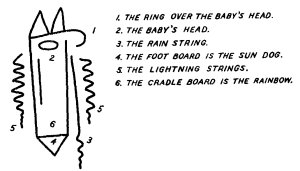
FIGURE 12.--The cradle of the White Bead Baby.
[41. Matthews (1897, pp. 104-105).
Recorder's note: He says that two sisters were the mothers of the "Twins"; one, Estsanatlchi, was the Woman-Who-Changes (the turquoise image), and that Yol'kai estan is the White Bead Woman. The Sun and the Water Fall were the fathers of the boys. Lummis, in Pueblo Indian Folk Stories, associates the mother of the Twins with the moon. Whitman follows Matthews. But both the informant and the interpreter agreed that certain medicine men differ.
42. Interpreter's note: The mountain on which the White Bead Baby was found is sometimes designated as Chol'i', and sometimes as the Mountain of the Fast, Sis'na'jin.
43. Franciscan Fathers (1910, pp. 46-47, and 1912, p. 156): natsi'lid, rainbow.]
The baby was the White Bead Baby, the female baby, and her cradle is called natsi'lid eta cote, the rainbow cut short. The baby was wrapped in four clouds, black, blue, yellow, and white, and the four vapors, and all the flowers with all their pollens. The baby's head was to the west and her feet were to the east.
First comes the story of the White Bead Baby and of her growth. One day the mountain Chol'i'i was hidden by clouds and First Man said to his wife: "Now for the whole day we have seen clouds over the mountain. There must be some reason for this." That night when he saw a fire on the top of the mountain First Man said: "All day the clouds have covered the mountain and now there is a fire there. There must be someone there. I will go and find him." His wife said: "No, stay at home. There are many monsters on the earth who eat people. It is not safe for you to go." But First Man said: "I will go. It must be the will of the Most High Power." The next day he started out, chanting as he walked. He called himself the Dawn Boy in the chant. He climbed the mountain, but he found nothing, neither fire nor hogan. All that second day the clouds hung over the mountain, and when First Man returned home that night both be and his wife saw the fire burning on top of Chol'i'. The next day First Man went again to the mountain but he found no fire or home or sign, so he returned to his home. That night when he saw the fire burning brightly he planted two forked sticks and sighted the fire, so that on the following day he could look and see at what point the fire had burned. In the morning, when he looked through the forked sticks, he knew just where to go. He started out as before and be chanted as he walked, naming the mountain toward which he was going, until he reached the top. On the top of the mountain there was a heavy mist. In the center of it he heard a baby crying. Lightning flashed from the baby and First Man saw her on her cradleboard.[44]
First Man picked the baby up and carried her home to his wife. But the baby was tied firmly on the cradleboard and First Woman did not know how to untie the strings. Just at this time they heard a noise: "ho'ho'ho'hooo." Then another noise: "A'ow, a'ow, ho'ho'ho'hooo." And two men entered the home. One said that his name was Ni'hada ho'nigi (he was Hasjelti), the other said he was Ni'ha ha nigi (Hasjohon). They were the two Yei. They told First Man and his wife that the baby had been their plan, and they showed them how to untie the cradle strings and told them what each string meant. Next they told First Man to go out and cut two slabs of wood from a tree, and to mark the tree, and to make from oak the bow for over the baby's head. They told him that he must make a cradle like this first
[44. Informant's note: There is a chant sung here.]
one. He must gather the soft bark from awae'ts al, the baby bush or cliff rose,[41] and place that on the board before putting the baby on it. So First Man went out and made the cradle as the Yei had directed, for they took away the cradle on which the baby had been found. But before the two Yei left First Man said: "Now she will be my daughter." His wife took the baby and breathed on her four times. "Now", she said, "she will he my daughter." And so the Yei left First Man and his wife.
First Woman washed the baby in a white bead basket, then in a turquoise basket, and in a white shell basket, and in a black jet basket. At the end of the second day the baby laughed for the first time and there came a man, Atse'hashke, the First Coyote, who said: "I was told that my grandchild laughed for the first time." A woman came saying: "I was told that my grandchild laughed for the first time." She was the Salt Woman. First Woman took charcoal and gave it to the Coyote saying: "This is the only thing that lasts." So he painted his nose with it and said: "I shall know all things. I shall live long by it." And First Woman also gave the Coyote salt. He swallowed it and said: "This shall be my meat. It will make my meat taste good.," And satisfied with his gifts he departed. It was the Salt Woman who first gave the gift of salt to First Woman. Then the two Yei returned for their gifts. One was given white bead moccasins, and the other decorated leggings. They took them and went away satisfied.
Now that is why all persons present receive a little gift when a baby laughs for the first time.[46] And later, when the White Bead Woman went West to her home she gave the gifts of beautiful flowers, the rain, and the plants bearing fruits and seeds for food.
The third day the baby sat up, the fourth day she walked. When the baby stood First Man put her on his knee and sang:
The old woman standing,
The old woman standing,
The old woman standing.
The White Bead Girl is standing.
The chant continues. It tells what developed on each day and how the White Bead Girl grew until the thirteenth day when she had her monthly period. (The same things happen to girls now, but the days of the White Bead Girl became our years.) On the thirteenth day she went to her foster-mother and said: "Something unusual has passed through me." First Woman spoke: "That is your 'first race.'"
[45. Recorder's note: Matthews (1886, vol. 20, pp. 767-777): Cliff rose, Cowania mexicana Don, a way tsal, baby's bed. The soft shredded bark of the cliff rose is used to line the baby basket. Franciscan Fathers (1910, p. 197): awaetsae, baby's bedding.
46. Informant's note: Origin of the First Laugh Ceremony.]
First Woman told her husband that their foster daughter had kin nas ta, her first race (first menstruation), also called her first cake.
They laid different kinds of blankets inside the home. Under them were the white flowers,[47] coyote robes, and such things. The girl lay stretched on these, face down. First Man shaped her all over. He pulled her hair down and she had a quantity of hair. He shaped her face and it was beautiful, and he dressed her in all the beautiful goods, beads, bracelets, and earrings. They let her hair hang down and they tied it at the neck with the rain string which hung down with her hair.
Then First Man and First Woman stepped outside the hogan and told her to run her first race, to go around a cedar tree yonder, as the sun travels, and return home. When she came back she looked from the doorway into the home and said: "You hid the ground with the beautiful goods, you hid the ground with the mixed chips of stones." Now this is what First Man and First Woman had said.
First man commenced planning where they should have the first chant over her. It was decided that it would be in the home on the top of the eight rings of the mountain called Dzil na'odili, at the home which is called hoghan ho'tez sos, Changeable House. The Home that Stretches Out, hogan na' hat tson'e is its second name.[48]
A great crowd gathered the evening of the fourth day. All the different people filled the home and there were 11 rings, or 11 circles, of people around it. As the chant was about to begin some people put their heads inside the home and said: "Why were we not invited?" And everyone said: "Come in. There is room in front for you." These newcomers were the Beautiful Goods People, a whole group of them. They sat in front of the others.
Two hogan chants were sung by the people who, planned how the White Bead Baby should be found. Then the White Bead Girl stood up and said that there was something missing. "You have not called upon Tse an no'hoi begay hojone, the Most High Power Whose Ways Are Beautiful," she said. "He should be put into your songs. No one knows his real name, but you must use the one I give you." So all the people sang their chants using the names of the Most High Power and that of the White Bead Girl.[49]
About dawn two men came in and asked why they had not been invited. Their moccasins and leggings were white; they were beautifully
[47. Interpreter's note: The white flowers are the mariposa lily.
Recorder's note: Mariposa lily, according to Franciscan Fathers (1910, p. 193), altsi'ni, Calochortus luteus.
48. Informant's note: A chant should be sung here. Today, in the chant, "white flowers" is probably used to designate beautiful goods.
49. Informant's note: Chants are sung here. They tell how the baby was found, about her growth, her first "race" or "cake," and when she went to the West and returned. No one man knows all the chants, only one group of them.]
dressed, each having 21 tail feathers for the headdress, and on the top of each feather there perched a beautiful singing bird. They were the two Yei, Hasjelti, the Dawn, and Hasjohon, the Twilight. They received gifts and they came in and sang their chant, and the dawn broke and it was day.
So now each girl at the time of her first and second "race" has this chant held over her. Her cake is made of the different colored corn flavored with a kind of yeast. This latter is made by soaking wheat in water and when it ferments it is dried and ground into powder. It makes the corn cake very sweet.
In the morning the men receive some of the maiden's cake as their gift for their chants.[50] Today the young girl sits in the back of the hogan and the goods or gifts are piled in front of her, symbolic of the Beautiful Goods People who filled the front circle in the "hogan" when the White Bead Girl had her first chant. The young girl, today, has her hair tied with a strip of buckskin from a deer not killed by a weapon.[51]
Now after the ceremony or Night Chant over the White Bead Girl the people went their ways and left First Man and First Woman and their foster daughter to live by themselves. It happened soon after this that this holy girl wished for a mate. Every morning when the sun rose she lay on her back until noon, her head to the west and her feet to the east. From noon on she went to the spring. She lay under the ledge and let spring water drip over her body. This took place each day for 4 days.
First Man said upon coming home one day: "Over to the east, at the foot of the mesa, there are two different kinds of grass. Their ripening seeds are plentiful." So First Woman and the girl went down to gather the seeds. But when they got there they began to think of the monsters who roamed about the country and became frightened.[52] Looking about them carefully they hurriedly gathered only one kind of seed before they ran back to their home. When they reached their hogan the girl said: "Mother, I want. to go back and collect the seeds from the other grass." First Woman said: "No, daughter, you can not go there alone. Some monster might catch you." But the girl insisted. She promised to be careful and to look out for herself.
[50. Informant's note: Certain men know the chants of the different people gathered there. There are 8 or 10 groups of these songs.
51. Informant's note: Today, the hide of a deer not killed by a weapon, for example, by a car, is used ceremonially.
52. Franciscan Fathers (1910, pp. 189-191; 1912, p. 172).
Informant's and interpreter's note. Two kinds of grasses with edible seeds. These are mountain grasses, tlo'tso and tlo'tsosi, tlo'dahikhali and ndid lidi. Tlo dei is Chenopodium, seeds-falling grass. This is what is called hard seed grass, also pigweed.]
After the request was made four times the old woman let her go, warning her to have great care.
The maiden went down the mesa as fast as she could and was soon busy gathering seeds from the grass. All of a sudden she heard something behind her. Looking around she saw a great white horse with black eyes. He, had a long white mane, and he pranced above the ground not on the earth itself. She saw that the bridle was white too, and that the saddle was white. And there was a young man sitting on the horse. The young man's moccasins and leggings and clothing were all white. All was as for a bride.
The holy rider spoke: "You lay towards me each morning until noon. I am he whom you faced. When I am half over the center of the earth you go to the spring. Your wish could not have two meanings." He continued:
Go home and tell your father to build a brush hogan to the south of your home. Make ready a meal out of the seeds of the grasses that you have gathered. Put this meal into a white bead basket. Have the pollen from a pair of blue birds (pollen which has been sprinkled over them), and use this pollen to draw a line from east to west across the basket on top of the meal. Turn the hand and make a line from north to south, and a line must be drawn around the outer edge of the basket. Set the basket inside the brush hogan. You and your father must sit there late into the night. He will then go home to his wife and you must stay there alone.
When the White Bead Girl returned home she told her mother of all that she had seen and all that she had heard. That night when First Man came home his wife, told him what the girl had related. First Man said: "I do not believe this thing. We are very poor. Why should we be visited by a Holy Being? I cannot believe what you tell me."
Now when the girl told her mother about her experience First Woman asked if she had acted according to this Holy One's directions each day. The maiden had said: "Yes." So the woman told her husband that indeed it was all true, and that he must go and prepare the brush shelter and not argue. When all was ready First Man took the white bead basket filled with the meal, and he and his foster-daughter went into the brush shelter and sat there.
They sat there late into the night, then First Man went home to his wife and left the maiden there alone. The White Bead Girl returned early in the morning, and First Man asked her at once: "Who came last night"? The girl said: "No one came." First Man turned to his wife, "Did I not tell you that it is all a lie," he said. But the girl said: "Wait, I thought that I heard someone, and this morning I found just one track, and some of the meal, that towards the east, had been taken." So First Man went with his daughter to the brush hogan and he saw the one track, and also, that the meal towards the east in the basket was gone.
That night they prepared another basket of meal, and again First Man took his daughter to the brush shelter, and again they sat there late into the night. He left the maiden there alone. In the morning the girl returned to the home and said: "There are two tracks of a man there now. The meal in the south of the basket is gone."
On the third night the same thing happened. In the morning when the maiden returned First Man asked: "Who came?" And the girl said: "No one came." Then First Man became angry. "I told you that this thing is all a lie," he said. But the maiden answered: "But Father, there are three tracks, and the meal towards the west is gone. And I thought that someone touched me last night."
The fourth night they went to the brush shelter as before taking with them fresh meal in the basket. They sat late into the night, then First Man returned to his wife. When the girl entered the home in the early morning her father asked: "Who came?" And the girl answered: "No one." First Man was very angry and insisted that it was all a lie. "But father," said the White Bead Maiden, "The meal towards the north is gone, and there are four tracks. I thought that I was moved by someone, and I was all wet when I awakened."[53]
Now after the maiden was visited the fourth time by the Holy Being she lived with her foster parents for 4 days as they had always lived. But at the end of the fourth day the young woman said: "Mother, something moves within me." First Woman answered: "Daughter, that must be your baby moving." (And it is at the end of the fourth month that a woman feels life.) After 5 more days had passed twin boys were born to the White Bead Woman. (It is so that a woman bears a child in the ninth month.)
Later, much later, First Man and First Woman were sent farther east, farther towards the east than where the Sun dwells.
The Twin Boys were cared for like their mother the White Bead Woman had been, each had a cradle, and when they first laughed gifts were given to all who came to the home. Not much is told about them until the fifteenth day. By that time they were young men.
[53. Informant's note: Now the story is told In a chant. It was given to the Dîné for their marriage ceremony. The meal basket, the pollen, etc. And because First Woman was not invited to the brush hogan explains why a man must not look upon his wife's mother. This was given to the Dîné (the Navaho) as well as to the Apache, who also have this custom.
54. Matthews (1897, pp. 105-107; Cushing, (1923, p. 164); Lummis (1910. p. 206) Franciscan Fathers (1910, pp. 359-360).
Recorder's note: The "Twins" appear In Zuni mythology. It is explained that a lightning shaft and a rainbow are brothers to one another. So are the serpent worm and the striped measuring worm; also, the gods of war and thunderstorms. Franciscan Fathers (1910) give the Twins as Naye'nez ghani, Slayer of Monsters, and Tqo bagish chi'ni, Child of Water. Again, medicine men differ: some say the Spider Woman and not Dotso, the All-Wise Fly, was the Twins' guide.]
First Man made bows and arrows for his two grandsons, and they played with them. One day when they were on the south side of the mesa they saw a strange animal with a long nose and a long tail, the coyote. Just as they took aim and were about to shoot, the animal went out of sight over the edge of the cliff. They hurried home and told their mother and First Man and his wife of what they had seen. They were frightened. The old ones said: "That was the spy of the Giant Elk, Anaye'tee'leget." Shortly thereafter when they were on the west side of the mesa they were frightened again, and again they hurried home and said: "We saw a great bird with a red bead flying towards us, but just as we took aim and were about to shoot it flew back to the mesa." The three older people were now frightened. "That was the turkey buzzard," they said. "He is the spy of Tse na'hale, the Giant Birds who devour people." They scolded the boys for having gone so far from home.
One day the boys returned from the north side of the mesa and they told of having seen a black bird with shining eyes. Just as they took aim it had flown away, they said. The White Bead Woman and her foster parents warned the boys again and said that the bird was the spy of the monsters. And again they scolded the youths for wandering so far. But they could not keep them at home.
Now the boys were afraid to go toward the south, west and north. The only safe place was the east, so they ran eastward chasing chickadees. And someone came to them and said: "Grandchildren, what are you doing?" This was Dotso, the All-Wise Fly who had spoken. He continued: "My grandchildren, your father is the Sun." He told them to ask their mother who was their father.
She will tell you that your father is ga'bege, the single barrel cactus.[55] Ask her a second time. She will tell you that your father is hostage bini', the small bunch barrel cactus. Ask her a third time and she will say that your father is hoish da' gogie, the sour cactus. Ask her a fourth time to tell you who is your father and she will answer: "You are nothing but rock bastards." Then you must tell her that those things which she has named could not father human beings. Tell her that you know that the Sun is your father.
So when the boys asked the questions and received the answers that Dotso,[56] the Great Fly, told them that they would receive, they spoke up and said that they knew that the Sun was their father.
This surprised the three older ones. They were speechless when the two boys said that they intended to go to the home of their father.
[55. Recorder's note: See page 8, this bulletin, regarding cactus.
Matthews (1897, pp. 106-107).
56. Recorder's note: Matthews gives the Spider Woman, not Dotso, the All-Wise Fly, as the guiding spirit of the Twins.
Matthews (1897, p. 109).]
The Twins warned their mother and First Man and First Woman not to look at them as they left. With that warning they started out.
When the boys stepped outside the hogan they stood side by side. Each had lifted his right foot to take a step. They stepped on the rainbow and were immediately on top of the mountain Chol'i'i where their mother had been found. The next step took them to Sis na'jin.[57] Then they found themselves way, way to the east in a country that they did not know, a country of nothing but rolling sand.
They found an old man there who asked them if they were the two boys whom he had heard were on the way to see their father. They told him, yes. The old man said: "My grandchildren, your father is fierce. He kills with many weapons. He will harm you if you are not careful." This old man was Au sayk' giddie, the worm with the sharp tail.[58] He vomited and said: "My grandchildren, take this. You must use it when your father tries you with his tobacco." They took what the old man had given them and continued their journey.
After passing over many difficulties the Twins found themselves way, way, way east standing at the door of a great turquoise house.[59] An old woman asked them where they were going. The boys said that they were going to see their father. She said: "Well, then you are my grandchildren. Come with me." She was the mother of the Sun. She took them to a room, and she wrapped them in the four coverings of the Sky, the dawn, the daylight, the twilight, and the darkness. After a while there was a loud galloping noise. It was the Sun returning home on his big turquoise horse.[60]
When the Sun entered his house he said: "Why is there no one here?"[61] His mother said: "Who would be here? There are only ourselves at all times." After asking this question four times the Sun said: "Why mother, at noon I saw two specks coming here. What are they?" Then came his wife who was a jealous woman. She told her husband that he had always said that he had been true to her during his journey to earth and back. "What you have seen are your bastard children coming here." Then the grandmother brought the Twins out to their father.
The Little Breeze sat behind the boys' ears and told them what to say. They spoke up: "Father, we have come a long way to get help
[57. Recorder's note: Here again, medicine men differ. Some say that the White Bead woman was found on Chol'i'i, others say, Sis na'jin.
58 Recorder's note: Some medicine men say this is wasek de, the spring caterpillar, which emits blue spittle.
Franciscan Fathers (1912, p. 190): wo'saek'id, tobacco worm.
59. Matthews (1897, pp. 108-111): The House of the Sun was built of turquoise. It was square, like a pueblo house, and stood on the shore of a great water.
60. Informant's note: Now the Sun only goes over half the earth and turns back. Another, like the Sun, goes on. The sand painting of the Sun and the Twins comes here.
61. Matthews (1897, p. 111): "Who are those who enter here today?"]
from you." The Sun did not answer them. They repeated their statement four times, but still the Sun did not answer them. He reached up and took down his turquoise pipe. He brought out a sack of tobacco and, filling his pipe, he lighted the tobacco and handed the pipe to the boys. They smoked the pipe until all the tobacco was burned. They shook out the ashes. The Sun filled the pipe again and the boys smoked it a second time. He asked them how they felt, and they said that they felt well. Then their father filled it a third time, and he filled it a fourth time, and they had their fourth smoke. He asked them how they felt, and they answered: "We feel well." The Sun said: "I see you are my sons." He received them as his sons. But still he was not sure that they were his children. He said: "I will take you outside now."
The Sun prepared a sweat house for the two boys and he placed two, big, heated flint stones inside it. The grandmother gave the Twins four feathers," and said: "Your father has not much mercy on you. Put these feathers under each arm when you enter the sweat house." They stripped themselves and went into the sweat house. They sang four sections of a chant. And then they heard someone calling: "Are you warm by now?" They answered: "No, we are not warm yet." The question was asked a second, third, and fourth time. After the fourth time the boys said: "Yes, we are warm now." The Sun turned water on the stones which exploded the sweat house; but the boys, with the help of the feathers, landed to one side. The Sun then knew for certain that they were his sons. He took them inside his house, and calling his daughter, said: "These are your brothers, wash them."
The Twins were washed first in a White bead basket, secondly, in a turquoise basket, thirdly, in a white shell basket, and fourthly, in a black jet basket. They learned that this had taken four days. Each day they had been bathed in a different basket. After this their sister brought them to their father who stood them all side by side, their sister between the Twins. The, Sun shaped them, legs, arms, fingers and all, even their faces like their sister's. And he powdered them with white powder[63] and their skins were made white. He put something black in a little bowl. It was hair ointment which he put on their hair.[64] He pulled their hair down to their ankles and they had a great
[62. Matthews (1897, p. 109).
Recorder's note: Matthews says that the Spider Woman not the grandmother ". . . gave them a charm called naye'atsos, or feather of the alien gods, which consisted of a hoop with two life feathers (feathers plucked from a living eagle) attached, and another life feather hyina'biltsos, to preserve their existence."
63. Informant's note: The white powder was probably white cornmeal, as is used in ceremonies.
64. Informant's note: Mountain sheep fat is the ointment for the body. Ak wol, the marrow inside a deer's hoof, is used for the hair.]
quantity of hair. Their sister dressed their hair for them and she dressed their persons.[65]
The Sun showed the Twins over his turquoise house and asked them to choose whatever they wished. One of the Twins said: "Father, we do not wish for anything that you have inside the house." The other brother repeated the same thing. Then they went outside the house. Over toward the East the Sun showed the Twins all the different kinds of horses[66] that he owned. He asked his sons if they wanted the horses, but they said it was not their wish. Toward the South he showed them all the domestic animals, cattle, sheep, etc. He asked them if they wanted these, but the Twins answered that it was not for these animals that they had come. Over toward the West the Sun showed them all the game animals and the birds, and he asked his sons if they were what they wanted. Again they said that they had not made the journey for these. He showed them the North and all the different kinds of stones, turquoise, white bead, red stone, and he asked them if these stones were what they wanted. But they said: "No, it is not for these that we have come."
Now on the outer wall of the Sun's house there hung a weapon. The Twins pointed to this weapon and said that that was what they had come for. The weapon looked like a bow and arrows, but in reality it was the lightning.[67] The Sun asked them what they would do with this weapon. The boys told their father of the suffering on earth, and how men were eaten every day by monsters. They named the monsters, one by one, and they said: "Father, if they eat all the people on the earth, and themselves last, for whom will you travel? What will you receive as a gift for the price of your journey?"
The Sun sat with his head down and thought a great thought for Yeitso, the One-Walking Giant, was also his son. Then he spoke and told the Twins that the Giant was their half brother and that they would be slaying their elder brother. (That is why they say that brothers will sometimes kill one another.)
The Sun explained to the Twins that it was not safe for the people on the earth to possess this weapon they asked for. He said that the boys could use the weapon for a little while, but that he would have to
[65. Informant's note: The boys were covered with the blankets of dawn, blue sky, yellow evening light, and darkness by their grandmother.
Matthews (1897, note 116, p. 233): "When they were thus equipped they were dressed exactly like their brothers, Black Thunder and Blue Thunder"; Franciscan Fathers (1910, p. 367).
66. Interpreter's note: In an earlier version given by some medicine men: in the Sun's house they were given the following to choose from:--East, fields of finest corn; South, game; West, domestic animals; North, precious stones.
67. Interpreter's note: This means what we now call electricity.]
reclaim it when they were through with it. "For of a certainty the people on the earth will destroy themselves if they are allowed to keep it," he said. He lifted down the weapon and continued: "Now let us go to the top of the middle of the earth where there is an opening in the sky." The Little Breeze whispered to the Twins: "Now he will ask you questions. He counts on your giving the wrong answers, and he plans on refusing to give you the weapons."
The Sun took the weapon[68] and led the Twins to the opening in the sky above Tso dzil, Mt. Taylor. That is where the guessing took place. If the boys did not guess correctly the Sun's plan was to keep them up there and not let them return to earth.
First the Sun pointed to the East and said: "What is that object way down on the earth?" Then the elder brother began chanting:
What is that he asks me?
That is the mountain called Sis na'jin.
It is the White Bead Mountain.
It is the Chief of the Mountain.
It is like the Most High Power Whose Ways Are Beautiful.
What is that down below? he asked me.
The questions included all the sacred mountains. The questions and the answers were just like, in form, the first verse of the chant, that of the East. The Sun said: "My Sons, your guessing is all correct. I know today that you will kill one of the members of your family." He handed the Elder Brother his weapon, which is the lightning, and to the Younger Brother he also handed his weapon, which is also the lightning. The first weapon is called hat tslin it lish ka, the lightning that strikes crooked. The second weapon is hat tsol ilthe ka', the lightning that flashes straight. They were then lowered with their weapons[69] to the center of the world.
[68. Matthews (1897, note 114, pp. 232-233): "Four articles of armour were given to each, and different kinds of weapons were given to them. The articles of armour were: peske' (knife moccasins), pesistle (knife leggings), pese' (knife shirt). and pestsa' (knife hat). The word "pes" in the above names for armour is here translated as knife. The term was originally applied to flint knives, and to the flakes from which flint knives are made. After the introduction of European tools the meaning was extended to include iron knives, and now it is applied to any object of iron, and, with qualifying suffixes, to all kinds of metal. . . Many of the Navahos now think that the magic armour of their gods was of iron. . . the armour was supposed to be made of stone flakes such as were employed in the making of knives in prehistoric days. The Mokis believe that their gods and heroes wore armour of flint."
Interpreter's note: In the guessing game, the four mountains were named as were the rivers. The Male River is the San Juan, the Female River is the Rio Grande.
60. Matthews (1897, pp. 232-233) gives the weapons as follows: atsinnikli' ska, chain-lightning arrows; hatsilki'ska, sheet-lightning arrows; sa bit lo'lka, sunbeam arrows; natsili'tka, rainbow arrows; and pesha'l, stone knife club.]
Yeitso, the Giant, lived at Tqo'sedo,[70] Hot Springs, and the Twins went there and waited for him to come for water. They saw him coming over the hill from the south. The Elder Brother sang two sections of a chant then and other chants as the Giant came nearer.
The Giant went down to the spring and drank four times. He drank all the water, and then he spat it back four times and the spring was as before. He walked back and forth and said: "What are the two beautiful things that I see? And how shall I kill them?" The Twins called back: "What beautiful Big Thing is walking about? And how shall we kill it?" They called to each other four times. Then the Little Breeze, who was with the youths, said: "Ako, look out! Up you go. Jump high in the air." The black knife, the Giant's powerful weapon, passed under the Twins. The Little Breeze said: "Keep low now." And over them passed the blue knife. The youths now got hold of the Giant's two weapons. Now came the time for them to use the sacred feathers that their grandmother, the mother of the Sun, had given them, and when the Little Breeze said: "Jump to this side. Look out!" they were able to do so. This time the Giant had thrown the yellow knife, and it passed them and they recovered it. The fourth time the Little Breeze warned the Twins. "Leap high up now," it said. "Here comes the last weapon." And this time the white knife with the many points passed under them. Then the Breeze said: "He has no more weapons."
The Sun had told the Twins that the Giant should be allowed to act first, for he was their elder brother. When their turn came there was a great, blinding flash of lightning and it struck the giant, but he stood there. The Twins aimed the first knife, the black knife, at the Giant. They threw it, but he stood there as before. They aimed and threw the Giant's own blue knife at him. It struck him, but still he stood up. The third knife was yellow, and they hit the Giant with it, but it did not harm him. But when they hit him with the last weapon, the great white knife, he commenced to fall with a terrible noise.
Then the blood began to flow from the Giant's mouth and the Little Breeze said: "Stop the blood before it runs into the water." So the Twins placed a stone knife and an arrow point between the blood and the water. Today you can see a strange formation where the Giant's blood flowed,[71] and also, where the Twins placed the stone knife there
[70. Interpreter's note: Tqo'sedo, hot springs, called Navajo Springs, Arizona.
71. Interpreter's note: South and west of the San Mateo Mountains there is a great plane of lava rock of geologically recent origin, which fills the valley and presents plainly the appearance of having once been flowing.]
is a big, black rock standing. This all happened at Tqo'sedo, beyond Gallup and this (Mesa Verde) side of Tso dzil, Mt. Taylor.
The Twins went to the Giant and cut off his scalp.[72] They saw that he was covered with flint armor[73] or clothing made of stone knives. This covered him from his neck to his feet. They gathered some of the stone knives and threw them towards the East, saying: "From now on the people of the earth shall use you. The Giant's spirit has departed from you." They threw the rest of the knives to the South, West and North, and they covered the whole country.
The Twins, carrying the Giant's scalp, started for their home. When they reached there they hung the Giant's scalp on a pole to the east of the hogan. And when they entered the home they found the three sitting there. First Man, First Woman and the White Bead Woman were very frightened. They had squeezed themselves against the wall for they thought that some monsters had arrived to kill them. They did not recognize the Twins for they had been reformed in the house of the Sun. They were now tall, handsome young men with long hair and beautiful beads and clothing. The Twins called out: "Mother do not be frightened, we, your sons, are here." They called out to their grandfather and grandmother adding: "We have been to our father's home."
The three came forward and looked about them. They were still frightened for the Twins shone with beauty. The Twins said: "We have killed the Giant, Yeitso." First Man said: "No one can kill the Giant." They said: "But we have the Giant's scalp hanging on the pole outside." First Woman went outside and, taking down the Giant's scalp, chanted and danced and then hung the scalp on the pole again. She said: "It was by this that I was made to live alone on earth." For long ago her maidens and her people were destroyed by their sins in the Yellow World.
The Twins spoke to the three in the home. "Yesterday our father told us that we must act together." They planted four prayer sticks and four hailstones in the hogan (fig. 13). The Younger Brother was
[72. Interpreter's note: El Cabason, the Great Head, the Spanish name, is for the Navaho the head of Yeitso. It is about 40 miles from Mount Taylor.
Whitman (1925, p. 58): "The Elder Brother killed Yeitso, the Younger scalped the giant"; Matthews (1897, p. 116) calls the Elder Brother Nay'enez gani, Slayer of Alien Gods; and the Younger Brother, not To'badsist sint, Child of Water, but is here given a new name: Naid ik isi, He Who Cuts Around, because he cut the scalp from the giant.
Recorder's note: Some medicine men say that he cut the giant's head off, others, that he scalped him.
73. Informant's note: Twenty songs are sung here, the Nidot'atso gisin. In the ceremony of Hazoni hata'l, near Dzil na odili (also according to Matthews) the Twins met Hasjelti and Hasjohon who embraced them and called them "grandchildren." They sang two songs and then conducted them to their home.]
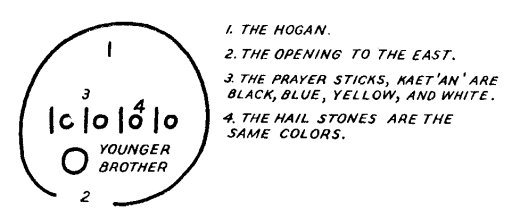
FIGURE 13--The plan of the hogan.
to remain there and watch the medicine sticks[74] each day, while the Elder Brother went out against the monsters. The Elder Brother said: "When you see one of the medicine sticks start to burn you will know that the enemy is getting the better of me. Take the medicine stick in your hand and draw the smoke from it into your mouth and blow the smoke onto the sticks and the hailstones, one by one. And then draw some more smoke from the burning stick and blow the smoke toward the four directions."
After everything was arranged the Younger Brother was left in the hogan and the Elder Brother asked his grandmother where he could find the Giant Elk. She said: "He is to be found over on Bikehalzi'n, the Red Plain, but no one can go near him. When he sees anyone in the distance he charges and catches them and eats them alive. He is very dangerous." Now these monsters had supernatural strength from the rainbow and the lightning, and they were very powerful. But the Elder Brother said: "To all the ends of the earth there is no such place as dangerous." So he went forth to find the animal.
He came to the Red Plain where his grandmother said that the Giant Elk was to be found. When he got to a knoll he gathered a bunch of grass and, as it was tall, he held it in front of himself and crept to the top inch by inch. Just as he reached the crest he saw the Giant Elk, through the bunch of tall grass, quite a distance away. The animal was standing. It was big. It had hair like a moose and a great pair of horns that stood up far into the air. The Elder Brother crept around in a huge circle trying to get closer, and. just as he was losing hope an old woman came to him.
She said: "What do you want, my grandchild?" She was the mother gopher. The Elder Brother said: "Grandmother, I am trying to get near the Giant Elk so that I can kill him." She said: "Grandchild, it is impossible. It is impossible to go near that animal. But when my children are cold I can go to him and chew off some of his hair which he gives me for my nest." The Elder Brother said: "Grandmother, you shall have a precious gift if I can have your help."
[74. Stevenson (1891, pp. 242-243). Preparation of sacred reeds (cigarettes) and prayer sticks.]
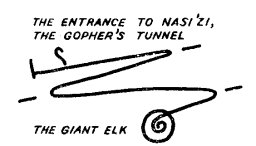
FIGURE 14.--The entrance to the Gopher's tunnel.
She agreed to help him, and she instructed him to wait there while she went into her hole. (See fig. 14.)
When she returned she said that all was in readiness. She had chewed away the hair over the Giant Elk's heart. She told the Elder Brother to follow her; but when he tried to enter the hole which was the entrance to her home he found that it was too small. He hesitated a moment. The mother gopher said: "Raise your right leg." And she puffed into the entrance of her tunnel four times. It was now large enough for the Elder Brother to walk into it. When he reached the end directly over him lay the Giant Elk. He could hear his heart beating: tap, tap, tap. The Elder Brother had with him the weapon which the Sun had given him, the lightning how and arrow. He aimed and shot. The Giant Elk leapt way up in the air, and when he fell, he fell horns first. He started to tear up the tunnel. The Elder Brother ran back as fast as he could. He ran back to almost the mouth of the tunnel when he heard the Giant Elk drop. Then the Elder Brother walked out onto Bikelialzi'n, the Red Plain.
In those days each animal had certain powers. It was theirs alone. This time the Elder Brother had used the power given the mother gopher. Now after the Elder Brother came out of the tunnel he found the mother gopher with her hands over her heart. She said: "Oh, my heart is sick with fright!" She told him how the Giant Elk acted. "If he had reached the mouth of the tunnel we would have been eaten alive."
Just then a man came up. He was the chipmunk.[15] He came to see if the great animal was really dead. They, the chipmunk and the gopher, were still frightened. The chipmunk wanted to make sure that this was so. He said: "If the animal is quite dead you will see me at the top of one of the horns." The Elder Brother and the mother gopher watched and when they saw the chipmunk at the top of the Giant Elk's horn they went near. The chipmunk had gotten the blood from the animal's mouth and wiped it on his back, from his head to his tail. That is why the chipmunk has dark lines on his back today. The gopher also took some of the blood and rubbed it over the
[71. Informant's note: Some say that It is hazai, the ground squirrel, not the chipmunk.]
palms of her hands, and then over her f ace. That is why gophers have dark faces.
The Elder Brother skinned the Giant Elk. He cut the hide and made it fit his body like a coat. He cut holes for his arms to pass through; he cut the belly and made holes for laces. Then he cut out the main arteries and blood vessels and tied them so that the blood remained inside, and he put them around his neck. They hung down over his heart, and he tied them there. Then he removed the coat, placing the arteries, and laces inside it. He took these things, together with the horns, but he told the mother gopher that she could have the rest of the Giant Elk. And so saying, he set out for his home.
When the Elder Brother returned he entered his home and said: "Grandmother, I have killed the Giant Elk." The grandmother spoke up: "That is an impossible thing to do." But he answered: "Look, the hide is outside." The grandmother went outside, and taking the hide she chanted[76] and danced as she had chanted and danced with the Giant's scalp.
Now two of the monsters were killed. The plan of the Sacred People was being fulfilled.
The next morning, after the Elder Brother had returned from killing the Giant Elk, he asked: "Mother, Grandmother, Where do the Giant Birds live?" They told him that they were to be found just north of La Plata Mountains, at a, place called Tse an' iska', A Tall Rock Standing.[78] "It is a dangerous place," they said. "No one can go near there." The Elder Brother said: "In all the world there is no such thing as a dangerous place." So he made his plan.
[76. Informant's note: The chant that the grandmother used was the one that the warriors used. It is sung also before going on a hunting trip. It is sacred. This part must never be told in the summertime--all the stories of the killing of monsters. This ceremony could be used against kin among the Navaho, should anyone be wicked enough to do it. Sometimes it has even been used between brothers and sisters, for the Twins killed their elder brother, the giant, Yeitso. The remedy is to use the chants the Elder Brother sang when going against the monsters. There are hundreds of these chants. By reading the stories one can get an idea of the wording of the chants. The chants always tell the story--the deeds of the holy ones, places, etc.
77. Recorder's note: Whitman (1925, pp. 66-75) gives Tsenahale as the name of the Giant Birds. There is also an interesting article "An Athabascan Tradition from Alaska, The Giant Birds," by Wright (1908, p. 33).
Informant's note: There are many versions of this story.
78. Matthews (18 97, p. 119, also note 136, p. 235): He says that tse bida'i is the Winged Rock or Shiprock. Franciscan Fathers (1910, p. 357): Tse bida'i Winged Rock or Shiprock.
But both the Informant and the Interpreter said that this was an error. The name is correct, but it was not the home of the Giant Birds.]
He put on the elkskin coat that he had made and laced the front of it. He placed the blood vessels which contained the Giant Elk's blood around his neck and laced the coat over them. Also he placed the two sacred feathers, which the Sun's mother had given him, one under each arm. He carried the black knife and the lightning bow and arrow and one of the horns of the Giant Elk; with these he started out.
When he neared the mountain, at a place where the town of Marvel now is located (this--Mesa Verde--side of Durango), all of a sudden he began to wonder if the Giant Birds had seen him.
The chant is like this:
I wonder if the lone eyes are watching me?
I wonder if the lone eyes are watching me?
I wonder if the lone eyes are watching me?
I am he who has killed the monsters.
The lightning is before me.
All is beautiful behind me.
(The chant continued: "I wonder what the big birds will do to me?" etc.)
As the Elder Brother approached La Plata Mountains he sang two other chants. And as he was singing he saw a black speck over the mountains. It was one of the Giant Birds. It swooped like a hawk after a chicken. The Elder Brother lay, face downward, flat on the ground. The bird [79] scratched the back of his coat but did not get a hold. The elder Brother chanted:
The Big Bird has missed me.
The Big Bird has missed me.
I alone have been missed.
I alone have been missed.
The big bird circled around again and dived for him. He missed him again, and again the Elder Brother chanted as before. The fourth time he lay on his back, and when the big bird swooped down he caught the lacings of the coat in his talons. Then the Elder Brother sang:
The Big Bird got hold of me.
The Big Bird got hold of me.
I alone shall be saved.
I alone shall be saved.
He repeated this chant eight times, and he blew eight times on the bird. In this way the Elder Brother was carried to the home of the Giant Birds.
The Giant Bird carried him over a high peak, and over a great smooth rock and there he dropped him. But the Elder Brother landed safely by the help of the sacred feathers and the Giant Elk's horn. There he lay on his back and cut open the blood vessels around his
[79. Informant's note: The Giant Birds are called Tse na'hale. They are named after the fashion in which they carry a being to the top of the rock and let him fall against it.]
neck, and out poured the blood. The Giant Bird called his two young ones, his two children, and he told them to go and eat. The two young birds approached the Elder Brother and made for his eyes, but he said: "Sash, Sash it!" and they backed away. (That is why an eagle flies backward when he first lands on the ground.) The young birds returned to their father and said: "He is alive, father." The Giant Bird told them to hush and go and eat. This happened four times. Each time the young birds called back to their father that they were afraid because the youth was still alive. Finally the Giant Bird flew away, but before he left he called to the young birds and told them if they were hungry to go ahead and eat.
When the young birds began to cry the Elder Brother told them to hush, that he would not harm them. So the young birds took him to their nest, and the three camped there that night. They had for their cover all the white flowers that grow on the mountains, made like a feather quilt.
The next morning the Elder Brother asked them when their father returned. They answered: "Our father returns when you see the Male Rain begin to fall." So when the Male Rain commenced falling at a certain time of the day the young birds looked up and said: "Our father is coming with a load." The Elder Brother looked into the sky but he could see nothing. He asked the young birds where their father would light, and they showed him the place. He went there and made ready, weapon in hand.
When the Giant Bird flew over the peak he threw a young man on the rock where he had thrown the Elder Brother the day before. The great bird circled and lighted just where the young birds said that he would. Before the Giant Bird's wings were closed the Elder Brother took aim and shot his arrow. The Giant Bird tumbled over with a great roar which was heard at a considerable distance, and then the echo was heard.
The two young birds began to cry, but the Elder Brother told them to hush, that he would not harm them, that he would save them. He asked them when their mother would return. They said: "When the Female Rain falls, then our mother will return." He waited, and he camped that night as before with the young ones. The next day when the Female Rain began to fall the young birds looked up and said: "Our mother is coming with a load." The Elder Brother asked them where the mother bird would light when she came home, and they told him the place. He went to the ledge indicated and sat under it and made ready his weapons. When the mother bird flew over the rock she threw down a beautiful maiden. The Elder Brother saw that she had lots of hair and strings of turquoise for earrings. Now as soon as the Giant Bird lighted the Elder Brother took aim and shot
his lightning arrow. The Giant Bird tumbled over the rock with a great noise which was heard over the mountain. The two young birds began to cry, but the Elder Brother went to them and said: "I shall not harm you. You will be saved."
The Elder Brother called to the older of the two birds and said:
Sit here before me. From this day on you will not think as your father thought. The thoughts of your mother have also departed from you. You will forget all that has happened to you, and the spirits of your father and mother will not enter you again. The tribe which is called Dîné shall use you. They shall use your claws, your feathers, your bill, your eyes and your bile.
This he said to the elder bird, and he raised him up and told him to go. The young bird rose and flew up into the sky and out of sight. He was the eagle.
Then the Elder Brother called the younger bird and said: "You sit before me now." He prepared a smoke for himself. He puffed the smoke on his fingers and passed his hand over the bird crosswise. He told him that the thoughts of his father and his mother had departed from him, and that their spirits would not enter him again. "The tribe called Dîné shall use your feathers. When they are out alone and lost you will help them. In case of famine they will eat you for meat. Whatever you say will have a double meaning: it can be taken for a lie or for the truth." He raised the young bird and told him to go. He did not fly high but just over the rocks. He circled around, and the Elder Brother heard an owl hoot. He had said that the owl could be eaten as food. The Giant Birds had big eyes, so are the eyes of the owl.
After that the Elder Brother was alone on top of the great rock. He searched everywhere but there was no way to descend. Now this was the fourth day since he had left his home. The Younger Brother kept watch over the medicine sticks and they were all standing as at first. But the Elder Brother was really worried and lonesome. He sat on the high peak and looked in the direction of his home. He Could see a black cloud hanging over his homeland and he saw a black streak of rain and lightning flashing, and the rainbow shone on one side.
This is the chant he sang as he sat there:
Far in the distance the black cloud rises.
I am he who killed the monsters.
Far in the distance the black cloud rises.
The Male Rain rises up from the far horizon.
Lightning rises from the far horizon.
The rainbow rises from the far horizon.
They rise like the Most High Power Whose Ways Are Beautiful.
They rise far in the distance.
I am he who came to earth with the lightning.
The black vapor rises far in the distance.
p. 91 The Female Rain rises far in the distance.
The lightning rises far in the distance.
The rainbow rises far in the distance.
They rise like the Most High Power Whose Ways Are Beautiful.
They rise far in the distance.
The Elder Brother circled the cliff and he saw the old Bat Woman carrying a basket way down below him. He called down from the top of the rock and said: "Grandmother, take me off the top of this rock in your basket." She mumbled something and hurried behind a rock for she was frightened as she had never heard anyone call from the home of the Giant Birds. He called down again, and she peered out from behind the rock. He said: "Grandmother there is no danger up here for I have killed the Giant Birds." Then he called again: "If you take me down you call have all the feathers from the Giant Birds." Then she called up: "You go over to the edge and dig a hole in the ground and put your head into it and wait until I come up."[81] So he did as she said. He stayed there with his head in the ground, and he heard her singing as she came up. It took a long time until she reached the top of the rock. She then said to the Elder Brother: "Get up, my child. What are you doing here?" When he stood up he saw the grandmother bat with her basket. "You may have all the feathers of the Giant Birds," said the Elder Brother, "if you take me down from this high peak." The grandmother bat said: "Very well. Get into my basket." He saw that it was made of tiny strings woven together, and be said: "Grandmother, those strings are too fragile to hold me up." Whereupon she filled her basket with heavy stones and danced around with it. When she dumped out the stones he got into the basket. She said to him: "You must close your eyes." To make sure of this she wrapped his head in the baby buffalo hide that she had received as her gift when she went to the home of the Great Gambler. So they started to climb down the cliff. It seemed a long time to the Elder Brother who began to open his eyes. He thought: where in the world is she taking me?
The Bat Woman started to fall. She hit over her shoulder with her walking stick and said: "Oh, you foolish-headed boy. You will wander where you do not belong." And she continued to lay on the stick. When they reached the ground the Elder Brother climbed out of the basket and asked: "What happened, Grandmother?" But she just shook her head.
They walked to the place where the Giant Birds had fallen to earth. There the Elder Brother filled the Bat Woman's basket with the feathers, those of the wings, tail and all. He covered the basket with the
[81. Interpreter's note: He had to bide his eyes for the Bat Woman wore only a small apron which flapped as she climbed.]
hide of the baby buffalo; and he told her that she must not go through the grove of sunflowers with her load. Then he gathered up the wing and tail feathers which he had put aside for himself, and started for his home.
As he had disobeyed the grandmother bat on their way down the cliff she decided to get even with him. She went straight for the sunflowers. A jackrabbit came up to her and said: "Grandmother, what have you in your basket?" He looked in and pulled out two tail feathers which he stuck through his headband. "Now I am quite fine," he said. (And that is why the jackrabbit has long ears.)
When the Bat Woman arrived in the sunflower patch thousands of little birds[82] flew out of her basket. She tried to pull them back, but she lost them all. She called out to the Elder Brother: "Oh, Grandson, look, I have lost all my feathers." But the Elder Brother was well on his way, and he thought to himself: now who will take the trouble to reload her basket.
When the Elder Brother reached his home the Younger Brother met him and said: "I have watched the kethawns (medicine sticks) all the time you were gone. I saw the black stick smoking and I knew that you were in danger; but it went out and I knew that you had overcome the enemy." The Elder Brother left the wing and tail feathers of the Giant Birds outside and the Twins entered the hogan. The Elder Brother said: "Mother, Grandmother, Grandfather, I have killed the two Giant Birds." But First Woman answered: "There is no one able to kill them." He said: "But go and see. The feathers are outside." The grandmother went outside and took up the feathers and danced, saying: "It was for this I was made to live alone."[83]
The next morning the Elder Brother asked his mother and grandmother where the big Rolling Rock could be found. They said: "It can be found at a place called Betchil gai,[84] the Shining Rock. But the Rolling Rock is dangerous. It runs after a person and rolls over him. It is very dangerous." But the Elder Brother said: "There is no such place as dangerous on the earth."
He gathered together all his knives and started out for the Shining Rock. When he came near it he took out his black knives and crossed
[82. Interpreter's note: All the little birds were created at this time: Juncos, nuthatches, titmice, etc. They were called naat'a'gi.
83. Informant's note: There comes a little chuckle in the narrative whenever the old ones think that they know more than the younger ones.
84. Matthews (1897, note 152, p. 237) gives the list of 17 places where pieces of the Rolling Rock were knocked off. He gives the place of the Rolling Rock as Tes'espai, as does Whitman (1925).]
them and planted them. A little farther on he planted the two blue knives, crosswise. On beyond he planted the two yellow knives, also crosswise. The last to be planted were the two knives with the serrated edges. These, also, he planted crosswise. He came out now in sight of the Rolling Rock. The Rock started for him; and he ran and jumped over the serrated knives. When the great Rock rolled over them a huge piece of it broke away. The Elder Brother jumped over the yellow knives, and when the Rock rolled over them again a big piece broke away. He jumped over the blue knives, and the Rock rolled after him, and another piece broke off. He jumped over the black knives, and when the Rock rolled over them there was only a little piece of it left, and it had very little life in it.
The Elder Brother chased this remaining piece of the Rock westward into the San Juan River. He got a piece of the rock that had been broken off the Rolling Rock and he sat down and told it that the thoughts of the great Rolling Rock had left it and would never again enter it. "The tribe called the Dîné will use you," he said. "They will use you for flint to strike fire from."
The Elder Brother carried the small piece of the Rolling Rock to his home. He left it outside and entered the hogan. He said: "Mother, Grandmother, Grandfather, I have killed the great Rolling Rock." They all answered: "No one has the power to kill the great Rolling Rock." The Elder Brother said: "But you can find a piece of it outside." So First Woman went out and taking up the stone she danced around four times, saying: "It was because of this that I was made to live alone."
So far four kinds of monsters had been killed.
The morning after the Elder Brother returned with the fragment of the Rolling Rock he said: "Mother, Grandmother, where can I find the Twelve Antelope who devour people?" Now these antelope were to be found on the plain surrounding Shiprock. The women said: "They are to be found at a place called Hale gai' e dinla'."
First he made a torch out of bark and then he started for the plain. When the Twelve Antelope saw him coming they all ran for him, but he lit the torch and touched off the dry grass. The antelope circled the fire and the rising smoke, and with his weapons he was able to kill eleven of them. He caught just one. He talked to the antelope and said: "All the thoughts and spirits of your comrades have departed from you. Those thoughts will never enter you again. People will use your flesh for meat. Your head, also, will be used by the people."
[85. Franciscan Fathers (1910, p. 358): Jadi nakhidzada, the 12 antelopes fathered by plants.]
He let the antelope go. "Your home will be on the plains," he said. "Later the people will use the antelope head, called bea da', when they go hunting."[86]
After the Elder Brother had sent the antelope away he cut off the head of one of the animals that he had killed and turned toward his home. Stepping inside the hogan he said: "Mother, Grandmother, Grandfather, I have killed the antelope." They all said: "No one has ever killed one of them. They are dangerous." But he answered: "But the head of one of the antelope is outside." And again the old woman went out, and taking up the head, she danced around four times, saying: "It was for this that I was made to live alone."
The morning after the Elder Brother returned from killing the antelope he asked: "Mother, Grandmother, where do I find the being called Tse'tahotsilta'li, the Kicker?" Now he was a monster in human form who lay in wait near the edge of a cliff and kicked anyone passing by over the cliff to where his children could reach him and eat him, for they were cannibals. This being lived on Wild Horse Mesa now in the Mesa Verde area. The Kicker could be found on a little neck of the mesa above Ute Canyon. The White Bead Woman and First Woman told the Elder Brother that this being was dangerous, that he kicked people off cliffs, but he said: "There is no place dangerous on earth."[88]
The Elder Brother left his home and journeyed to the top of Wild Horse Mesa. All of a sudden he saw a man lying on his back, his arm doubled under his head. He stopped and said: "Grandfather, is it all right to pass through here?" This person answered: "Yes Grandson, people pass back and forth through here." The Elder Brother pretended to take a quick step forward, but he stepped back instead. The being had kicked. The young man said: "What does this mean, Grandfather?" The being said: "Oh, I had a bad cramp in my leg." The same thing happened four times. Then the Elder Brother hit the being with his long knife and killed him.
The Elder Brother threw the being down over the cliff[89] where his own children were waiting. There was a great shouting below.
[86. Informant's note: The tongues of the antelope are black because once upon a time they ate human beings.
87. Franciscan Fathers (1910, p. 358): Tse'dahidzitqa'li, the one who kicks from the cliff. Matthews (1897, p. 122).
88. Informant's note: Here there are chants, as there are chants of all the killings of monsters.
89. Matthews (1897, p. 122; also note 143, p. 236): ". . . he discovered that the being's long hair grew, like roots of cedar, into a cleft in the rock. He cut the hair and the body tumbled down out of sight."]
Some one said: "Mine is the head." Another said: "Mine is the heart." And so on, for they wanted different parts of the body. But when the body reached the ground they all stepped back. "This is the body of our father!" They cried. But the mother told them to go ahead and eat.
When the Elder Brother reached them he saw that they were ugly and dirty. First, he told them to eat if they wanted the head and the heart of the monster. Then he talked to the wife and the children. He said that they must all travel to the West. He told them that the thoughts and the spirit of the father had departed from them, that they would no longer think nor act as he had done. But because of the evil that their father had committed they would always be a poor people; they would not have the beads and turquoise as had the other tribes. He sent them toward the west to Natsisa'an, Navaho Mountain. Some later became the Paiutes[90] but others journeyed still farther westward. They were barefoot and the soles of their feet turned black.
After the wife and children had departed the Elder Brother cut off the Kicker's scalp and went home. Stepping inside the house he said: "Mother, Grandmother, I have killed the Great Kicker." They said: "No. No one could kill him." He said: "But, Grandmother, his scalp is outside." So First Woman went outside the home and taking up the scalp she danced about four times, chanting: "It was for this that I was made to live alone."
The next morning the Elder Brother asked: "Now where are the Slashing Reeds to be found?" They told him that they were to be found at a place called Tse'nee'tlene near the mouth of La Plata River. They told him that they were dangerous reeds, that they cut people to pieces.
The Elder Brother made himself flint armor and started out for the place. When he arrived near them the reeds began to slash about in different directions, but they could not harm him because of his "knife" armor. He lit a torch, which he had brought with him, and burned the reeds. He burned all but one, which he saved, and to this one he spoke. "All the evil actions of the Slashing Reeds you must forget. People will use you. You will be used in the cutting medicine
[90. Matthews (1897, p. 123): "They went to Natsisaan, Navaho Mountain, and became the progenitors of the Pahutes." Franciscan Fathers (1910, p. 400): Natsis'an, Navaho Mountain.
Informant's note: It is sometimes said that these creatures were turned into birds of prey.
91. Matthews (1897, p. 110); Franciscan Fathers (1910, p. 358), luka digi'shi, slashing reeds.]
stick, which will be given as a gift to the Sacred People, and also, for the stick itself." Then he waved the reed all around him and planted it in the ground, and reeds sprang up in quantity. He carried one of these home with him.
He stepped inside the hogan and said: "Mother, Grandmother, I have destroyed the Slashing Reeds." They told him that no one who had gotten among them had come out alive. "But look, Grandmother," he said, "one of them is outside."
First Woman went outside and danced and chanted four times with the reed in her hand. She said: "It was for this that I was made to live alone."
The next is the story of the beautiful young woman called Bet jo'gie etta hi ee',[91] meaning overwhelming sex. She was a wild young woman who thought only of one thing. She was very beautiful and very dangerous, for she went from place to place catching young men whom she harmed. She crushed their sex organs.
The day after the Elder Brother returned from destroying the Slashing Reeds, he asked: "Mother, Grandmother, where is that certain young woman to be found?"
"She is to be found at a place called Tse' et ha' ee, Red Mesa." They told him this and also what she did to a young man if she caught him.
He made his plan, and he fashioned four sticks, each shaped as a man's sex organ. He covered them with the sour juice of a certain plant and he went forth to find the woman monster. He reached the place where his mother told him he would find her, and he saw her fresh tracks. He was following them when all of a sudden he heard a noise behind him and looking back he saw a beautiful maiden coming toward him.
"Where are you from, may I ask?" she said. "Oh," he said, "I just happened along." Coming nearer she said: "You must be my husband. The two of us can live together." The Elder Brother said: "I have never touched a woman." But she told him that she knew all, that he did not have to worry. He repeated the same thing four times, and four times she assured him that she knew all. Then he told her that when they lay together they must both close their eyes, and she was willing. When he used the first of his sticks it was cut in two. He used the second and it was also cut in two. He used the third and it was cut in two; and he used the fourth and she was dead. Her sex organ had its power from the night and the blue haze and the twilight and the black sunbeam.
[92. Franciscan Fathers (1910, p. 358): bijosh yeda'a', the overwhelming vagina. She conceived of cane cactus, qosh naola'li.]
The Elder Brother cut out her sex organs and said: "There shall be no more women like you found here. But I'll cases where a man gets a sickness from a woman, the medicine I use will be used as a cure."[93]
(Here there is a certain ceremony which pertains to this. It is used for either man or woman.)
He took what he had cut out, and her scalp, and returned to his home. And as before, his grandmother danced four times, carrying them, and saying: "It was for this that I was made to live alone."
There remained the great Swallow People in the Mancos Canyon and beyond. They had been at war ever since the killing of the Coyote.
The Elder Brother said: "Mother, Grandmother, Grandfather, where are the Swallow People to be found?" They told him that they were to be found at a, place called Tqo tzosko, Water in the Narrow Canyon. So he started out and traveled to Jackson Canyon.
There were thousands and thousands of Swallow People and he killed them right and left. He killed and killed, and he worked his way to the mouth of Mancos Canyon. Then he began running. He was tired and there were still thousands to be killed. When he reached the second rock near the San Juan River he was very tired. At home, in the hogan, all the medicine sticks were seen burning. The Younger Brother said: "Look, Grandmother, all the medicine sticks are burning." First Woman said: "Hurry and do as your brother told you to do." So the Younger Brother took the smoke from the first stick and blew it on the hailstone next to it, and so on for all four. Then he blew the smoke in the four directions.
A big, black cloud shot out of the sky over the place where the Elder Brother was resting. A great storm broke, thunder, lightning, rain, and hail. This hail destroyed the remaining Swallow People and all the lesser giants who lived in the mesa country.[94]
[93. Recorder's note: Probably the sour cactus. But the plants used In the ceremony called be'e kanze, or, be e ganze, for the "itching disease" are: tsil'jin, or, tsil chin, a shrub whose leaves resemble sumac; dit joli, leechee e', and, dit tse de koshi (these are unidentified). The roots of these four plants are boiled and the juice is used.
Informant's note: This ceremony has a chant and medicine sticks, with offerings. The sickness is called dit chit. It is not syphilis. There is a story that tells of one of the Twin Brothers contracting syphilis from a woman. The cure was a plant found on Mesa Verde.
Recorder's note: This plant was identified as Oregon grape, one of the barberries (Saunders, 1933, pp. 88-89.) Oregon grape is gathered; an infusion with salt added is taken. There is also the sweat bath and bathing with the infusion.
94. Recorder's note: The Swallow People, the people who live In the cliffs, appear in the myths of the Zuñi and Hopi as well as the Navaho. The informant, however, identified them with the Cliff Dwellers of Mesa Verde.]
The Elder Brother caught just one of the Swallow People and he told him that from now on he would be of very little use. "You will be harmless from now on," he said. And he let him go. But he took the scalp of one of the dead Swallow People and started for his home.
On his way someone ran after him. It was Mother Earth, herself. She said: "Grandson, you suffered greatly that time, didn't you?" He said: "Yes, Grandmother, I surely did." And she said: "You are in a hurry; but let me sing you this chant." She sang the two chants for the Twin Brothers.[95]
When the Elder Brother returned to his home with the scalp, the Grandmother danced and chanted four times as before.
Now although the Swallow People were the last of the Great Ills, still there were other dreadful beings that destroyed humans on the earth. Way back in time there was a piece of rock brought up from the underworld; and people were told that at times rocks would hurt them. There was a place called Tse'a haildehe', a narrow place between two cliffs, where, if one started to step over it, it widened or drew apart, and then returned to its first position crushing the person who had fallen into the crevice. This place was beyond Salt Canyon near the head of a canyon having many cracks in the rocks.
The time the Elder Brother went there, there was a distance of about 2 feet between the cliffs. He made as though to step across, but the opposite cliff drew away. When he took a step backward the cliffs drew together. This happened four times. He then placed the Giant Elk's horn across it and it remained in place. He carried a piece of this cliff rock to his home; but before leaving he commanded the cliffs to stay in place and never to move again.
The Elder Brother asked his mother and grandmother about the Evil Eyes, and they told him that they lived to the south of their home.
He walked until he arrived at a Rock with a Black Hole, Tse' ahalizi'ni, where these evil beings lived. When he reached the place he built a fire and after it was burning brightly he stirred it. He had brought a bag of salt with him, and, as soon as the whole family of beings looked at him with their many eyes, he threw the salt on the fire and there was a great smoke which hurt their eyes and tears came and
[95. Informant's note: The same chants are used here as when a party goes to war.
96. Franciscan Fathers (1910), tse yi'donahunt'i, impassable crevices (1912, p. 182), tse aqae'ndil, stones which clap together.
97. Franciscan Fathers (1910, p. 358): bina'yeagha'ni, who killed by the charm of their eyes. Whitman (1925, p. 75): Binaye ahani, Evil Eyes.]
they could not see. So he killed them.[98] From these beings came the trouble of sore eyes among people. The Elder Brother prayed that there should be no more of such beings formed to harm the people of the earth.
The White Bead Woman and First Woman told the Eldest Brother that the four last ills could be found south of their home.
He traveled southward and he found a ragged old man. He was just a bundle of rags. The Elder Brother was about to kill him when he said: "No, my Grandson, you must not kill me, even though I am Tie en, Poverty, for in six months people will have good clothing, and at the end of that time, called autumn, they will use it for the winter, in order to keep themselves warm." The Elder Brother, knowing that the virtue accompanying poverty is appreciation, let him live.
He walked on and he found an old, old woman. He was about to kill her for she was San, Old Age, but she stopped him and said: "No, no, my Grandson, do not kill me. People will grow old. Know that it will be the old people who will tell the young people what happened in years past. It would not be well if there were only young people on the earth. Every growing thing, including human beings will grow old." The Elder Brother knew that wisdom walked with old age, and he let her live.
Then he traveled on and he found the two E ya a', lice,[100] and he was about to kill them when they said: "No, don't kill us. We shall be seen on animals at different times. When we get on people they will say: 'Sister,[1] there is something on me. Look for it.' Let us live." The Elder Brother let them live, for although they were evils they brought with them compassion.
The fourth ill that the Elder Brother met was a creature of bluish color. "Do not kill me," he said. "I am death, Grandson. Spare me, for if every creature lived there would be no place on earth for youth and laughter." The Elder Brother left him with the others.
[98. Matthews (1897, pp. 123-124) says that the two youngest were spared. He changed one into Tsi dil to'i, shooting bird, who gives warning at the approach of an enemy; and the other, Hos to'di, the bird that sleeps in the day and comes out at night.
99. Matthews (1897, pp. 130-131): San, Old Age, is an old woman who lived on Debentsa, San Juan Mountains. She represents the good element and the increase of people. Hakaz estsen, Cold Woman, lived on the summit of Debentsa. She is given as a lean. old woman who sat without clothing in the snow. The good element: if it were always hot weather the springs would dry up, and the land would dry up and burn. Tie en, Poverty, lived on Dzil asdzi'ni. The good element: the joy in having new clothes, etc. Ditsi'n, Hunger, lived on Tlo hadashai, White Spot of Grass. The good: the enjoyment of food. Whitman (1925), in his Navaho Tales, calls Debentsa, Mount Big Sheep.
100. Lowie (1908, p. 114) ". . . the reflection of a social custom. Picking lice from each other's heads is a sign of mutual friendship and love."
1. Interpreter's note: This is so that people may know their true relations. The term "sister" is used as one denoting relationship.]
He thought great thoughts of the earth and the waters and the sky. If there was no death there could be no new life.
The Elder Brother went to the East and returned. All was well in the East. "There are no more monsters there," he said. And he went to the South and returned. "All is well in the South," he said. Then he went to the West and came back to his home and said: "There are no more monsters in the West. All is well towards the West." Last he went North and he came back from the North and said: "All is well in the North. Mother, Grandmother, Grandfather, there is no longer danger on earth. All is well to the ends of the earth."
The Twins said that now their work was finished. All the monsters who harmed the people of the earth had been slain. Naye'nez gani[2] the Elder Brother, took off his armor and his moccasins and leggings, he laid down his knives and the lightning weapon that the Sun had given him.[3] Then the Sun came and said: "My son, it is all well now. I shall take my weapons back with me. If I leave them with you, people will use them and harm themselves." But before he left the Elder Brother picked up an arrow and drew two crooked lines and one straight one on the shaft. He did this as a reminder of the sacred weapons. The Sun began to gather the sacred weapons together before starting out. He spoke to the Twins. "I want the White Bead Woman, your mother, to live in a beautiful white shell house in the West. A house like the turquoise house in the East." So the White Bead Woman went to the top of Chol'i'i, where she had been found as a baby. And there she made her plan.
Now up to that time all the things that the Sun had planned had not been successful; but all that the Yei Hasjelti and Hasjohon had planned had come out well. The Sun lost, although he had married the maiden which they had left on Chol'i'i. So power went to the two Yei who had formed the White Bead Baby. Some of the power went to the White Bead Woman herself. With this power she was able to make her people, the tribe called Dîné This tribe looks upon her as their mother. The Dîné pray to her as well as to Hasjelti and Hasjohon. So it is partly with the power of Wyol gie san, the White Bead Woman, that the monsters were destroyed, and that the tribe called Dîné came to this country and multiplied.
[2. Franciscan Fathers (1910, p. 360): The Twin Brothers are named: Naye'nez ghani, Slayer of Monsters; and Tqo bajish chi'ni, Child of the Water. See page 77, this bulletin, footnote 54.
3. Informant's note: Here there is a chant.]