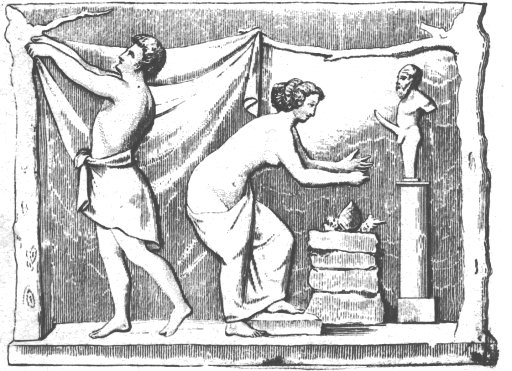
Envocation to Priapus: 19th Century Engraving of a Bas-Relief from Pompeii
Envocation to Priapus: 19th Century Engraving of a Bas-Relief from Pompeii
translation by Leonard C. Smithers and Sir Richard Burton
[1890]
Scanned at www.sacred-texts.com, December, 2000.
Introduction
A Word to the Reader
THE EPIGRAMS
To the Reader
Additional Epigram
NOTES EXPLANATORY AND ILLUSTRATIVE AND EXCURSUS
List of terms used in the Priapeia as designations of Priapus
List of term used in the Priapeia to designate the virile member of Priapus
Alphabetical list of additional terms used by Latin authors in designation of the male sexual organ
List of terms used in the Priapeia to designate the female sexual organ
Alphabetical list of additional terms used by Latin authors in designation of the female sexual organ
Sodomy with Women
Erotic Classical Writers
List of agricultural and horticultural terms used tropically in a venereal sense
Sodomy
Irrumation
The Supine Posture in Coition
Dancing Girls
Masturbation
Depilation by Catamites
Braccae
Bestiality
Postures of Coition
Infibulation
The Cunnilinges
Index of First Lines
I have such papers that grim Cato's wife
May read, and strictest Sabines in their life.
I will this book should laugh throughout and jest,
And be more wicked than are all the rest,
And sweat with wine, and with rich unguents flow,
And sport with boys, and with the wenches too;
Nor by periphrasis describe that thing
That common parent whence we all do spring;
Which sacred Numa once a prick did call.
Yet still suppose these verses Saturnal.
(O my Apollinaris) this my book
Has no dissembled manners, no feign'd look.
--FLETCHER'S Martial
The Priapeia, now for the first time literally and completely translated into English verse and prose, is a collection of short Latin poems in the shape of jocose epigrams affixed to the statues of the god Priapus. These were often rude carvings from a tree-trunk, human-shaped, with a huge phallus which could at need be used as a cudgel against robbers, and they were placed in the gardens of wealthy Romans, for the twofold purpose of promoting fertility and of preventing depredations on the produce.
Most of these facetiae are by unknown authors. Although they appear in early editions of Vergil, and are attributed to that writer by J. M. Catanaeus, it is, to say the least, doubtful that he played any part in their authorship. Politian attributes them to Ovid; others, such as François Guiet, hold Domitius Marsus to be their author. The general opinion is that they are the collective work of a group of beaux esprits who formed a reunion at the house of Maecenas (the well known patron of Horace), and who amused themselves by writing these verses in a garden-temple consecrated to Priapus. Subsequently Martial and Petronius added several imitative epigrams, and eventually the whole were collected in one volume by the writer of the opening verses. Catullus, Tibullus, Cinna and Anser are also credited with a share in the work. The cento consists chiefly of laudatory monologues by Priapus himself, jocosely and satirically written, in praise of his most prominent part--the mentule--and of fearful warnings to thieves not to infringe upon the Garden God's domains under pain of certain penalties and punishments, obscene and facetious. At times a witty epigram sparkles from the pages, notably numbers 2, 14, 2 5, 37, 47, 69 and 84, the Homeric burlesque in number 69 being merum sal, whilst numbers 46 and 70 show a degree of pornography difficult to parallel.
That the Priapeia has not hitherto been translated into the English tongue is to be expected: the nature of the work is such that it cannot, be included in a popular edition of the classics. But to the philological and anthropological student this collection is most valuable, and the reason for omitting it from the list of translations is not applicable to a version produced for private circulation and limited to an edition of five hundred copies. Putting aside conventionalities, the translators have endeavoured to produce a faithful reflection of the original Latin, shirking no passages, but rendering all the formidably plain-spoken expressions in a translation as close as the idioms of the two languages allow. Indeed the keynote to the volume will be found in Epigrams 1 and 46, on pages 33 and 70, verses probably scrawled on the temple walls of Priapus or scribbled upon the base of his statue by some libertine poet.
Although the value of the work in illustrating the customs of the old Romans may be small per se, yet when read in conjunction with the legacies of certain writers (Catullus, Petronius, Martial, Juvenal and Ausonius, for example), it explains and corroborates their notices of sundry esoteric practices, and thus becomes a supplement to their writings. With the view of making the work an explanatory guide to the erotic dicta of the authors above-mentioned, the bulk of the notes and the excursus explaining and illustrating the text and exceeding its length by some five times is devoted to articles on pederasty with both sexes, irrumation, the cunnilinges, masturbation, bestiality, various figurae Veneris (modes and postures of coition, particularly that in which the man lies supine under the woman); excerpts from the Latin erotic vocabulary, including exhaustive lists of Latin terms designating the sexual organs, male and female; a list of classical amatory writers, and a host of miscellaneous matters, e.g. the habits of the Roman dancing-girls, eunuchism, tribadism of the Roman matrons, the use of phalli, religious prostitution, aphrodisiacs, the 'infamous' finger, tabellae or licentious paintings, the fibula as a preventive of coition, the crepitus ventris, etc., etc., illustrated by poetical versions of many of the epigrams culled from various sources, by parallel elucidatory passages (many hitherto untranslated) from classical writers, and by quotations from authors, ancient and modern.
English literary students have good reason to congratulate them selves on the collaboration of a certain talented littérateur, the mere mention of whose name would be a sufficient guarantee for the quality of the work. He has most kindly enriched the volume with a complete metrical version of the epigrams, and this is, indeed, the principal raison d'être of this issue. I have also gratefully to acknowledge obligations of no small weight, not only for his careful and thorough revision of the prose portion of the translation, but also for the liberal manner in which I have availed myself of his previous labours in the preparation of my notes and excursus. The name of Sir Richard F. Burton, translator of The Book of the Thousand Nights and a Night, has been inadvertently connected with the present work. It is, however, only fair to state that under the circumstances he distinctly disclaims having taken any part in the issue.
And here I may state that a complete and literal translation of the works of Catullus, on the same lines and in the same format as the present volume, is now in preparation. Catullus is, of all the Latin poets, the one who has been oftenest paraphrased and traduced, and even yet, in the year of grace 1890, we have no version of him in our tongue which can be regarded by the student as definitive. Of the merits of Catullus's poesy and the desirability of a trustworthy translation there is no need to speak.
A long dissertation on Priapic worship, the Linga-pújá of the Hindus, considered as an ancient and venerable faith, would be out of place in this recueil; consequently that subject is merely glanced at in the next few pages, most of the information here presented being drawn from modern volumes which contain a digest of the writings of well-known authorities and specialists.
In the earliest ages the worship of the generative Energy was of the most simple and artless character, rude in manner, primitive in form, chaste in idea, the homage of man to the Supreme Power, the Author of Life, the Sun, as symbolised by the reproductive force.
Afterwards the cult became depraved, a religion of feeling, of sensuousness, corrupted by a priesthood who, not slow to take advantage of this state of affairs, inculcated therewith profligate and mysterious ceremonies, union of gods with women, religious prostitution and other sexual rites. Thus it was not long before the emblems lost their real and original meaning, and became licentious statues and debased art.[1] Hence we have the debauched ceremonies at the festivals of Bacchus, who became, not only the representative of the creative
[1. Sir R. F. Burton, in his paper read before the Anthropological Society on 'Certain Matters connected with the Dahoman', describes the Dahoman Priapus as 'a clay figure of any size between a giant and the pigmy, crouched upon the ground as if contemplating its own attributes. The head is sometimes a wooden block, rudely carved, more often dried mud, and the eyes and teeth are supplied by cowries. A huge penis, like a section of a broomstick, projects horizontally from the middle.']
Energy, but the god of pleasure and licentiousness.
This corrupted religion readily found eager votaries, captives to a pleasant bondage compelled by the impulse of physical luxury: such was the case in India and Egypt, and among the Phoenicians, Babylonians, Hebrews and other Eastern races.
Sex-worship once personified became the supreme and governing deity, enthroned as the ruling god over all; and monarchs, complying with the prevailing faith, became willing devotees to the cult of Isis and Venus on the one hand, and on the other of Bacchus and Priapus, appealing, as they did, to the most tyrannical passion of human nature.
The worship of Priapus amongst the Romans was derived from the Egyptians, who, under the form of Apis, the Sacred Bull, adored the generative Power of Nature; and as the syllable pri or pre signifies (we are assured) principle, production, natural or original source, the word Priapus may be translated principle of production or of fecundation of Apis. The same symbol also bore among the Romans the names of Tutenus, Mutinus[1] and Fascinum.[2] According to Macrobius, the corresponding deity amongst the Egyptians was called Horus--a personification of the sun. This Horus is painted as a winged youth, with a quoit lying at his feet, a sceptre in his right hand, and in his left a Phallus[3] equal in size to the rest of his body. The Phallus was the ancient emblem of creation, and representative of the gods Bacchus, Priapus, Hercules, Siva, Osiris, Baal and Asher, who were all Phallic deities, the symbols
[1. According to Festus, Mutinus or Mutenus is a god differing wholly from Priapus, having a public sanctuary at Rome, where the statue was placed sitting with penis erect. Newly-mated girls were placed in his lap, before being led away to their husbands so that the deity might appear to have foretasted their virginity, this being supposed to render the bride fruitful. In Primitive Symbolism we read, 'The Romans named Mutinus or Tutenus, the isolated Phallus, and Priapus, the Phallus affixed to a Hermes.'
2. Fascinum primarily means a bewitching, an enchantment. It gained its topical meaning from a custom practised by the ancients of hanging a Phallus round the neck of children as a charm or preventive against witchcraft, and hence the word became synonymous with penis.
3. Phallus, or privy member (membrum virile), signifies 'he breaks through or passes into'; German (pfahl); English (pole); of Phoenician origin, the Greek word, pallo--'to brandish preparatory to throwing a missile'; in Sanskrit, phal--'to burst, to produce, to be faithful', 'a ploughshare', and also the names of Shiva and Mahadeva, who are Hindu deities of destruction. The kteis, or female organ, as the symbol of the passive or reproductive powers of nature, generally occurs on ancient Roman monuments as the concha Veneris, a fig, barley, corn and the letter delta.]
being used as signs of the all-creative Energy or operating Power of the Demiurgos, from no consideration of mere animal appetite but in token of the highest reverence.[1] The tortoise, believed to have been androgynous, was chosen to accompany statues of Venus. The fig was a still more common symbol, the statue of Priapus being made of that tree, and the fruit being carried with the Phallus in the ancient processions to the honour of Bacchus. In conformity with the religious ideas of the Greeks and Romans, Vergil describes the products of the globe as the result of the conjugal act between Jupiter (the sky) and Juno (the earth). Among the Greeks, the membrum virile was borne in procession to the temple of Bacchus and was there crowned with a garland by one of the most respectable matrons of the city. According to St Augustine the sexual organ of man was consecrated in the temple of Liber, that of women in the sanctuaries of Liberia, these two divinities being named father and mother. Payne Knight states that Priapus, in his character of procreative deity, is celebrated by the Greek poets under the title of Love or Attraction, the first principle of Animation, the father of gods and men, the regulator and dispenser of all things. He Is said to pervade the universe with the motion of his wings, bringing pure light, and thence to be called 'the splendid, the self-illumined, the ruling Priapus'. According to Natalis Comes, the worship of Priapus was introduced into Athens by express order of an oracle.
The Priapi were of different forms, some having only a human head and the Phallus, some with the head of Pan or of a faun--that is, with the beard and ears of a goat. Among the paintings found in Pompeii there are several representations of hircine sacrifices and offerings of milk and flowers to Priapus. The god is represented as a Hermes on a square pedestal, with the usual characteristic of the deity, a prominent Phallus. Similar Hermae or Priapi were placed at the forkings of two or three roads, and were confounded with the divinities Mercury and Terminus presiding over boundaries. When furnished with arms, in his character of 'Terminus', Priapus held with one hand a reaping hook and, like Osiris, grasped with the other the characteristic feature of his divinity which was always of a monstrous size and in a state of statant energy. One of the paintings discovered at Pompeii represents a sacrifice or offering to Priapus, made by two persons. The first is a young man with a dark skin, entirely naked, except for the animal's skin
[1. Survivals of this worship may be seen in our maypole, the steeple, the ecclesiastical cross, etc.]
which is wrapped round his loins, his head being encircled with a wreath of leaves. He carries a basket wherein are flowers and vegetables, the first offerings of his humble farm; and he bends to place them at the foot of a little altar, on which there is a small statue in bronze representing the god of gardens. On the other side is a woman, also wearing a wreath, and dressed in a yellow tunic with green drapery; she holds in her left hand a golden dish and in her right a vase and she appears to be bringing an offering of milk:
Sinium lactis et haec te liba, Priape, quotannis
Expectare sat est; custos es pauperis horti.
VERGIL, Eclogues
Offerings were made to Priapus according to the season of the year:
Vere rosa, autumno pomis, oestate frequentor
Spicis: una mihi est horrida pestis hiems
Epigram 86
In another painting Priapus is represented as placed on a square stone, against which rest two sticks. His head is covered with a cap, he has a small mantle on his shoulder, and exhibits his usual prominent characteristic.[1] According to Herodotus and Pausanias statues of Mercury were represented as ithyphallic,[2] and the latter mentions one in particular at Cyllene.
In the towns Priapus had public chapels, whither devotees suffering from maladies connected with his attributes repaired for the purpose of offering to him ex-votos figuring the parts afflicted; these ex-votos being sometimes paintings and, at others, statuettes made of wax or of wood, and occasionally of metal, stone and marble. Females as superstitious as they were lascivious might be seen offering in public to Priapus as many garlands as they had had lovers. These they would hang upon the enormous phallus of the idol, which was often hidden from sight behind the number suspended by one woman alone. Others presented to the god as many phalli, made of willow-wood, as the men whom
[1. The statue is evidently placed by the roadside, and holds a stick in its hand to point out the way to travellers.
2. Ithyphallus, a piece of wood shaped like the erect virile member, which was carried about in the festivals of Bacchus. Hence, applied to Priapus, who was represented with an erect member. Priapus was also called Triphallus (triphallos), a threefold phallus, an immense phallus, on account of the extraordinary size of his member.]
they had vanquished in a single night. St Augustine informs us that it was considered by the Roman ladies a very proper and pious custom for young brides to seat themselves upon the monstrous member of Priapus; and Lactantius says, 'Shall I speak of that Mutinus, upon the extremity of which brides are accustomed to seat themselves in order that the god may appear to have been the first to receive the sacrifice of their modesty?'
These facts prove that the worship of Priapus had greatly degenerated amongst the Romans since, losing sight altogether of the object typified, they attached themselves to the symbol alone, in which they could see only what was indecent; and hence religion became a pretext for libertinism. Respected so long as Roman manners presented their pristine simplicity, but degraded and vilified in proportion as the morals of that people became corrupted, the very sanctuary itself of Priapus failed to protect him from the biting sarcasm of the poets, and the obloquy and ridicule of the wits. Thus his statue[1] was placed in orchards as a scarecrow to drive away superstitious thieves, as well as children and birds.
The 'personal' history of Priapus represents him as the son of Dionysus and Aphrodite. It is said that Aphrodite, who was in love with Dionysus, went to meet him on his return from India, but soon abandoning him, made for Lampsacus, and there gave birth to her child by the god. Hera, who was dissatisfied with her conduct, caused her to bear a babe of extreme ugliness, who was presently named Priapus. The earliest Greek poets, as Homer and Hesiod, do not mention this divinity, and it was only in later times that he was honoured with divine worship. He was adored more especially at Lampsacus on the Hellespont, whence he is sometimes called Hellespondiacus.[2] By some writers Priapus is said to have been the son of Dionysus and a nymph called Chione. He was regarded as the promoter of fertility both in vegetation and in all animals connected with an agricultural life, and in this capacity he was addressed as the protector of sheep and goats, of bees, of the vine, of all garden produce and even of fishing. Like other divinities presiding
[1. The statue of Priapus was generally chopped roughly out from the trunk of a standing tree. It was usually shaped from fig-tree wood, dry oak or cypress; sometimes of marble or even of wheaten dough.
2. The enormous size of his member so endeared him to the women of Lampsacus that their husbands banished him from the city, whereupon a fell disease attacked their pudenda and continued until, by the oracle's command, he was recalled and crowned as the garden god.]
over agricultural pursuits, he was believed to be possessed of prophetic powers and he is sometimes mentioned in the plural. As Priapus had many attributes in common with other gods of fertility, the Orphics identified him with their mystic Dionysus, Hermes, Helios and others. The Attic legends connect Priapus with such sensual and licentious beings as Conisalus, Orthanes and Tychon; in like manner he was confounded by the Italians with Mutunus or Muttunus, the personification (as has been shown) of Nature's fructifying power. The sacrifices offered to him consisted of the firstlings of gardens, vineyards and fields; of milk, honey, calves, rams, asses and fishes. He was represented by carved images, mostly in the form of Hermae, carrying fruit in the sinus of the garment and either a sickle or cornucopia in the hand; the statues of Priapus in Italy, like those of other rustic divinities, were usually painted red, whence the god is called ruber or rubicundus.[1] A chief seat of the worship of this god was Priapus, a city of Mysia, on the Propontis, a colony of the Milesians; in Spain he was worshipped under the name of Hortanes, and in Slavonia under the appellation of Pripe-gala.
Antwerp was the Lampsacus of Belgium, Priapus being the tutelary god of that city; Ters was the name given to him by the inhabitants, who held this divinity in the highest veneration. Females were accustomed to invoke him on the most trivial occasions, a custom which, Goropius informs us, continued as late as the sixteenth century; and in order to eradicate or replace that superstition by the ceremonies of the Christian Church, Godefroy de Bouillon, the illustrious leader of the First Crusade, sent from Jerusalem, as a present of inestimable value, the foreskin of Jesus Christ, of which no less than twelve are still said to be extant.
Sir W. Hamilton's account of the worship paid to St Cosmo and St Damiano is very curious:
On the 17th September, at Isernia, one of the most ancient cities of the kingdom of Naples, situated in the Contado di Molise, and adjoining the Abuzzo, an annual fair is held which lasts three days. In the city and at the fair, ex-votos of wax, representing the male parts of generation, of various dimensions, sometimes even of the length of a palm, are publicly exposed for sale. There are also waxen vows that represent other parts of the body; but of these there are few in comparison with the Priapi.
The distributors of these vows carry a basket full of them in one
[1. The Hindus follow a similar custom of painting their gods with vermilion.]
hand, and hold a plate in the other to receive the money, crying out, 'Saints Cosmos and Damiano!' If you ask the price of one, the answer is 'Più ci metti, più meriti'--the more you contribute, the more the merit The vows are chiefly purchased by the female sex and they are seldom such as represent legs, arms, etc., but most commonly the male parts of generation. The person who was at the fête in the year 1780, and who gave me this account (the authenticity of which has since been confirmed to me by the Governor of Isernia), told me also he heard a woman say, at the time she presented a vow, 'Santo Cosmo, benedetto, cosi lo voglio!'--'Blessed St Cosmo, let it be like this!' The vow is never presented without being accompanied by a piece of money, and is always, kissed by the devotee at the moment of presentation.
But, as might naturally be expected, this ghostly voluptas does not suffice to fructify barren women; and, consequently, another ceremony, doubtless more efficacious, was required. The votaries who resorted to this fair slept there for two nights, some in the Church of the Capuchin friars and the others in that of the Cordeliers; when these two were insufficient to contain all the devotees, the Church of the Hermitage of St Cosine, received the overflow.
In the three edifices the women during the two nights were separated from the men, the latter lying under the vestibule, and all the others in the chapels. These, whether in the Church of the Capuchins, or in that of the Cordeliers, were under the protection of the father guardian, the vicar, and a monk of merit. In the Hermitage it was the hermit himself who watched over them. From this it may easily be imagined how the miracle was effected without troubling St Cosmo and St Damiano, as well as that the virtue possessed by these two saints extended to young maidens and widows.
In the neighbourhood of Brest stood the chapel of the famous Saint Guignole or Guingalais, whose Phallic symbol consisted of a long wooden beam, which passed right through the body of the saint, and whose forepart was strikingly characteristic. The devotees of this place, like those of Puy-en-Velay, most devoutly rasped the extremity of this miraculous symbol, for the purpose of drinking the scrapings, mixed with water, as an antidote against sterility; and when, by the frequent repetition of this operation, the beam was worn away, a blow from the mallet in the rear of the saint propelled it to the fore. Thus, although it was being continually scraped, it appeared never to diminish, a miracle due exclusively to the mallet.
I will conclude this hasty sketch of the Priapic cult with a brief description of the Dionysia, or festivals celebrated in honour of Bacchus, which throw considerable fight on this worship. They were brought from Egypt into Greece by Melampus, the son of Amithaon, and the Athenians celebrated them with more pomp than the other Greeks. The principal Archon presided over diem, and the priests who celebrated the religious rites occupied the first places in the theatre and in the public assemblies. Originally these festivals exhibited neither extravagance nor splendour, they were simply devoted to joy and pleasure within the houses; all public ceremonies were confined to a procession, in which there appeared a vase full of wine and, wreathed with vine leaves, a goat, a basket of figs and the Phalli. At a later period this function was celebrated with greater pomp; the number of priests of Bacchus increased; those who took part therein were suitably dressed, and sought by their gestures to represent some of the customs which faith attributed to the god of wine. They dressed themselves in fawn skins; they wore on head a mitre; they bore in hand a thyrsus, a tympanum or a flute and their brows were wreathed with ivy, vine leaves and pine-branches. Some imitated the dress and fantastic postures of Silenus, of Pan and of the Satyrs; they covered their legs with goatskins, and carried the horns of animals; they rode on asses, and dragged after them goats intended for sacrifice. In the town this frenzied crowd was followed by priests carrying sacred vases, the first of which was filled with water, then followed young girls selected from the most distinguished families, and called Canephori, because they bore small baskets of gold full of all sorts of fruit, of cakes and of salt; but the principal object among these, according to St Croix, was the Phallus, made of the wood of a fig tree. (In the comedy of the Acharnians, by Aristophanes, one of the characters in the play says, 'Come forward a little, Canephoros, and you, Xianthias, slave, place the Phallus erect.')
After these came the Periphallia, a troop of men who carried long poles with Phalli[1] hung at the end of them; they were crowned with violets and ivy, and they walked repeating obscene songs. These men
[1. In the Thesaurus Eroticus Linguae Latinae, four kinds of Phalli are described:
1 Those made of wood, chiefly of the fig tree, used at the festivals of Priapus and Bacchus.
2 Those of glass, ivory, gold and silken stuffs and linen, which Giraldus tells us were used by the Lesbian women to satisfy their passions.
3 Wheaten images shaped like the male pudenda.
4 Drinking vessels of gold or glass of a like shape.]
were called Phallophori;[1] these must not be confounded with the Ithyphalli, who, in indecent dresses and sometimes in women's costume, with garlanded heads and hands full of flowers, and pretending to be drunk, wore at their waist-bands monstrous Phalli made of wood or leather; among the Ithyphalli also must be counted those who assumed the costume of Pan or the Satyrs. There were other persons, called Lychnophori, who had care of the mystic winnowing-fan, an emblem whose presence was held indispensable in these kinds of festivals. Hence the epithet 'Lychnite', given to Bacchus.
Outside the town, the more respectable persons, the matrons and modest virgins, separated themselves from the procession. But the people, the countless multitude of Sileni, of Satyrs and of Nymph-bacchantes, spread themselves over the open spaces and the valleys, stopping in solitary places to get up dances or to celebrate some festival and making the rocks re-echo with the sound of drums, of flutes, and more especially with cries, constantly repeated, by which they invoked the god: 'Evohé Sabæe! Evohé Bacche! O Iacche! Io Bacche!' The first of these words recalls the words with which Jupiter encouraged Bacchus when, in the Giants' War, the latter defended his father's throne.
The description here given applied chiefly to the greater Dionysia, or to the new Dionysia; there were six other festivals of this name, the ceremonies of which must have borne some resemblance to those already mentioned. There were, in the first place, the ancient Dionysia, which were celebrated at Limnae, and in which appeared fourteen priestesses called Geraerae, who, before entering on their duties, swore that they were pure and chaste. There were the lesser Dionysia, which were celebrated in the autumn, and in the country; the Brauronia of Brauron, a village of Attica; the Nyctelia, whose mysteries it was forbidden to reveal; the Theoina; the Lenean festivals of the wine press; the Omophagia in honour of Bacchus Carnivorus, to whom human victims were formerly offered, and whose Priests ate raw meat; the Arcadian, celebrated in Arcadia by dramatic contests; and, lastly, the Trieterica, which were repeated every three years in memory of the period during which Bacchus made his expedition to further Ind.
The Bacchic mysteries and orgies are said to have been introduced from Southern Italy into Etruria, and thence to Rome. Originally they were celebrated only by women, but afterwards men were admitted, and
[1. Herodotus speaks of these Phallophori in the festivals of Bacchus as men who bore statues of a cubit's length, with members almost equal in size to the rest of their bodies.]
their presence led to the greatest disorders. In these festivals, the Phallus played a prominent part, and was publicly exhibited. At Lavinium the festival lasted a month, during which time a Phallus, remarkable for its proportions, was carried each day through the streets. The coarsest language was heard on all sides and a matron of one of the most considerable families placed a wreath on this suggestive image.
Pacula Annia, pretending to act under the inspiration of Bacchus, ordered that the Bacchanalia should be held during five days in every month. It was from the time of these orgies being carried on after this plan that, according to the statement of an eye-witness (Livy xxxix, 13), licentiousness prevailed and crimes of every description were committed. Disorder was carried to such an excess that the Senate in 186 B.C. issued a decree to suppress and prohibit these festivals; and it was ordered that no Bacchanalia should be held in Rome or in Italy.
I may here offer a few bibliographical details on the principal editions of the Priapeia. Five leaves in some copies of the Editio Princeps of Vergil (Rome, 1469) contain part of the work and a complete reproduction (nine leaves) is in the second edition of Sweynheym and Parnnartz, also published in Rome (1470). Other early editions of Vergil, presumably issued under authority, which contain the Priapeia are those of Venice, 1472 (Virgilii opera, necnon reliqua opuscula, cum priapeiis); Milan 1472; sine loco, 1472, 1473, by L. Achates; Rome, 1473, Milan, 1474; Milan, Zarot, 1475; Vicenza, 1476; and Venice (in aedib. Aldi), 1501. Other Aldine editions of Vergil do not contain such recueil, but this famous family of printers issued in 1517 (and reprinted in 15 34) Diversorum veterum poetarum in Priapum lusus, with other pieces falsely attributed to Vergil. The work is also found with the corrections of J. Avantius in the edition of Catullus, Tibullus and Propertius, published in Venice in 1500, in folio. The edition of Martial given by Gruter in 1600 (reprinted 1602, 1619, etc.), the edition of Deux Ponts (1784), and that issued in 1804 (Vindobonae, 2 volumes, 8vo) all contain these poems; as also do some editions of Petronius, notably that of Paris, 1601; Amsterdam, 1669 (the text of which edition the translators have used in preparing the present volume); Paris, 1677; Amsterdam, 1677 (32mo); and the edition of Deux Ponts. In the Vergil of Basle, 1613, the Priapeia is inserted, and a portion is to be found in volume ii, pp. 203-30 of the Meursius of 1770 (Birminghamiae). The separate editions of the Priapeia sive diversorum poetarum in Priapum lusus are Francof., 1596, 1606; cum Scaligeri commentariis ac F. Lindenbruch notis, Batavii (Amst.), 1654, 1664, 1667, 1694; s. 1. 1780, 1781. The edition of 1606 contains the commentary of G. Scioppius: and there are added five epigrams and Heraclii et aliorum epistolae de prupudiosa Cleopatrae libidine. In 1781 was published Priapeia sive diversorum poetarum in Priapum lusus aliaquae incertorum poemata emendata et explicata. Acc. Episolae de priapismo s. propudiosa Cleopatrae libidine, Jos. Scaligeri versiones duorum Priapeiorum et Index (cur. J. C. Anton, Lipsiae, 8vo). In the recueil published by François Noël under the title of Erotopaegnion, sive Priapeia veterum et recentorum, Veneri jocosae sacrum (Paris, 1798, in 8vo), these poems occupy pages 1-85 of the first part of the volume. Modem editions are the version printed in Weber's Corpus Poet. Lat., 1833; the variorum edition published in 1853 (J.A. Wernicke, Thoruni, 8vo) which contains the notes of Scaliger, Lindenbruch and P. Burmann; the Liber Priapeiorum, edited by F. Büchelor, added to his edition of Petronius (1862); and two editions privately printed in England in 1888 and 1889, under the imprint of Athens, the former of which contains, in addition to the text, a translation into English prose with notes, etc. In the Berlin (1827, tome i, pages 206 et seq.) and other editions of Lessing may be found a dissertation by him on the subject. In 1866, M. Gustave Brunet issued a little volume under the tide of Les Priapeia, Note de Lessing, translated from the German with a commentary by Philomneste Junior (Bruxelles, Mertens, 12mo; published for J. Gay). Müller's Catullus (Leipzig, Teubner, 1870) may also be consulted; and many carmina inscribed to Priapus are to be found in the Greek Anthology, the French translation of which, published in 1863 (2 Volumes, 12mo), includes about thirty of these pieces, mostly, however, of an innocent nature.
NEANISKOS
July 1890
In the Priapieia sive diversorum poetarum in Priapum Lusus, the friend with whom I have the pleasure to collaborate has come upon 'treasure trove', in the shape of a sprightly Latin cento of humour peculiarly Italic, most interesting to anthropologists and humanists and--rarer merit--undeflowered by the translator. He has made the most of his trouvaille providing the booklet with a history and a bibliography and illustrating, in copious notes and excursus, the Priapic cult and the manners and customs of the Roman days so quaintly depicted in these old (monkish?) pages. In brief, he has monopolised the learned and literary side of the epigrams, and he has assumed the whole responsibility thereof.
My share of the labour is on a scale much humbler. A 'cute French publisher lately remarked to me that, as a rule, versions in verse are as enjoyable to the writer as they are unenjoyed by the reader, who vehemently doubts their truth and trustworthiness. These pages hold in view one object sole and simple, namely to prove that a translation, metrical and literal, may be true and may be trustworthy.
As Captain Burton has told the public (Camoëns: Life and Lusiads; ii, 185-98), it has ever been his ambition to reverse the late Mr Matthew Arnold's peremptory dictum: 'In a verse translation no original work is any longer recognisable.' And here I may be allowed to borrow from the same writer's Supplemental Arabian Nights, vol vi, appendix pages 411-12 (a book known to few and never to be reprinted), his vision of the ideal translation which should not be relegated to the Limbus of Intentions.
My estimate of a translator's office has never been of the low level generally assigned to it, even in the days when Englishmen were in the habit of translating every work, interesting or important, published out of England, and of thus giving a continental and cosmopolitan flavour to their literature. We cannot at this period expect much from a 'man of letters' who must produce a monthly volume for a pittance of �20; of him we need not speak. But the translator at his best, works, when reproducing the matter and the manner of his original, upon two distinct lines. His prime and primary object is to please his reader, edifying him and gratifying his taste; the second is to produce an honest and faithful copy, adding naught to the sense or abating aught of its especial cachet. He has, however, or should have, another aim wherein is displayed the acme of hermeneutic art. Every language can profitably lend something to and take somewhat from its neighbours--an epithet, a metaphor, a naive idiom, a turn of phrase. And the translator of original mind who notes the innumerable shades of tone, manner and complexion will not neglect the frequent opportunities of enriching his mother-tongue with novel and alien ornaments which shall justly be accounted barbarisms until formally naturalised and adopted. Nor will any modern versionist relegate to a footnote, as is the malpractice of his banal brotherhood, the striking and often startling phases of the foreign author's phraseology and dull the text with well-worn and commonplace English equivalents, thus doing the clean reverse of what he should do. It was this beau idéal of a translator's success which made Eustache Deschamps write of his contemporary and brother bard, 'Grand Translateur, noble Geoffrey Chaucier'. Here 'the firste finder of our fair language' is styled 'a Socrates in philosophy, a Seneca in morals, an Angel in conduct and a great Translator'--a seeming anti-climax which has scandalised not a little sundry inditers of 'Lives' and 'Memoirs'. The title is no bathos; it is given simply because Chaucer translated (using the term in its best and highest sense) into his pure, simple and strong English tongue, with all its linguistic peculiarities, the thoughts and fancies of his foreign models, the very letter and spirit of Petrarch and Boccaccio.
For the humble literary status of translation in modern England and for the shortcomings of the average English translator, public taste or rather caprice is mainly to be blamed. The 'general reader', the man not in the street but the man who makes up the educated mass, greatly relishes a novelty in the way of 'plot' or story or catastrophe, while he has a natural dislike of novelties of style and diction, demanding a certain dilution of the unfamiliar with the familiar. Hence our translations in verse, especially when rhymed, become for the most part deflorations or excerpts, adaptations or periphrases, more or less meritorious, and the 'translator' has been justly enough dubbed 'traitor' by critics of the severer sort. And he amply deserves the injurious name when ignorance of his original's language perforce makes him pander to popular prescription.
But the good time which has long been coming seems now to have come. The home reader will no longer put up with the careless caricatures of classical chefs d'oeuvre which satisfied his old-fashioned predecessor. Our youngers, in most points our seniors, now expect the translation not only to interpret the sense of the original but also, when the text lends itself to such treatment, to render it verbatim et literatim, nothing being increased or diminished, curtailed or expanded. More over, in the choicer passages, they so far require an echo of the original music that its melody and harmony should be suggested to their mind. Welcomed also are the mannerisms of the translator's model, as far as these aid in preserving, under the disguise of another dialect, the individuality of the foreigner and his peculiar costume.
'Mat this high ideal of translation Is at length becoming popular now appears in our literature. The Villon Society, when advertising the novels of Matteo Bandello, Bishop of Agen, justly remarks of the translator, Mr John Payne, that his previous works have proved him to possess special qualifications for 'the delicate and difficult task of transferring into his own language at once the savour and the substance, the matter and the manner of works of the highest individuality, conceived and executed in a foreign language'.
In my version of hexameters and pentameters I have not shirked the metre, although it is strangely out of favour in English literature, while we read it and enjoy it in German. There is little valid reason for our aversion; the rhythm has been made familiar to our ears by long courses of Greek and Latin and the rarity of spondaic feet is assuredly to be supplied by art and artifice.
And now it is time for farewelling my friends.
We may no longer (alas!) address them with the
ingenuous ancient imperative, Nunc plaudite!
OUTIDANOS
Carminis incompti lusus lecture procaces,
conveniens Latio pone supercilium.
non soror hoc habitat Phoebi, non Vesta sacello,
nec quae de patrio vertice nata dea est,
sed ruber hortorum custos, membrosior aequo,
qui tectum nullis vestibus inguen habet.
aut igitur tunicam parti praetende tegendae,
aut quibus hanc oculis adspicis, ista lege.
Thou, who be ready to read these cultureless sallies of singing,
Lower awhile yon brow suiting the Latian pride:
Here in this fane dwells not or Phoebus' sister or Vesta,
Neither the deity sprung forth of the patrial poll;
But the red guard of our garths, with organ grosser than rightful
Aye of his privities nude, guiltless of covering gear.
So with thy tunic hide what part is made to be hidden,
Or with what eyes see the parts deign these my lines to peruse.
Do thou, who art about to read these wanton sallies of careless verse, lay aside the brow befitting Latium.[1] Not Phoebus's sister, not Vesta in her sanctuary, nor that Goddess sprung from her father's brain,[2] dwells here: but the ruddy Protector of our Gardens, larger membered than is usual, and who has his groin covered by no garment. Therefore, either spread thy tunic over that part which 'tis meet to conceal; or with the same eyes that thou lookest upon it, peruse these.
[1. The poet commemorates the three goddesses, Diana, Vesta and Minerva, whose perpetual virginity knew no man. 'Callimachus, in a Hymn to this Goddess [Diana], represents her as asking Jove for perpetual chastity and many names; attributes which seem rather discordant to us, who are taught to esteem a number of aliases as not connected with any virtue. However, she thought the distinction of value, for she preserved it more carefully than Jove's other gift. Minerva is, I believe, of all heathen goddesses the only one of quite unimpeached chastity, except the Furies.'--The Poems of Caius Valerius Catullus, trans. George Lamb, 1821.
2. It has been thought that the penis of Priapus was reddened by its exposure to the weather, and its normal condition of rigid tension. This is not so. It was painted red. Pliny has a curious passage on the custom practised by the early Romans of adorning the faces of their gods, and even the bodies of their triumphant generals, triumphantumque corpora, with red paint. Camillus, he says, followed that fashion when he triumphed. The Hindus use vermilion extensively in painting their gods.]
Ludens haec ego teste te, Priape,
horto carmina digna, non libello,
scripsi non nimium laboriose.
nec Musas tamen, ut solent poetae,
ad non virgineum locum vocavi.
nam sensus mihi corque defuisset
castas, Pierium chorum, sorores
auso ducere mentulam ad Priapi.
ergo quicquid id est, quod otiosus
templi parietibus tui notavi,
in partem accipias bonam, rogamus.
In play, Priapus (thou canst testify),
Songs, fit for garden not for book-work, I
Wrote and none over-care applied thereto.
No Muses dared I (like the verseful crew)
Invite to visit such unvirginal site.
For heart and senses did forbid me quite
To set the choir Pïérian, chaste and fair,
Before Priapus' tool--such deed to dare.
Then whatsoe'er I wrote when idly gay,
And on this Temple-wall for note I lay,
Take in good part--such is the prayer I pray.
For pastime, and with little care, have I written these verses, thee attesting,[1] O Priapus--verses worthy a garden,[2] not a little book! Nor have I, as poets are wont, invoked the Muses to this unvirginal spot. For I had neither mind nor heart for the emprise, to bring the chaste sisters, the chorus of Pïérides, to the mentule[3] of Priapus. Therefore, whatever it is I have jotted in an idle hour on the walls of thy temple, take it in good part, I pray thee.
[1. Possibly with a punning allusion to testicles.
2. A double entendre intended to be conveyed by the word 'garden'.
3. The male member--mentula.]
Obscure poteram tibi dicere: 'da mihi, quod tu
des licet assidue, nil tamen inde perit.
da mihi, quod cupies frustra dare forsitan olim,
cum tenet obsessas invida barba genas,
quodque Iovi dederat, qui raptus ab alite sacra
miscet amatori pocula grata suo,
quod virgo prima cupido dat nocte marito,
dum timet alterius vulnus inepta loci.'
simplicius multo est 'da pedicare' Latine
dicere: quid faciam? crassa Minerva mea est.
Darkly might I to thee say: Oh give me for ever and ever
What thou may'st constantly give while of it nothing be lost:
Give me what vainly thou'lt long to bestow in the days that are coming
When that invidious beard either soft cheek shall invade;
What unto Jove gave he who, borne by the worshipful flyer,
Mixes the gratefullest cups, ever his leman's delight;
What on the primal night maid gives to her love-longing bridegroom
Dreading ineptly the hurt dealt to a different part.
Simpler far to declare in our Latin, Lend me thy buttocks;
What shall I say to thee else? Dull's the Minerva of me.
Covertly I might say to thee, 'Give me what thou may'st continually give, without anything being thence lost to thee. Give to me what thou wilt, perchance, vainly long to give in time to come, when the envious beard invades thy youthful checks; what he gave to Jove, who, carried off by the sacred bird, now mingles luscious cups for his Royal lover; what the virgin-bride gives on the first night to her eager husband, while she is senselessly fearing the wound in another part.' 'Tis much simpler to say, in plain English, 'Give me thy buttocks!'; how else can I put it? Mine is a dull brain.
Obscenas rigido deo tabellas
dicans ex Elephantidos libellis
dat donum Lalage rogatque, temptes,
si pictas opus edat ad figuras.
These tablets, sacred to the Rigid God,
From Elephantis' obscene booklets drawn,
Lalage offers and she prays thee try
To ply the painted figures' every part.
Lalage dedicates a votive offering to the God of the standing prickle, bringing pictures from the shameless books of Elephantis, and begs him to try and imitate with her all the different coitions of the painted figures.
Quam puero legem fertur dixisse Priapus,
versibus hic infra scripta duobus erit:
'quod meus hortus habet, sumas impune licebit,
si dederis nobis, quod tuus hortus habet'.
All the conditions (they say) Priapus made with the youngling
Written in verses twain mortals hereunder can read:
'Whatso my garden contains to thee shall be lawfullest plunder
If unto us thou give whatso thy garden contains.'
Hereunder is written in two verses the condition which Priapus is said to have made with a boy:
Whate'er my garden has is freely thine,
If to my will thy garden[1] thou'lt consign.
[1. A likening of the lad's posteriors to a garden.]
Quod sum ligneus, ut vides, Priapus
et falx lignea ligneusque penis,
prendam te tamen et tenebo prensum
totamque hanc sine fraude, quantacumque est,
tormento citharaque tensiorem
ad costam tibi septimam recondam.
Though I be wooden Priapus (as thou see'st),
With wooden sickle and a prickle of wood,
Yet will I seize thee, girl! and hold thee seized
And This, however gross, withouten fraud
Stiffer than lyre-string or than twisted rope
I'll thrust and bury to thy seventh rib.
Though I am, as you see, a wooden Priapus, with wooden reaping-hook and a wooden penis; yet I will seize thee, and when thou art caught [my girl], I will enjoy thee. And the whole of this,[1] large though it be, and stiffer than twisted cord, than the string of the lyre, I will surely bury in thee to thy seventh rib.
Cum loquor, una mihi peccatur littera; nam te
pe-dico semper blaesaque lingua mihi est.
Oft in my speech one letter is lost; for Predicate always
Pedicate I pronounce. Reason--a trip of the tongue!
Whenever I speak, one word slips me; for, talking with a lisp, I always say instead of praedico, paedico![2]
[1. Which he held in his hand.
2. Instead of saying 'praedico', meaning 'I warn you not to trespass', he lisps and says 'paedico', meaning 'I am sodomising you'.]
Matronae procul hinc abite castae:
turpe est vos legere impudica verba.-
non assis faciunt euntque recta:
nimirum sapiunt videntque magnam
matronae quoque mentulam libenter.
Matrons avoid this site, for your chaste breed
'Twere vile these verses impudique to read.
They still come on and not a doit they heed!
O'ermuch these matrons know and they regard
With willing glances this my vasty yard.
Go far hence, ye virtuous wives, 'tis unseemly for you to read lewd verses.[1] They care not an as [for my words],[2] and straightway approach. Verily these matrons are sensible, and look joyfully, too, on the well-grown mentule.
[1. The obscene inscriptions scrawled on the base of his statue.
2. A Roman copper coin of small value.]
Cur obscena mihi pars sit sine veste, requiris?
quaere, tegat nullus cur sua tela deus.
fulmen habet mundi dominus, tenet illud aperte;
nec datur aequoreo fuscina tecta deo.
nec Mavors illum, per quem valet, occulit ensem,
nec latet in tepido Palladis hasta sinu.
num pudet auratas Phoebum portare sagittas?
clamne solet pharetram ferre Diana suam?
num tegit Alcides nodosae robora clavae?
sub tunica virgam num deus ales habet?
quis Bacchum gracili vestem praetendere thyrso,
quis te celata cum face vidit, Amor?
nec mihi sit crimen, quod mentula semper aperta est:
hoc mihi si telum desit, inermis ero.
'Why be my parts obscene displayed without cover?' thou askest:
Ask I wherefore no God careth his sign to conceal?
Wieldeth the Lord of the World his thunderbolt ever unhidden,
Nor is trident a-sheath given to the Watery God:
Mars never veileth that blade whose might is his prevalent power,
Nor in her tepid lap Pallas concealeth the spear:
Say me, is Phoebus ashamed his gold-tipt arrows to carry?
Or is her quiver wont Dian in secret to bear?
Say, doth Alcides hide his war-club doughtily knotted?
Or hath the God with the wings rod hidden under his robe?
When did Bacchus endue with dress his willowy Thyrsus?
Who ever spied thee, Love! wilfully hiding thy torch?
Ne'er be reproach to myself this mentule ever uncover'd:
Lacking my missile's defence I shall be wholly unarm'd.
Why are my privy parts without vesture? you demand. I ask why no God conceals his emblem? The Lord of the World [Jupiter] has his thunderbolt, and holds it unconcealed; nor is a covered trident given to the God of the Sea [Neptune]. Mars does not secrete the sword by whose means he prevails; nor does Pallas's spear lie hid in the warm bosom of her robe. Is Phoebus ashamed to carry his golden arrows? Is Diana wont to bear her quiver secretly? Does Alcides conceal the strength of his knotted club? Has the winged God [Mercury] his caduceus under his tunic? Who has seen Bacchus draw his garment over the slender thyrsus; or thee, O Love, with hidden torch? Nor should it be a reproach to me that my mentule is always uncovered. For if this spear be wanting to me, I am weaponless.
Insulsissima quid puella rides?
non me Praxiteles Scopasve fecit,
nec sum Phidiaca manu politus;
sed lignum rude vilicus dolavit,
et dixit mihi: 'tu Priapus esto'.
spectas me tamen et subinde rides?
nimirum tibi salsa res videtur
adstans inguinibus columna nostris.
Why laugh such laughter, O most silly maid?
My form Praxiteles nor Scopas hewed;
To me no Phidian handwork finish gave;
But me a bailiff hacked from shapeless log,
And quoth my maker, 'Thou Priapus be!'
Yet on me gazing forthright gigglest thou
And holdest funny matter to deride
The pillar perking from the groin of me.
Why, most foolish girl, do you laugh? Neither Praxiteles[1] nor Scopas[2] has given me shape, nor have I been perfected by the hand of Phidias;[3] but a bailiff carved me from a shapeless log, and said to me, 'You are Priapus!'[4] Yet you gaze at me, and laugh repeatedly. Doubtless it seems to you a droll thing--the 'column' standing upright from my groin.
[1. Praxiteles, according to Pliny, lived in the time of Pompeius: his statue of Venus was very famous.
2. Scopas was a celebrated sculptor in marble and carved in relief on the Mausoleum.
3. Phidias was a renowned ivory sculptor.
4. The statue was so badly carved that the sculptor had to explain what his work was intended to represent.]
Ne prendare, cave, prenso nec fuste nocebo,
saeva nec incurva vulnera falce dabo:
traiectus conto sic extendere pedali,
ut culum rugam non habuisse putes.
'Ware of my catching! If caught, with rod I never will harm thee
Nor to thee deal sore wound using my sickle that curves.
Pierced with a foot-long pole thy skin shall be stretched in such fashion
Thou shalt be fain to believe ne'er had a wrinkle thine arse.
Take heed lest thou art caught. If I do seize thee, nor with my club will I belabour thee, nor cruel wounds with the curved sickle will inflict on thee. Thrust into by my twelve-inch I pole, thou shalt be so stretched that thou wilt drink thy anus never had any wrinkles.
Quaedam haud iunior Hectoris parente,
Cumaeae soror, ut puto, Sibyllae,
aequalis tibi, quam domum revertens
Theseus repperit in rogo iacentem,
infirmo solet huc gradu venire
rugosasque manus ad astra tollens,
ne desit sibi, mentulam rogare.
hesterna quoque luce dum precatur,
dentem de tribus exscreavit unum.
'tolle' inquam 'procul ac iube latere
scissa sub tunica stolaque rufa,
ut semper solet, et timere lucem,
qui tanto patet indecens hiatu,
barbato macer eminente naso,
ut credas Epicuron oscitari'.
A she (than Hector's parent longer aged,
Sister to Cumae's Sibyl seemeth me;
Equal to thee whom, to his home returned,
Theseus found lying in the fosse a-cold!)
Hither with tottering gait is wont to come;
And, wrinkled hands upraising to the stars,
Begs that she'll never fail a yard to find;
And, as yester'een she prayed ere daylight fled
One of three teeth she happened out to crache.
'Bear it afar (cried I) and let it lurk
Beneath thy tattered robe and tawny stole;
(Fen as 'tis ever wont); and dread the fight
Of meagre jaws which ope with such a gape--
By hairy nostrils capped and eminent nose--
Thou hadst deemed to see an Epicurean yawn.'
A certain hag, more aged than the mother [Hecuba] of Hector (the sister, I opine, of the Cumaean Sibyl), old as thou whom Theseus when he came back home found lying in the grave, often comes hither with tottering steps, and lifting her shrivelled hands to the stars, begs that she may not lack the mentule. In yesterday's fight too, while praying, she spat out one of her three teeth. Take it far away, I say, and bid it he concealed under thy tattered tunic and thy scarlet stole, as 'tis its custom; let it shun the fight of thy meagre jaws, which, thy hairy nose in the air, gape with a chasm so foul and enormous that you would. think an Epicurean was yawning.
Percidere puer, moneo: futuere puella:
barbatum furem tertia poena manet.
Thou shalt be pedicate (lad!), thou also (lass!) shalt be rogered;
While for the bearded thief is the third penalty kept.
I warn thee, my lad, thou wilt be sodomised; thee, my girl, I shall futter;[1] for the thief who is bearded, a third punishment[2] remains.
[1. Futuere. Used frequently by Martial. Derived from fundo, to pour out (the semen).
2. Tertia poene in the Latin original meaning irrumation, or coition with the mouth.]
Huc huc, quisquis es, in dei salacis
deverti grave ne puta sacellum.
et si nocte fuit puella tecum,
hac re quod metuas adire, non est.
istuc caelitibus datur severis:
nos vappae sumus et pusilla culti
ruris numina, nos pudore pulso
stamus sub Iove coleis apertis.
ergo quilibet huc licebit intret
nigra fornicis oblitus favilla.
Here' Here! nor dare expect (whoe'er thou be)
To 'scape the Lecher God's fane venerand;
And, if a damsel lay the night with thee,
From this my presence fear not to be bann'd
Fen as the sterner Gods of Heaven command.
The Ne'er-do-wells and paltry gods are we
Of rural worship and 'spite modesty
Aye under Jove with balls a-bare we stand:
Then enter whoso hither entry seek
Reckless of bawdy-house's blackened reek!
Hither, hither, whoever thou art, to the venerable sanctuary of the lecherous God, nor think to be turned away. And if a girl were with thee in the night, 'tis no reason why thou shouldst fear to approach my altar; though it is otherwise with the stem Gods above.[1] I am a good-for-naught, a paltry rustic deity of scant culture. I stand in the open air, my modesty thrust aside, My bollocks exposed to view. Therefore, 'tis permitted to enter hither all who will, besmirched with the black filth of the stews.[2]
[1. The ancients thought that those defiled by carnal coition generally were precluded from worship of the gods until they had been purified by bathing.
2. In the stews, they had lamps hanging, on the back part of which was expressed, hieroglyphically, to whom they were dedicated. Many of these lamps bore phallic emblems: I have seen one on the upper part of which was a sculpture representing Leda in the act of coition with the swan. The Satyricon of Petronius Arbiter and the Satires of Juvenal and Horace all speak of the Roman brothels, which were constructed in the form of a gallery along which were ranged, on each side like a nunnery, a number of contiguous cells or chambers. Over the door of each of these was posted a bill with the price and name of the tenant, who stood at the entrance soliciting the preferences of the visitors.]
Commisso mihi non satis modestas
quicumque attulerit manus agello,
is me sentiet esse non spadonem.
dicat forsitan haec sibi ipse: 'nemo
hic inter frutices loco remoto
percisum sciet esse me', sed errat:
magnis testibus ista res agetur.
Charged to my charge the fieldlet who shall dare
With hand not modest anywise molest,
Me fox no eunuch he shall know and feet.
Here in a distant place the hurst amid
He peradventure to himself shall say--
'None! saw me so misused.' But he is wrong:
These huge attestors shall the cause maintain.
He who shall plunder with dishonest hand the little field committed to my charge, shall feel me to be no eunuch[1] in this lonely place among the bushes. Here, perhaps, he will say this to himself, 'None will know that I have been thrust through.'[2] He will be mistaken; that cause will be sustained by 'weighty' witnesses![3]
[1. Martial and Juvenal have many references to eunuchism and the use to which the Roman ladies put these castratos, who were of various kinds: castrati (castare, meaning to cut oft)--those who had lost both penis and testicles; spadones (either spata, a Gallic word meaning a razor, or Spada, a Persian village where the operation of eunuchism is performed)--those who still retained the penis; thlibiae (from the Greek meaning to rub with hemlock, etc.)--those whose testicles had been extracted by compression; thliasiae (from the Greek meaning to crush); cremaster (so called from the destruction of the muscle, cremaster, by which the testicle is suspended or drawn up or compressed in the act of coition); and bagoas. The subject scarcely calls for extended notice in this work, but I would refer those interested in the subject to The Book of the Thousand Nights and a Night, translated by Sir Richard F. Burton.
2. Praecidere (literally meaning to cut off). Here means to cut through the bowels. It has a similar meaning in Juvenal--'to run against yesterday's supper'. Like expressions are billas dividere, 'to divide the bowels', and cacare mentulam, 'to defile the mentule with ordure'.
3. In the original, magnis testibus, meaning trustworthy witness; and, by a play upon words, large testicles.]
Qualibus Hippomenes rapuit Schoeneida pomis,
qualibus Hesperidum nobilis hortus erat,
qualia credibile est spatiantem rure paterno
Nausicaam pleno saepe tulisse sinu,
quale fuit malum quod littera pinxit Aconti,
qua lecta cupido pacta puella viro est:
taliacumque pius dominus florentis agelli
imposuit mensae, nude Priape, tuae.
Rare as those apples wherewith Hippomenes Schoeneïs ravished;
Fair as the fruits that enfam'd Garths of the Hesperid maids;
Fen as one fancies the lot which, pacing her patrial vergers,
Nausicaä full oft bare in her well-fillèd lap;
Sweet as the pome whereon Acontius limnèd the letters
Which being read his Fair pledged to her love-longing swain;
Such be the fruits that youth who owneth the flourishing fieldlet
Placed on the table of stone, naked Priapus! for thee.
As the apples with which Hippomenes raped the daughter of Schoeneus;[1] for which the garden of the Hesperides was renowned; which one may imagine Nausicaa[2] often carrying in her teeming lap as she walked in her father's domains; as was that apple graced by the words of Acontius, which, read aloud [by Cydippe], pledged the maiden to this ardent lover[3]--such are those which the boy-owner of a small but fertile field has placed on thy sacrificial table, O naked Priapus.
[1. Referring to the story of the race between Hippomenes and Atalanta, and how the crafty lover tricked the damsel into defeat by the three gold apples.
2. Nausicaa was the daughter of Alcinous, king of Phaeacia, whose pleasure demensnes and luxuriousness became a proverb.
3. The story is very prettily told by Aristaenetus. The words on the apple were--'I swear to thee inviolably, by the mystic rites of Diana, that I will join myself to thee as thy companion and will become thy bride.' According to Vossius the gift of an apple was equivalent to a promise of the last favour. The Emperor Theodosius caused Paulinus to be murdered for receiving an apple from his empress.]
Quid mecum tibi, circitor moleste?
ad me quid prohibes venire furem?
accedat, sine: laxior redibit.
What hast thou, meddling watch, with me to do?
Why baulk the robber who to me would come?
Let him draw nigh: the laxer shall he go.
What hast thou to do with me, thou meddlesome watchman? why dost thou hinder the thief from coming to me? Let him approach: he will return more 'open'!
Commoditas haec est in nostro maxima pene,
laxa quod esse mihi femina nulla potest.
Aye in this prickle of ours the bonniest boon to be found is,
Loose for my daily use never a woman can be.
The greatest advantage in my penis is this, that no woman can be [too] roomy[1] for me.
[1. A popular theme of the poets. From Scioppius, 'However loose her coynte may be I will zealously fill it.' And from Martial against Lydia--
'Me roomy Lydia's private parts surpass
The lusty dray horse' elephantine arse;
Wide as the schoolboy's ringing iron hoop;
Vast as the ring the agile riders stoop
And leap through neatly, touching not the side,
As round and round the dusty course they ride;
Capacious as some old and well-worn shoe,
That's trudged the muddy streets since first 'twas new;
Stretched like the net the crafty fowler holds;
And drapery as a curtain's heavy folds;
Loose as the bracelet gemmed with green and scarlet,
That mocks the arm of some consumptive harlot;
Slack as a feather bed without the feathers;
And baggy as some ostler's well-used leathers;
Relaxed and hanging like the skinny coat
That shields the vulture's foul and flabby throat.
'Tis said, while bathing once we trod love's path,
I know not, but I seemed to fuck the bath.
A somewhat similar person was the provident wife in the poem of "The Sutler', who when her husband was robbed of his horses and waggon and all his goods by a party of the enemy's forces, consoled him as follows--
'No matter,' she said, and look'd with a smile,
'I did the damn'd party, in some sort, beguile;'
Then drew out a purse twice as big as your fist,
'Tho' they search'd me,' said she, 'this treasure they missed;
Then prithee, be cheerful.' This gave him new life,
He wept, and he laugh'd, and he ogl'd his wife,
And leering upon her, said, 'Tell me, my dear,
Where was it you hid the purse I see here?'
She smil'd on her spouse, then laugh'd in his face,
'I hid it,' said she, 'in a certain place,
With which you're acquainted! He said, 'My dear life,
I see you're a careful and provident wife;
You've done very well, but you'd had more to brag on,
If you there had conceal'd the horses and waggon.']
Hic quando Telethusa circulatrix,
quae clunem tunica tegente nulla
exstans altius altiusque movit,
crisabit tibi fluctuante lumbo:
haec sic non modo te, Priape, possit,
privignum quoque sed movere Phaedrae.
Will ever Telethusa, posture-mime,
Who with no tunic veiling hinder cheeks
Higher than her vitals heaves with apter geste
Wriggle to please thee with her wavy loins?
So thee, Priapus, not alone she'll move
E'en Phaedra's stepson shall her movement rouse.
Will Telethusa, the posture-dancer, who heaves up her haunches, denuded of tunic, more gracefully and higher than her bosom,[1] ever, with undulating loins,[2] wriggle her thighs[3] for thee in such wise as not only to excite thy desires, O Priapus, but even those of the stepson of Phaedra?
[1. The posture alluded to is that attitude in coition in which the man lies supine, whilst the woman mounts on him and provokes the orgasm by her movements.
2. In the original Latin, flucto, referring here to the wave-like motion of the loins during congress.
3. In the original Latin, crisso, meaning the buckings and wrigglings of a woman's thighs and haunches during congress.]
Fulmina sub Iove sunt, Neptuni fuscina telum,
ense potens Mars est, hasta, Minerva, tua est,
sutilibus Liber committit proelia thyrsis,
fertur Apollinea missa sagitta manu,
Herculis armata est invicta dextera clava:
at me terribilem mentula tenta facit.
Thunders are under Jove; with the trident weaponed is Neptune;
Forceful is Mars with brand, spear, O Minerva, is thine;
Liber engages in fray, confiding on sheaflets of Thyrsi;
By th' Apollinean hand shafts (they assure us) are shot;
Hercules' right is armed with the club that cannot be conquer'd;
But a distended yard makes me an object of awe.
Jove controls the thunderbolts; the trident is Neptune's weapon; Mars is mighty by the sword; thine, Minerva, is the spear. Bacchus fights his battles with a bundle of thyrsi; the bolt, we are told, is shot by Apollo's hand. Hercules' invincible right arm is equipped with a club; but a mentule at full stretch makes me appalling.
Copia me perdit: tu suffragare rogatus
indicio nec me prode, Priape, tuo,
quaeque tibi posui tamquam vernacula poma,
de sacra nulli dixeris esse via.
Wealth is my loss! Do thou vouchsafe lend aid to my prayer,
Nor, by thy signal shown, me, O Priapus, betray:
Whatso before thee I laid, of home-grown apples the firstlings,
(Prithee, be pleased not to tell!) from Via Sacra be ta'en.
All my wealth have I lost; be propitious when I ask thee, nor betray me, Priapus, by word or deed. Tell it to none, that these home-grown apples, which I have placed on thy altar, are from the Sacred Way.[1]
Femina si furtum faciet mihi virve puerve,
haec cunnum, caput hic praebeat, ille nates.
An fro' me woman shall thieve or plunder me man or a man-child,
She shall pay me with coynte, that with his mouth, this with arse.
If a woman, man, or boy, thieve from me, let her coynte, his mouth, the latter's buttocks, be submitted [to my mentule].
[1. Cheaply purchased in the market: not grown in the donor's orchard. The Via Sacra was a market street in Rome, in the fourth region leading from the Forum to the Capitol. The sense of this epigram is somewhat obscure. Priapus's master, who has suffered reverses, is making an offering to the god, and wishes Priapus to keep up the deception apropos his wealth by concealing from enquirers that the offering of fruit was not from the orchard of the giver, but purchased in the public market.]
Quicumque hic violam rosamve carpet
furtivumve holus aut inempta poma,
defectus pueroque feminaque
hac tentigine, quam videtis in me,
rumpatur, precor, usque mentulaque
nequiquam sibi pulset umbilicum.
Whoso of violets here shall pluck or rose,
Or furtive greens or apples never bought,
May he in want of woman or of boy
By the same tension you in me behold
Go burst, I ever pray, and may his yard
Against his navel throb and rap in vain.
Whoever shall herein pluck a violet or a rose, or pilfer vegetables or unbought apples, I pray that in the absence of both woman and boy he may continually burst with that rigid tension which you see in me, and that his mentule may in vain beat throbbing on his navel.
Hic me custodem fecundi vilicus horti
mandati curam iussit habere loci.
fur habeas poenam, licet indignere 'feram'que
'propter holus' dicas 'hoc ego?' 'propter holus'.
Here has the bailiff, now of this plentiful garden the guardian,
Bidden me care for the place he to my service entrusts.
Thief! thou shalt suffer the pain albeit crying in anger--
'What! for a cabbage all this? This for a cabbage I bear?'
The steward has bidden me, the protector of this fertile garden, have a care of the place committed to my charge. Thou, O thief, shalt be punished; thou mayst be enraged, and say, 'On account of a cabbage am I to endure this? On account of a cabbage?'[1]
[1. Some read prope, meaning near--'Am I to be sodomised near a cabbage?' instead of propter, meaning on account of. Because, it is presumed, the thief thought a cabbage plot too open a space for such a punishment.]
Hoc sceptrum, quod ab arbore est recisum,
nulla iam poterit virere fronde,
sceptrum, quod pathicae petunt puellae,
quod quidam cupiunt tenere reges,
cui dant oscula nobiles cinaedi,
intra viscera furis ibit usque
ad pubem capulumque coleorum.
This staff of office cut from tree as 'tis,
No more with leafage green for aye to bloom;
Staff by the pathic damsels fondly loved,
Which e'en the kings delight in hand to hold
And oft by noble catamites bekissed--
This staff in robbers' vitals deep shall plunge
Up to its bushy base and bag of balls.
This staff of office, which, severed from the tree, can now shoot forth no verdure; sceptre, which pathic maidens crave, and some kings love to hold; to which patrician[1] paederasts give kisses; shall go right into the very bowels of the thief, as far as the hair and the bag of balls.[2]
[1. 'Patrician' and 'notorious' are alternative renderings of 'the Latin word oscula.
2. The whole of Priapus's member to the very hair of the pudendum and the scrotum would be thrust into the thief.]
Porro - nam quis erit modus? - Quirites,
aut praecidite seminale membrum,
quod totis mihi noctibus fatigant
vicinae sine fine prurientes
vernis passeribus salaciores,
aut rumpar, nec habebitis Priapum.
ipsi cernitis, effututus ut sim
confectusque macerque pallidusque,
qui quondam ruber et valens solebam
fures caedere quamlibet valentes.
defecit latus et periculosam
cum tussi miser exspuo salivam.
Hither, Quirites! (here what limit is?)
Either my member seminal lop ye off
Which thro' the livelong nights for aye fatigue
The neighbour-women rutting endlessly,
Lewder than sparrows in the lusty spring;
Or I shall burst and ye Priapus lose.
How I be futtered-out yourselves espy
Used-up, bejaded, lean and pallid grown,
Who erstwhile ruddy, in my doughtiness wont
To kill with poking thieves however doughty.
My side has failed me and poor I with cough
The perilous spittle ever must outspew.
Hither! ye Romans' Either lop off my seminal member, which the neighbouring women, ever itching with desire, exhaust the whole night through[1]--more lecherous than sparrows in the spring[2]--or I shall be ruptured (for where is the limit of their lust?), nor will ye have a Priapus. Ye see that I am spent with venery, jaded, thin and pale, who once, ruddy and vigorous, used to thrust through the stoutest thieves. My strength has faded me; and, wretched with coughing, I spit out noxious saliva.[3]
[1. Either the women exhausted Priapus with their mouths or by riding upon him.
2. Scioppius recounts having seen sparrows in spring copulate so many times in succession that, when trying to fly away, they fell to the ground exhausted.
3. In connection with this epigram may be mentioned the practice of tribadism with phalli amongst the Roman ladies. Giraldus tells us that the Lesbian women used dildoes made of glass, ivory, gold and silken stuffs and linen to satisfy their lechery. Suidas and Aristophanes speak of the use by Milesian women of a leathern penis succedaneum, called olisbos. Martial and Suetonius hint at the use of a snake for a similar purpose. Petronius makes Oenothea introduce a leathern fascinum, smeared with oil, pepper and crushed nettle seeds, into the anus of Encolpius as an aphrodisiac.]
Deliciae populi, magno notissima circo
Quintia, vibratas docta movere nates,
cymbala cum crotalis, pruriginis arma, Priapo
ponit et adducta tympana pulsa manu.
pro quibus, ut semper placeat spectantibus, orat,
tentaque ad exemplum sit sua turba dei.
Well-known darling of folk in the Circus Maximus far famed,
Quinctia, tremulous hips trainèd and artful to wag,
Cymbals and castanets (the wanton arms) to Priapus
Offers and tambourine struck with the hand to self drawn.
Wherefore prays she that aye she please her mob of admirers;
Let one and all stand stiff after the wont of her god.
Quinctia, the people's darling, renowned in the Great Circus, cunning to flirt her tremulous buttocks to and fro, the cymbals and the castanet, the weapons of wantonness,[1] dedicates to Priapus, and the tambour, struck by the hand towards her drawn. And she prays for them, that she may always find favour with her spectators; and that her crowd of admirers may be 'rigid'[2], after the manner of the god.
[1. So called because the songs and dances to which the cymbals and castanets were accompaniments were of a loose and wanton character, inciting the spectators to venery.
2. This was looked on as a mark of the dancer's success in arousing the spectators' passions by her lascivious movements and postures.]
Tu, qui non bene cogitas et aegre
carpendo tibi temperas ab horto,
pedicabere fascino pedali.
quod si tam gravis et molesta poena
non profecerit, altiora tangam.
Thou, of unrighteous thought, that hardly canst
Refrain from robbing this my garden-plot,
With foot-long fascinum shalt bulghar'd be:
Yet if so mighty grievous punishment
Profit thee naught, at higher stead I'll strike.
Thou who wickedly designest, and scarce forbearest from robbing my garden, shall be sodomised with my twelve-inch fascinum [phallus]. But if so severe and unpleasant a punishment shall not avail., I will strike higher.[1]
Obscenis, peream, Priape, si non
uti me pudet improbisque verbis.
sed cum tu posito deus pudore
ostendas mihi coleos patentes,
cum cunno mihi mentula est vocanda.
Priapus! perish I an words obscene
And wicked terms to use I'm not ashamed:
But whenas thou, a god (bylaying shame),
To me displayest bollocks evident,
With Coynte the Prickle I must baldly name.
May I die,[2] Priapus, if I do not blush to make use of lewd and impure words; but when you, a deity without shame, display to me your balls in all openness, I must call a tool a tool, a coynte a coynte.
[1. Thy mouth shall serve as the instrument of thy punishment.
2. A favourite formula of oath amongst the Romans.]
'Falce minax et parte tui maiore, Priape,
ad fontem, quaeso, dic mihi qua sit iter.'
Dreadful wi' sickle and dire with thy greater part, O Priapus!
Prithee to me point out which be the way to the fount?
Priapus, terrific with thy sickle and thy greater part, tell me, prithee, which is the way to the fountain?[1]
[1. Scaliger says that figures of Priapus and of Mercury were placed at crossroads, with rods in their hands, pointing out the way to fountains. 'The figure of Hermes had, like that of Priapus, a long and massive phallus; I have seen them in a cardinal's palace at Rome; and another proof is the saying of the philosophers, who, deriding the gluttony and lust of the youths, compared them to tois ermais [statues of Mercury], which had nothing but the head and the penis.' Therefore, Priapus is here referred to as a god of the road.]
Vade per has vites, quarum si carpseris uvam,
cur aliter sumas, hospes, habebis aquam.
Hie thee amid these vines whereof an thou gather a grape-bunch
Guest! of the water shalt drink serving for different use.
Haste thee through these vines, for if thou hast plucked off their clustering grapes, guest! thou wilt take the water for another purpose.[1]
Donec proterva nil mei manu carpes,
licebit ipsa sis pudicior Vesta.
sin, haec mei te ventris arma laxabunt,
exire ut ipse de tuo queas culo.
Long as thy wanton hand to pluck refrain
Chaster than Vesta's self thou may'st remain
Else thee my belly's arm shall loosen so
Out of thy proper anus thou shalt flow.
So long as thou snatchest nothing from me with audacious hand, thou mayst be chaster than Vesta herself. But, if thou dost, these belly-weapons of mine will so stretch thee that thou wilt be able to slip through thy own anus.
[1. If on his way to drink at the fountain, the wayfarer plucked the grapes in the orchard guarded by the god, Priapus threatened him with irrumation. He would then require water, not only to quench his thirst, but also to cleanse his mouth. 'Because you suck, and gargle your mouth with water, Lesbia, you do no wrong. You take water where there is need of it, Lesbia.' Following the example of other women, who after coition bathe their privy parts, Lesbia rinses her mouth. The poet calls her Lesbia because the Lesbians were given to this fantasy.]
Uvis aridior puella passis,
buxo pallidior novaque cera,
collatas sibi quae suisque membris
formicas facit altiles videri,
cuius viscera non aperta Tuscus
per pellem poterit videre haruspex,
quae suco caret ut putrisque pumex,
nemo viderit hanc ut exspuentem,
quam pro sanguine pulverem scobemque
in venis medici putant habere,
ad me nocte solet venire et affert
pallorem maciemque larualem.
ductor ferreus insularis aeque et
lanternae videor fricare cornu.
A damsel drier than the raisin'd grape,
Warmer than boxwood or than virgin wax,
Who pismires clustering on her every limb
Maketh a bulky-corpulent folk appear;
One whose unopened bowels through her skin
The Tuscan wizard can at will prospect;
One who like rotten pounce so lacking juice
None ever saw her with a slavering lip;
One whom for blood her arteries within
To have sand or sawdust differing leeches deem--
Such one to visit me anights is wont
Bringing with ghostly leanness ghastly hue;
Whist I (like island iron-forger) seem
To rub and rasp me on a lanthorn's horn
Girl, more meagre than dried grapes,[1] more dusky-white than boxwood or unsullied wax; who makes the ants congregated on her body and members seem corpulent; whose bowels the Etruscan soothsayer could without opening see through the skin; who, like pumice, has no sap, insomuch as no one has seen her sputter; who, physicians think, has sand for blood, and in her veins sawdust--[this girl] is wont to come to me in the night, and approaches me, wan, attenuate and ghostlike, whilst I, as an insular iron-worker scrapes,[2] seem to be rubbing in the horn of a lantern.[3]
[1. This is reminiscent of an epigram by Catullus against Furius, in which he describes him as having a body more dried than horn by extreme poverty; adding, 'Sweat, saliva, mucus and nasal snivelling, all these are absent from thee. Add to this cleanliness the still greater cleanliness that thy buttocks are purer than a salt-cellar. Thou does not cack ten times in the whole of the year, and then it is harder than a bean or than pebbles, so that if thou rubbest and crumblest it in thy hands thou canst never dirty a finger.'
2. Islands abound in metals, hence convicts in ancient times were transported to work on them.
3. Here used in a jocular comparison of the girl's parts with the horn of a lantern for hardness and dryness in coition.]
Naidas antiqui Dryadasque habuere Priapi,
et quo tenta dei vena subiret, erat.
nunc adeo nihil est, adeo mea plena libido est,
ut Nymphas omnis interiisse putem.
turpe quidem factu, sed ne tentigine rumpar,
falce mihi posita fiet amica manus.
Wont the Priapi of old were to have both Naiads and Dryads
And the stiff vein of the God all had what causes to droop;
Now there's naught of the kind; now so fulfilled my desire is
Fain am I left to believe every Nymph to be dead.
Vile thing 'twere to be done, but lest I burst me with straining
Sickle unhanding I mistress must make of my hand.
Of old, the Priapi enjoyed the Naiads and Dryads, and there was the wherewithal to cause the swollen vein of the God to droop. Now there is naught of this; moreover, I am so full of desire that I think the whole of the Nymphs have perished. 'Tis doubtless an unseemly thing to do, but lest I burst with the excessive tension [of my member], my hand, the sickle laid aside, shall become my mistress.
Cum sacrum fieret deo salaci,
conducta est pretio puella parvo
communis satis omnibus futura,
quae quot nocte viros peregit una,
tot verpas tibi dedicat salignas.
At holy offering to the Lustful God
Hired was a harlot for a slender price
To meet the common wants of commonweal;
And for as many men one night outworked
So many willow yards she'll give to thee.
At a sacrifice made to the God of Lechery, a girl was cheaply hired as sufficient for the wants of the common weal, who as many men she spent in a single night, dedicates to thee so many willow-wood pokers.[1]
[1. In the original Latin verpa, meaning the virile member. So called from its similarity in shape to the instrument used in scouring furnace fires. The damsel laid on the altar of Priapus, as ex-votos, a quantity of wooden members equal in number to the men with whom she had had connection in a single night. This seems to have been a customary practice amongst the lower classes of women.
Juvenal relates how the Empress Messalina was accustomed in disguise to visit a brothel at night, and borrowing her cell from Lycisca, one of the courtesans, to show such capability for the work that she exhausted all who cared to visit her, and returned to the palace in the early morning, still raging with unsatisfied lust. It is said that within twenty hours she surpassed the above-named courtesan by twenty-five 'rides'.]
Pedicabere, fur, semel; sed idem
si deprensus eris bis, irrumabo.
quod si tertia furta molieris,
ut poenam patiare et hanc et illam,
pedicaberis irrumaberisque.
Thief, for first thieving shalt be swived, but an
Again arrested shalt be irrumate;
And, shouldst attempt to plunder time the third,
This and that penalty thou shalt endure,
Being both pedicate and irrumate.
Thou shalt be bardashed,[1] thief, for the first theft; and if twice caught, I will irrumate thee. But if thou shalt attempt a third theft, that thou mayst suffer penalties twain, I will both sodomise and irrumate thee.
[1. Bardache, meaning a catamite. Italian bardascia, from the Arabic baradaj, a captive, a slave. The old English was ingle or yngle (a bardachio, a catamite, a boy kept for sodomy). In Latin Bulgarus means a Bulgarian or a heretic, from which our vulgar modern word 'bugger' is derived, as is the Italian bugiardo and the French bougre.]
Notas habemus quisque corporis formas:
Phoebus comosus, Hercules lacertosus,
trahit figuram virginis tener Bacchus,
Minerva ravo lumine est, Venus paeto,
in fronte cornua Arcados vides Fauni,
habet decentes nuntius deum plantas,
tutela Lemni dispares movet gressus,
intonsa semper Aesculapio barba est,
nemo est feroci pectorosior Marte:
quod si quis inter hos locus mihi restat,
deus Priapo mentulatior non est.
We all show special notes of bodily shape:
Long-haired is Phoebus, arm-strong Hercules,
And tender Bacchus owneth virginal form;
Pallas hath grey-blue eyes, Venus a cast;
Th' Arcadian Fauns thou seest bloody-browed
And the Gods' Messenger shows proper feet;
The Guard of Lemnos moves unequal steps;
Ever untrimmed is Aesculapius' beard;
None hath a broader breast than bully Mars;
But, an Priapus' rank 'mid these remain,
There be no better-membered deity.
We have each distinguishing features in the formation of our bodies: in Phoebus 'tis luxuriant locks, in Hercules muscular power; and the effeminate Bacchus has the figure of a girl. Minerva's eye is light in colour, Venus's prettily blinking. You see the forehead of the Arcadian Fauns rubicund with colour. The messenger of the gods, [Mercury] has shapely feet, the guardian of Lemnos walks with an uneven step [the lame Vulcan] and Aesculapius always wears a never shaven beard. No man is more broad-chested than the warlike Mars; but if 'mid this array there remain any place for me, than Priapus no Deity hath a larger or better-hung mentule!
Cur pictum memori sit in tabella
membrum, quaeritis, unde procreamur?
cum penis mihi forte laesus esset
chirurgamque manum miser timerem,
dis me legitimis nimisque magnis,
ut Phoebo puta filioque Phoebi,
curatum dare mentulam verebar.
huic dixi: 'fer opem, Priape, parti,
cuius tu, pater, ipse pars videris,
qua salva sine sectione facta
ponetur tibi picta, quam levaris,
compar consimilisque concolorque'.
promisit fore mentulamque movit
pro nutu deus et rogata fecit.
Why on memorial tablet do they limn
(You ask) the member which begets us all?
Whenas by accident my yard was hurt
And I (unhappy!) feared the surgeon's hand
To such legitimate almighty gods--
Phoebus for instance take or Phoebus' son--
I blushed to offer for a cure my cock
And prayed--'Priapus, an thou heal the part,
O Sire, whose very counterpart thou seem'st
And without hacking make it whole again,
One linmed on tablet shall to thee be given
Like-sized, like-coloured and alike of shape.'
The God to promise deigning wagged his yard,
By way of nod divine, and did my bede.
You ask why the instrument of procreation has been painted on the memorable tablet. When by accident I had bruised my penis, and wretched with suffering, dreaded the hand of the surgeon (moreover I was afraid to give the cure of my mentule to the legitimate and almighty gods, such as Phoebus, for instance, and Phoebus's son),[2] 'Help, O Priapus,' quoth I, 'help thou the part whose very counterpart, O Sire, thou seemest; and if thou shalt restore it safely to health without amputation,[3] I will consecrate to thee, painted on a tablet, a very facsimile of it, alike in size, shape and colour! 'The God promised; for nod bobbed his mentule;[4] and has granted my prayer.
[1. Pacificus Maximus addresses a similar entreaty to Priapus, when suffering from the pox, offering, if cured, to dedicate to the god a waxen column equal in size to that of the sufferer. Cures were sought to such morbi venerii as inflamatio coleomm (swollen testicles), tubercula circa glandem (warts on the glans penis), cancri carbunculi (chancre or shanker) and a few others.
2. Phoebus was the god of the healing art. Aesculapius was his son.
3. Reminding one of Don Juan's healthy horror when they proposed to circumcise him.
4. Parodying the majestic nod of Jupiter when grating a request.]
Simpliciter tibi me, quodcumque est, dicere oportet,
natura est quoniam semper aperta mihi:
pedicare volo, tu vis decerpere poma;
quod peto, si dederis, quod petis, accipies.
Simply to thee I say whatever to say shall behove me,
Since my 'nature' alway openly showeth to fight;
Fain would I pedicate thee who'rt Fain to plunder my apples;
An my want thou shalt grant, eke shall be granted thy want.
Since my nature[1] is always open, it behoves me to say to thee--whate'er it is--frankly. I wish to pedicate; thou wishest to pluck apples. What I desire, if thou wilt give: what thou desirest, thou shalt receive.
[1. In the original Latin, natura, punningly used in the double sense 'native character' and 'privy part'.]
Forma Mercurius potest placere,
forma conspiciendus est Apollo,
formosus quoque pingitur Lyaeus,
formosissimus omnium est Cupido.
me pulchra fateor carere forma,
verum mentula luculenta nostra est:
hanc mavult sibi quam deos priores,
si qua est non fatui puella cunni.
Form-charms in Mercury have might to please;
Form in Apollo is conspicuous charm;
Formose in picture is Lyaeus limned
And Cupid most formose of all is shown.
Freely of lovely form the lack I own;
Yet is our mentule a resplendent gem;
And this to th'erst-named gods shall aye prefer
The damsel dowered with no fatuous coynte.
Mercury has a pleasing form, Apollo's is eminent for its beauty; Lyaeus too is painted of comely figure; Cupid is handsomest of all. My figure is, I confess, wanting in beauty, but my mentule is, in truth, magnificent; and if there be a girl with a sensible coynte, she had rather have that for herself than all the former gods.
Nota Suburanas inter Telethusa puellas,
quae, puto, de quaestu libera facta suo est,
cingit inaurata penem tibi, sancte, corona:
hunc pathicae summi numinis instar habent.
Yon Telethusa befamèd amid the damsels Suburran
(Who by her gains I hold freedwoman now is become)
Girds with a gilded crown, O Holy! thine inguinal organ,
Held by the pathic girls like in degree to a god.
Telethusa, notorious amongst the damsels of the Via Subura,[1] who, I believe, has bought her freedom with the profits of prostitution,[2] encircles thy penis, O venerable one, with a golden crown, for these pathic women consider it equal in eminence to a god.
[1. The Via Subura was a street in Rome, in the second region, under the eastern wall of the Carinae, at the foot of the Coelian Hill, where provisions were chiefly sold, and where many thieves and prostitutes dwelt. Martial writes, of Subura: 'Then hand over the tyro to a Suburan mistress in the art. She will make a man of him; but a virgin is an inexperienced teacher.' And: 'A young lady of not over good reputation, such as sit in the middle of the Subura.'
2. For the female slaves to gain their freedom by prostitution was not uncommon. Plautus writes: 'You will speedily be free if you will often lie on your dowry in the same manner. Plautus attributes this to the Tuscans, Augustus to the Phoenicians, Justinus to the Cyprians and Strabo to the Armenians. Herodotus under Clio states that the women of Lydia prostituted themselves to obtain their marriage portion, and that it was a custom amongst the Babylonians that every woman should once in her life prostitute herself at the temple of Venus to a stranger. This practice is confirmed by Jeremiah and Strabo; The prostitution of women, considered as a religious institution, was not only practised in Babylon, but at Heliopolis; at Aphace, a place betwixt Heliopolis and Biblus; at Sicca Veneria, in Africa, and also on the Isle of Cyprus. It was at Aphace that Venus was supposed, according to the author of the Etymologicum Magnum, to have first received the embraces of Adonis. At Argalae, in Africa, women were prostituted on the wedding night. The Loricans, when hard pressed in war, vowed to offer up their daughters to be deflowered in a festival in honour of Venus, if they should be victorious. The Marquis de Sade in his priapistic book La Philsophie dans le Boudoir states Babylonian children were deflowered at the temple of Venus at an early age; and gives some curious details on the subject of prostitution in Pegu and Tartary.]
Quisquis venerit huc, poeta fiat
et versus mihi dedicet iocosos.
qui non fecerit, inter eruditos
ficosissimus ambulet poetas.
Whoso comes hither shall a bard become
And to me dedicate facetious verse;
But who thiswise doth not, 'mid learnèd poets
Shall pace with fundament fulfilled of 'figs'.
Whoever comes hither let him become a poet and dedicate to me jocose verses. He who does not, shall, teeming with piles,[1] walk amongst learned poets.
[1. Piles were a frequent result of sodomy. The word ficus means primarily a fig, and piles were so called from their resemblance in shape to that fruit.]
Laetus Aristagoras natis bene vilicus uvis
de cera facili dat tibi poma, deus.
at tu sacrati contentus imagine pomi
fac veros fructus ille, Priape, ferat.
Bailiff Aristagoras of his grapes high-pedigree'd boasting
Apples moulded in wax giveth, O Godhead, to thee:
But thou, pleased with the fruit in effigy placed on thine altar,
Genuine 'fruit' vouchsafe he, O Priapus! shall bear.
The steward Aristagoras, rejoicing in his promising grapes, offers to thee, O God, apples formed from wax. Do thou, O Priapus, contented with the semblance of a votive apple, cause him to bear genuine fruit.[1]
Nolite omnia, quae loquor, putare
per lusum mihi per iocumque dici.
deprensos ego ter quaterque fures
omnes, ne dubitetis, irrumabo.
Refrain from deeming all my sayings be
In sport bespoken for mine own disport;
Thieves taken thrice or four tunes in the fact
(Believe my word) I'll surely irrumate.
Think not that everything I say is spoken in jest and for my own amusement. That ye may not be in doubt, I tell ye this, that all thieves who are often caught I shall irrumate.
[1. See footnote on page 67.]
Velle quid hanc dicas, quamvis sim ligneus, hastam,
oscula dat medio si qua puella mihi?
augure non opus est: 'in me' mihi credite, dixit
'aptetur veris usibus hasta rudis'.
What shouldest say this spear (although I'm wooden) be wishing
Whenas a maiden chance me in the middle to kiss?
Here none augur we: need: believe my word she is saying -
'Let the rude spear in me work with its natural wont!'
What dost thou say this spear, although I be wooden, is wishing, if any girl give kisses to my middle? It needs no soothsayer, for, believe me, she has said, 'The rude spear will exercise its true functions on me.'[1]
Cum quendam rigidus deus videret
ferventi caput ustulare ferro,
ut Maurae similis foret puellae,
'heus' inquit 'tibi dicimus, cinaede,
uras te licet usque torqueasque,
num tandem prior es puella, quaeso,
quod sunt, mentula quos habet, capilli?'
Whenas the Rigid God espied a wight
Crisping his head with curling-tongs aglow
That he be likest to a Moorish maid,
'Ho thou! (cried he) we tell thee, catamite;
However much thou toast and curl thyself
Is then a damsel more of worth, I ask,
Than are the hairy honours of thy yard?'
When the Rigid God beheld an effeminate crisping his hair with the heated curling-irons, to liken himself to a Moorish damsel, 'Ho there, thou catamite,' quoth he. 'We tell thee, thou mayst crisp and curl to thy liking, but is a girl, prithee, of more value than are the hairs which deck thy mentule?'[2]
[1. It needs no augur, because the girl's kisses have put the spear (although it is only wooden) into such a state of erection as self-evidently shows its willingness to swive her.
2. Is it worthwhile disturbing a hair even on thy mentule, much less thy head, to take the semblance of a girl?]
O non candidior puella Mauro,
sed morbosior omnibus cinaedis,
Pygmaeo brevior gruem timente,
ursis asperior pilosiorque,
Medis laxior Indicisve bracis,
mallem scilicet ut libenter ires.
nam quamvis videar satis paratus,
erucarum opus est decem maniplis,
fossas inguinis ut teram dolemque
cunni vermiculos scaturrientis.
Ho girl! no whiter-skinned than Moorish man
Yet, Oh! than every pathic softer far;
Squatter than Pygmey fearful of the crane;
Harsher and hairier than pelt of bear;
Looser than Median or than Indian hose;
Remain as please thee or at will depart.
For, though full ready seem I, yet I want
Of rockets half-score bundles at the least,
Ere I that ditch-like groin can scrub and crush
The swarming wormlets of thy privy parts.
O Damsel, no fairer-skinned than the Moor, but limper than any catamite, briefer in stature than the Pygmies timorous of the crane, harsher in aspect and shaggier than a she-bear, roomier [in thy vulva] than the trousers of the Medes and Indians, thou mayst tarry here or depart at thy will. For, though I may seem fully equipped, 'twould be the work of ten handfuls of rockets* to [induce me to] scrub through the ditches 'twixt thy thighs, and bethwack the worms swarming in thy coynte!
[1. A kind of colewort or rocket, a salacious herb sacred to Priapus. The derivation of the word eruca is either from uro to bum (quasi urica), or from erodere, as it were biting the tongue by its pungent taste. According to Scioppius, however, it was so called because it consumed an the little insects which thrive on the body. Columella writes--
The eruca, Priapus, near thee we sow,
To rouse to duty husbands who are slow.
And Moretus--
The rocket reviving languishing love.
Horace and Pliny mention rocket, and Martial cites both onions and rocket as aphrodisiacs. Beans (fabae) were also regarded as provocatives to lust. Savory is spoken of as salacious by Ovid. Other aphrodinars of a less innocent kind were in use amongst the Romans. Hippomes ('the dire excrescence of a new-dropt foal'), menstrual blood and human semen were employed in the preparation of love philtres; and the introduction of a dildo smeared with oil, pepper and crushed nettle seeds into the anus was used for a like purpose. Flagellation, so extensively practised in England as a provocative to venery, is almost entirely unnoticed by the Latin erotic writers; although in the Satyricon of Petronius, Encolpius, in describing the steps taken by Oenothea to undo the temporary impotence to which he was subjected, says, 'Next she mixed nasturtium juice with southernwood, and having bathed my foreparts, she took a bunch of green nettles, and gently whipped my belly all over below the navel.']
Quicumque vestrum, qui venitis ad cenam,
libare nullos sustinet mihi versus,
illius uxor aut amica rivalem
lasciviendo languidum, precor, reddat,
et ipse longa nocte dormiat solus
libidinosis incitatus erucis.
Who of you people here shall come to sup
Yet bring no verses suited to my taste;
I pray his wife or punk, hot-wantoning,
Reduce his rival to most languid state;
While he, all lonely through the livelong night,
Lie, by the lustful rockets sore disturbed.
Whichever of you, who, coming to my banquet, abstains from inscribing to me any verses, I pray that his wife or mistress may make languid his rival with lascivious sporting, whilst he himself sleeps alone through the weary night, excited by lustful rockets.[1]
[1. Rocket which he had eaten at supper.]
Quod partem madidam mei videtis,
per quam significor Priapus esse,
non ros est, mihi crede, nec pruina,
sed quod sponte sua solet remitti,
cum mens est pathicae memor puellae.
Tho' see you drenchèd wet that part of me
Whereby Priapus I am signified;
Nor dew (believe me!) 'twas nor hoary frost,
But whatso gusheth of its own accord
When I bethink me of a pathic god.
Altho' you see that part of me to be wet by which I'm signified to be Priapus, 'tis not dew, believe me, nor hoarfrost, but what is wont to gush forth spontaneously when my mind recalls a pathic girl [catamite].
Tu, quicumque vides circa tectoria nostra
non nimium casti carmina plena ioci,
versibus obscenis offendi desine: non est
mentula subducti nostra supercilii.
Thou, who art 'customed to view around the walls of our temple
Verse of a strain jocose rather than modest and chaste,
Cease to be hurt by the song obscene, for verily ne'er was
Wont our mentule to wear eyebrow up-drawn in surprise.
Thou who seest the walls of my temple covered round with jocose poems, not too chaste, cease to be shocked at the obscene verses: mine is not a mentule with raised eyebrow.
Quaedam, si placet hoc tibi, Priape,
fucosissima me puella ludit
et nec dat mihi nec negat daturam,
causas invenit usque differendi.
quae si contigerit fruenda nobis,
totam cum paribus, Priape, nostris
cingemus tibi mentulam coronis.
A certain person, an thou please (Priapus!),
Plays me, a girl with piles full many piled;
And nor she gives me nor denies her gift,
While for deferring ever finds she cause.
But, if to 'joy her shall our lot befall,
We will (Priapus!) gird thy total yard
With the twin garlands to thy favours due.
If it like thee, O Priapus, a certain girl, most sorely troubled with the piles, sports with me, and neither gives me nor denies her favours, but hitherto has found pretexts for deferring. If it shall to my lot to enjoy her, we will encircle the whole of thy mentule, O Priapus, with our twin garlands.
Quid hoc negoti est quave suspicer causa
venire in hortum plurimos meum fures,
cum quisquis in nos incidit, luat poenas
et usque curvos excavetur ad lumbos?
non ficus hic est praeferenda vicinae
uvaeque, quales flava legit Arete,
non mala truncis adserenda Picenis
pirumve, tanto quod periculo captes,
magisque cera luteum nova prunum
sorbumve ventres lubricos moraturum.
praesigne rami nec mei ferunt morum
nucemve longam, quam vocant Abellanam,
amygdalumve flore purpurae fulgens.
non brassicarum ferre glorior caules
betasve, quantas hortus educat nullus,
crescensve semper in suum caput porrum.
nec seminosas ad cucurbitas quemquam
ad ocimumve cucumeresque humi fusos
venire credo, sessilesve lactucas
acresque cepas aliumque furatum,
nec ut salaces nocte tollat erucas
mentamque olentem cum salubribus rutis.
quae cuncta quamvis nostro habemus in saepto,
non pauciora proximi ferunt horti.
quibus relictis in mihi laboratum
locum venitis, improbissimi fures:
nimirum apertam convolatis ad poenam,
hoc vos et ipsum, quod minamur, invitat.
What be this pother? For what cause suspects
My mind so many thieves will rob my garth,
When all pay forfeit (as on us they light)
Of being diggèd deep to bending loins?
Here be no better Figs than neighbours, figs
Nor Grapes as pluckt by blond-haired Areté,
Nor Apples grafted on Picenian stock,
Nor Pear-fruits worthy such a risk to run,
Nor Plum though yellower than wax virginal,
Nor Sorb that stayeth slippery stomach-flux.
My branches bear not best of Mulberries,
Or oval Filbert men 'Avellan' clepe,
Or Almond gleaming with a rosy flame.
I greed not Coleworts or fine greens to grow,
Or Beets of bigness by no garden borne,
Or Scallion ever shooting at the head,
Ne'er deem I any for the seed-full Gourd,
Basil or Cucumbers aground bestrown,
Come to my garth; or sessile Lettuces;
Or that one nightly lustful Rockets rob,
The Mint strong-smelling and the healthful Rue,
The fibrous Garlic and the Onion sharp--
Which all though safely fenced and hedged by us
Not less are cultured in the neighbouring garths.
Yet, these abandoning, to what grounds I worked
(Most villainous of thieves!), you're fain to flock.
Doubtless for open penalty ye come
And that attracts you wherewithal we threat.
What is this? Or wherefore do I suspect the greatest number of thieves to come into my garden, when everyone of them who happens unexpectedly upon me pays the penalty and is excavated up to his undulating loins? The fig tree here is no better than my neighbour is, nor are the grapes such as golden-haired Arete[1] gathered; nor are the apples meet to be the produce of the trees of Picenum. Neither is the pear, which at such hazard you try to pilfer; nor the plum, more mellow in colour than new wax, nor the service-apple which stays slippery stomachs. Neither do my branches yield an excellent mulberry, the oblong nut, hight filbert, nor the almond bright with purple blossom. I do not, more gluttonously, grow divers kind of cabbage and beet, larger than any other garden trains, and the scallion with its ever-growing head; nor think I that any come for the seed-abounding gourd, the clover, the cucumbers extended along the soil, or the dwarfish lettuce. Nor that any bear away in the night-time lust-exciting rockets, and fragrant mint with healthy rue, pungent onions and fibrous garlic. All of which, though enclosed within my hedgerow, grow with no sparser measure in the neighbouring garden, which having left, ye come to the place which I cultivate, O most vile thieves. Without doubt, ye flock to the open punishment,[2] and the very thing with which I threaten, allures you.[3]
[1. The wife of Alcinous, King of the Phaeacians.
2. So called because the natural parts of Priapus were always exposed to view.
3. The thieves came for the pleasure of being sodomised, instead of looking on it as a punishment.]
Heus tu, non bene qui manum rapacem
mandato mihi contines ab horto,
iam primum stator hic libidinosus
alternis et eundo et exeundo
porta te faciet patentiorem.
accedent duo, qui latus tuentur,
pulchre pensilibus peculiati;
qui cum te male foderint iacentem,
ad partes veniet salax asellus
nilo deterius mutuniatus.
quare qui sapiet, malum cavebit,
cum tantum sciet esse mentularum.
Ho thou, which hardly thy rapacious hand
Canst from the garden in my charge contain,
First shall this watchman, ever lustful loon,
Entering and exiting alternate-wise
Widen thy portal to its fullest stretch
Then shall the couple guarding either flank,
Grandly provided with those pensile parts,
After they've sorely pierced thee prostrate thrown
Bring to the self-same part an ass-foal lewd
Gifted with pizzle not a whit the worse.
Then who is wise beware of working ill,
Knowing so much of pego waits him here.
Hark ye, thou who scarcely withholdest thy greedy hand from the garden entrusted to me. Now, first the watchman, full of lechery, with alternate entrance and exit, shall make thy passage an open one. Then two shall approach, who stand guard at each side, nobly provided with pensile property. Who, when they have grievously ploughed thee, stretched prostrate, to the same part shall come a rampant little ass, by no means inferior in well-hung pizzle. Wherefore, he who is wise will beware of ill-doing, when he knows that here is so much of the mentule.
Contentus modico Bacchus solet esse racemo,
cum capiant alti vix cita musta lacus,
magnaque fecundis cum messibus area desit,
in Cereris crines una corona datur.
tu quoque, dive minor, maiorum exempla secutus,
quamvis pauca damus, consule poma boni.
Bacchus often is wont with a moderate bunch to be sated,
When the deep brim-full vats hardly the must shall contain;
So when the threshing-floors all fail for the plentiful harvest
Ceres' ringlets to crown only one garland we bring.
Thou too, a minor god, example borrow from the major--
Though few apples we give, take thou our gift in good part.
Bacchus is wont to be content with a modest cluster from the vine, even when the deep vats can barely contain the must. And when the spacious threshing floors are insufficient for the rich harvest, in Ceres' locks a single garland is wreathed. Do thou also, less potent deity, guided by their greater example, although our offering be only a few apples, take it in good part.
CD si scribas temonemque insuper addas,
qui medium vult te scindere, pictus erit.
E, D, an thou write, conjoining the two with a hyphen,
What middle D would bisect this shall be painted to view.
If thou writest E and D then addest a joining line, that which wishes to cleave through the middle of D [thee] will be represented.[1]
[1. If you write the letters E D and place a dash between them, thus E-D, a mentule will be represented, which wishes to cleave through the middle of D. The ambiguity is in writing the letter D, instead of the Latin word Te (thee), in the second verse. The shape of the mentule is not strikingly apparent at first sight, but the top and bottom strokes of the letter E may be taken as forming the testicles, whilst the middle stroke of the E, continued by the dash thus E-, represents the mentule itself. The D (Te) stands for the anus to be cleaved by the mentule.]
Credere quis possit? falcem quoque - turpe fateri -
de digitis fures surripuere meis.
nec movet amissi tam me iactura pudorque,
quam praebent iustos altera tela metus:
quae si perdidero, patria mutabor, et olim
ille tuus civis, Lampsace, Gallus ero.
Who could believe my words? 'Tis shame to confess that the sickle
Yon thief-folk have availed e'en from my fingers to thieve.
Nor doth its loss so much affect my mind or dishonour
As the just, natural dread other my weapons to lose,
Which lost shall I stand mulcted of country, and he that was erewhile
Son of the city to thee, Lampsacus! Gaul shall become.
Who could believe ('tis a shameful confession!) that the thieves have even purloined the sickle from my very fingers? nor do the disgrace and loss so much affect me as the well-grounded fears of losing other weapons. Which if I lose, I shall be expatriated; and he formerly thy citizen, O Lampsacus, will become a Gaul.[1]
[1. The word Gallus means one born in Gaul, and also an emasculated priest of Cybele. Therefore, were the thieves to steal Priapus's phallus, which was often used as a cudgel against garden robbers, he would become a Gallus. Martial relates that a Tuscan soothsayer whilst sacrificing a goat to Bacchus ordered a rustic who was assisting him to castrate the animal. The haruspex, busily intent on cutting the goat's throat, exposed to his assistant's view an immense hernia of his own, which the countryman seized and cut off by mistake, thus converting the Tuscan into a Gaul (Gallus). The priests of Cybele (who were all castrated) were called Galli from Gallus, a river in Phrygia, which turned to madness those who drank of its waters.]
Derides quoque, fur, et impudicum
ostendis digitum mihi minanti?
eheu me miserum, quod ista lignum est,
quae me terribilem facit videri.
mandabo domino tamen salaci,
ut pro me velit irrumare fures.
Thou too dost mock me, Thief! and the infamous
Finger dost point when menacèd by me!
Ah hapless I, that should be only wood
What makes me ever formidable seem!
Yet will I charge my garden's lustful lord
For me deign robber-folk to irrumate.
Thou also mockest, O thief, and when threatened, dost stretch out to me the indecent finger![1] Alas, unhappy I! that the thing is but wood which makes me seem fearsome. But no matter, I will charge the lecherous owner of the garden that he may be willing to irrumate the thieves for me.
[1. The middle finger. It was called 'infamous', according to some writers, on account of the custom of the Jews, who used to wipe the podex when they suffered from bleeding piles. This is not so. It derived its name from its resemblance to the mentule, and it is used in that sense here. When the middle finger is pointing, the other fingers are turned inside, representing a mentule with its accessories; for which reason it was thus pointedly shown in derision to sodomites. Martial: 'Cestus with tears in his eyes often complains to me, Mamurianus, of being teased with your finger.' In an admirable article on pederasty in The Book of the Thousand Nights and a Night: 'Debauchees had signals like Freemasons whereby they recognised one another. The Greek skematízein was made by closing the hand to represent the scrotum and raising the middle finger as if to feel whether a hen had eggs; hence the Athenians called it catapygon or sodomite and the Romans digitus impudicus or infamis, the 'medical finger' of Rabelais and the Chiromantists--though properly speaking medicus is the third or ring-finger, as shown by the old Chiromantist verses. The modern Italian does the same by inserting the thumb-tip between the index and medius to suggest the clitoris. When the Egyptians wish to represent pederasty, they painted two partridges, who, when bereft of their mates, were supposed to enjoy each other. Pliny supports this statement.
The finger was also pointed at people as a mark of simple contempt. Martial: 'He points with the finger, but with the infamous finger.' Persius says, without any obscene afterthought, 'The grandmother cleanses with infamous finger the infant.']
Cornix et caries vetusque bustum,
turba putida facta saeculorum,
quae forsan potuisset esse nutrix
Tithoni Priamique Nestorisque,
illis ni pueris anus fuisset,
ne desit sibi, me rogat, fututor.
quid si nunc roget, ut puella fiat?
si nummos tamen haec habet, puella est.
A chough, a caries, an eld-worn grave,
By lapse of crowding centuries rotten grown,
Who as a wetnurse haply may have fed
Tithonus, Priam, Nestor, and perchance
When they were little lads was agèd crone,
Sues me for swiver she may never lack!
How if she pray me to be girl again?
Yet, if she's moneyed, she's again a girl.
An old crow, a thing of decay, a very sepulchre, grown rotten through the lapse of generations, who perchance might have been the wet-nurse of Tithonus, of Priam, and of Nestor, or who was an old woman maybe when they were boys, beseeches me that a futterer may not be wanting to her. How if she were now to pray that she may become a girl again? Nevertheless if she hath- money, she is a girl.[1]
[1. Suggesting she may obtain a lover if she will pay for him. Martial writes,
'Lesbia swears that she has never been futtered gratis. It is true: for when she
wants to futter, she is wont to pay.' And,
Wouldst thou be wimbled gratis when thou art
A wrinkled wretch deformed in every part?
O 'tis a thing more than ridiculous:
To take a man's full sum, and not pay Use!]
Quicumque nostram fur fefellerit curam,
effeminato verminet procul culo;
quaeque hic proterva carpserit manu poma
puella, nullum reperiat fututorem.
Whatever thief shall trick my faith may he
Wither, far banisht from th' effeminate bum!
Whatever damsel plucks with wanton hand
This fruitage, never find she one to strum!
Whatever thief who deceives my faith[1] may he wither away, far from the buttocks of a catamite. And whatso girl who with audacious hand plucks off these apples, may she meet with no futterer.
Praedictum tibi ne negare possis:
si fur veneris, impudicus exis.
Know, lest due warning be denied by thee,
An thief thou come male whore shalt surely flee.
Know this, lest thou shouldst deny being warned, if thou comest a thief thou wilt go dishonoured.[2]
Si quot habes versus, tot haberes poma, Priape,
esses antiquo ditior Alcinoo.
Hadst thou as many of apples as offers of verses (Priapus!),
Richer than Alcinous ancient of days were thy lot.
If as many verses so many apples thou hast dedicated to
thee, O Priapus, thou wilt be richer than of yore Alcinous.
[1. Steals anything without my being aware of it.
2. Sodomised.]
Quid frustra quereris, colone, mecum,
quod quondam bene fructuosa malus
autumnis sterilis duobus adstem?
non me praegravat, ut putas, senectus,
nec sum grandine verberata dura,
nec gemmas modo germine exeuntes
seri frigoris ustulavit aura,
nec venti pluviaeve siccitasve,
quod de se quererer, malum dederunt;
non sturnus mihi graculusve raptor
aut cornix anus aut aquosus anser
aut corvus nocuit siticulosus,
sed quod carmina pessimi poetae
ramis sustineo laboriosis.
Why, cultivator, vainly moan to me
That I, a fruitful apple-tree whilom,
For two autumnal seasons barren stand?
Weighs me not down (as deemest thou) old age
Nor am I floggèd by the hailstone hard,
Nor yet my burgeon-gems a-budding new
Are burnt by rigours of a wintry spring:
Neither the winds nor rains nor yet the droughts
Caused just complaining to the apple-tree;
Nor me the starling or the robber 'Daw
Or crow as crone old-grown or watery goose
Or thirsty raven e'er endamagèd.
No! but from bearing scribblers' rubbish verse
On labouring branches comes mine every woe.
Why dost thou vainly complain, O husbandman, that I, once a well-fruited apple tree, have now remained sterile throughout two autumns? 'Tis not old age, as thou imaginest, which tells upon me; nor have I been beaten by a violent hailstorm; nor has an unseasonable wintry blast nipped off the blossoms just breaking forth from the stem. Neither have winds, nor rain, nor droughts, given the apple tree any cause to murmur. The starling, the plundering 'daw, the old crow, the water-loving goose, the thirsty raven, none of these has injured me; but the verses of the most execrable of poetasters which I bear on my grievously overladen branches.
Securi dormite, canes: custodiet hortum
cum sibi dilecta Sirius Erigone.
Sleep, O ye watchdogs! safe, while aid in guarding the garden
Lover his leman beloved, Seirius Erigone.
Sleep dogs in safety: Sirius will watch over the garden with his beloved Erigone.[1]
[1. Sirius, the Dog Star, Erigone, the constellation Virgo. Icarus, the father of Erigone, having been slain by some intoxicated shepherds, his dog Maera, returning home, drew his daughter by her robe to where her father lay. She hanged herself for grief, and the dog perished of hunger. In compassion, Bacchus raised them to the sides, calling Icarus by the name of Boötes; Erigone the Virgin; and Maera, Canicula, Sirius, 'the Dog Star' or Procyon.]
Parum est quod hic ut fiximus semel sedem,
agente terra per caniculam rimas
siticulosam sustinemus aestatem?
parum, quod hiemis perfluunt sinus imbres
et in capillos grandines cadunt nostros
rigetque dura barba vincta crystallo?
parum, quod acta sub laboribus luce
parem diebus pervigil traho noctem?
huc adde, quod me fuste de rudi vilem
manus sine arte rusticae dolaverunt,
interque cunctos ultimum deos numen
cucurbitarum ligneus vocor custos.
accedit istis impudentiae signum,
libidinoso tenta pyramis nervo.
ad hanc puella - paene nomen adieci -
solet venire cum suo fututore,
quae tot figuris, quot Philaenis enarrat,
non inventis, pruriosa discedit.
'Tis not enough, my friends, I set my seat
Where earth gapes chinky under Canicule,
Ever enduring thirsty summer's drought.
'Tis not enough the showers flow down my breast
And beat the hail-storms on my naked hair,
With beard fast frozen, rigid by the rime.
'Tis not enough that days in labour spent
Sleepless I lengthen through the nights as long.
Add that a godhead terrible of staff
Hewed me the rustic's rude unartful hand
And made me vilest of all deities,
Invoked as wooden guardian of the gourds.
And more, for shameless note to me was 'signed
With lustful nerve a pyramid distent,
Whereto a damsel (whom well nigh I'd named)
Is with her fornicator wont to come
And save in every mode Philaenis tells
Futtered, in furious lust her way she wends.
'Tis not enough, O friends, that I have fixed my abode here, where the earth gapes into chinks through the heat of the dog days, and that I daily endure the summer's drought; 'tis not enough that the rains flow down my bosom, that hail-storms beat amongst my bared locks, and that my beard frozen together is stiffened by the ice: 'tis too little that having spent the day in labour, I protract it, sleepless, through a night equally long. Add to this, that the unskilled hands of a rustic have chopped me, the awe-inspiring god with a cudgel, and that, amongst all the gods the lowest deity, I am called the wooden guardian of gourds. A pyramid [the virile member] stretched forth with libidinous vigour joins to these the symbol of shamelessness. Hither a damsel (I had almost added her name) is wont to come with her futterer: who if as many forms as Philaenis narrates she does not experience, she departs raging with unsated lust.
Quidam mollior anseris medulla
furatum venit huc amore poenae:
furetur licet usque, non videbo.
One than a goose's marrow softer far,
Comes hither stealing for its penalty's sake:
Steal he as please him: I will see him not.
A certain one, more tender than the marrow of a goose, comes hither thieving for love of the punishment.[1] He may steal when he fists, I shall not see him.
Hic tibi, qui rostro crescentia lilia mersit,
caeditur e tepida victima porcus hara:
ne tamen exanimum facias pecus omne, Priape,
horti sit, facias, ianua clausa tui.
This, with his snout aye alert to uproot the lilies a-blowing,
Slain for thy victim 's the pig bred in the stye's tepid reek.
But, an thy will be not to murther the herd, O Priapus,
Grant of thy grace yon gate into the garden be shut.
This pig, which has crushed the rising lilies with his snout, is sacrificed to thee--a victim warm from the stye. But lest thou shouldst cause the whole herd to be annihilated, O Priapus, bid the gate of thy garden to be closed.[2]
[1. The effeminate come, allured by the pleasure of being sodomised.
2. The priestesses of Priapus were sometimes represented in marble sculptures as clothed with hides of swine.]
Tu, quae ne videas notam virilem,
hinc averteris, ut decet pudicam:
nimirum, nisi quod times videre,
intra viscera habere concupiscis.
Thou, who lest manly mark thy glances meet,
Hence fain avertest thee as suits the pure;
No wonder 'twere if that to see thou fear'st
Within thy vitals thou desire to feel.
Thou who, lest thou behold the virile sip, hence withdrawest, as becomes a maiden of modesty: forsooth, unless what thou fearest to see, in thy bowels to have thou longest.
Penelopes primam Didonis prima sequatur
et primam Cadmi syllaba prima Remi,
quodque fit ex illis, mihi tu deprensus in horto,
fur, dabis: hac poena culpa luenda tua est.
PEnelope's first syllable followed by firstling of DIdo
Take, and of CAmus--the front also of REmus the head.
Whatso thou makest of these unto me when caught in my orchard
Thief thou shalt give, such pain shall for thy thieving atone.
Let the first syllable of PEnelope be followed by the first of DIdo, the first of CAmus by that of REmus.[1] What is made from these thou to me, when caught in my garden, O thief, shalt give; by this punishment thy fault is atoned for.
[1. PE-DI-CA-RE--pedicare, meaning to sodomise.]
Rusticus indocte si quid dixisse videbor,
da veniam: libros non lego, poma lego.
sed rudis hic dominum totiens audire legentem
cogor Homereas edidicique notas.
ille vocat, quod nos 'psolen', 'psoloenta keraunon',
et quod nos culum, 'kouleon' ille vocat.
'merdaleon' certe nisi res non munda vocatur,
et pediconum mentula merdalea est.
An I rustical seem to have spoken somewhat unlearned,
Pardon me: apples I pluck, pluck I no matter of books;
Yet in my rudeness ok when hearing the dominie reading,
Stood I storing in mind much of Homerical lore.
'Psoleon' fain he calls what we 'Psoloenta' be calling;
What we 'Culum' name, 'Culeon' loves he to term;
'Smerdaleos' forsure designs what is nothing too cleanly
And is the Pedicon's yard rightly 'Smerdalea' hight.
If I, a rustic, shall seem to say anything unlearnedly, pardon me: I gather not knowledge from books, I gather apples. But, untaught, I have often listened to my master, who constantly reads here, and have learnt by heart the Homeric vocabulary. He calls psolen [the virile member], what we call psoloenta. What we call culum [the fundament], he culeon. And surely, unless an unclean thing be called smerdalos [merde], the mentule of a sodomist is smerdalea.
Quid? nisi Taenario placuisset Troica cunno
mentula, quod caneret, non habuisset opus.
mentula Tantalidae bene si non nota fuisset,
nil, senior Chryses quod quereretur, erat.
haec eadem socium tenera spoliavit amica,
quaeque erat Aeacidae, maluit esse suam.
ille Pelethroniam cecinit miserabile carmen
ad citharam, cithara tensior ipse sua.
nobilis hinc nata nempe incipit Ilias ira,
principium sacri carminis illa fuit.
altera materia est error fallentis Ulixei;
si verum quaeras, hunc quoque movit amor.
hic legitur radix, de qua flos aureus exit,
quam cum 'molu' vocat, mentula 'molu' fuit.
hic legimus Circen Atlantiademque Calypson
grandia Dulichii vasa petisse viri.
huius et Alcinoi mirata est filia membrum
frondenti ramo vix potuisse tegi.
ad vetulam tamen ille suam properabat, et omnis
mens erat in cunno, Penelopea, tuo:
quae sic casta manes, ut iam convivia visas
utque fututorum sit tua plena domus.
e quibus ut scires quicumque valentior esset,
haec es ad arrectos verba locuta procos:
'nemo meo melius nervum tendebat Ulixe,
sive illi laterum sive erat artis opus.
qui quoniam periit, vos nunc intendite, qualem
esse virum sciero, vir sit ut ille meus.'
hac ego, Penelope, potui tibi lege placere,
illo sed nondum tempore factus eram.
What then? Had Trojan yard Taenerian dame and her Cunnus
Never delighted, of song never a subject had he;
But for the Tantalid's tool being known to Fame and well noted
Old man Chryses had naught left him for making his moan.
This did his mate dispoil of a fond affectionate mistress
And of a prize not his plunderèd Aeacides,
He that aye chaunted his dirge of distress to the lyre Pelethronian,
Lyre of the stiff taut string, stiffer the string of himself.
Ilias, noble poem, was gotten and born of such direful
Ire, of that Sacred Song such was original cause.
Matter of different kind was the wander of crafty Ulysses:
An thou would verity know Love too was motor of this.
Hence does he gather the root whence springs that aureate blossom
Which whenas 'Moly' hight, 'Moly' but 'Mentula' means.
Here too of Circe we read and Calypso, daughter of Atlas,
Bearing the mighty commands dealt by Dulichian Brave
Whom did Alcinous' maiden admire by cause of his member
For with a leafy branch hardly that yard could be dad.
Yet was he hasting, his way to regain his little old woman:
Thy coynte (Penelope!) claiming his every thought;
Thou who bidest so chaste with mind ever set upon banquets
And with a futtering crew alway thy palace was filled:
Then that thou learn of these which were most potent of swiving,
Wont wast thou to bespeak, saying to suitors erect--
'Than my Ulysses none was better at drawing the bowstring
Whether by muscles of side or by superior skill;
And, as he now is deceased, do ye all draw and inform me
Which of ye men be the best so that my man he become.'
Thy heart, Penelope, right sure by such pow'r I had pleasèd,
But at the time not yet had I been made of mankind.
What? had not the Trojan mentule gladdened the Spartan coynte he would have had no theme for his song.[1] If the mentule of the descendant of Tantalus[2] had not been of renown, the aged Chryses would have had naught of complaint. The same [mentule] deprived his ally of a tender mistress,[3] and she whom the grandson of Achilles possessed it desired for itself. Achilles chaunted his woeful dirge to the strains of the Pelethronian lyre, himself more 'rigid' than its strings. His ire, thus aroused, verily unfolds the famous Iliad: this was the origin of that immortal poem. The subject of the other [the Odyssey] is the wandering of the crafty Ulysses. If you would know the truth, love inspired this also. Hence is given [to Ulysses] a root from which a golden blossom springs: which, when called moly [by Homer], moly means mentule.[4] Whence we read that Circe and Calypso, daughter of Atlas, bore children by the mighty implement of the Dulichian hero; and the daughter of Alcinous [Nausicaa] marvelled that his member could scarcely be covered by a leafy branch. Yet he hastened to his little old woman, and all his thoughts were centred in thy coynte, Penelope. Thou who keepest so chaste that in the meantime thou givest banquets and thine house is filled with futterers. And, that of these thou might'st ascertain which wight was the most vigorous, with these words spoken, thou art asking the nerve-extended crew: 'No man stretched his bow-string[5] better than my Ulysses, whether 'twas by reason of his side-muscles or of his skill. Who being dead, do ye now stretch forth yours. Thus shall I see if there be a man like unto him; that that man be mine.' With such a treaty, I could have Pleased thee, Penelope: but at that time I was not yet made.
[1. Had not Helen eloped with Paris, Homer would not have written the Iliad. Priapus means that sexual love was the cause of the Trojan War. Horace writes--'For before Helen's time [many] a coynte was the dismal cause of war.'
2. Agamemnon was the great-grandson of Tantalus.
3. In the Trojan War the Greeks, having sacked some of the neighbouring towns and taken captive two beautiful maidens, Chryseis and Briseis, allotted the former to Agamemnon and the latter to Achilles. Chryses, priest of Apollo and father of Chryseis, on being refused his daughter's ransom, invoked a pestilence on the Greeks. Agamemnon was thus compelled to deliver up his captive, but in revenge he seized on Briseis, his comrade Achilles' prize. Achilles, in discontent, thereupon withdrew himself and his forces from the rest of the Greeks.
4. The moly was a fabulous herb said by Homer to have been given by Mercury to Ulysses, as a counter-charm against the spells of the enchantress Circe. According to the writer of this epigram, however, the charm simply consisted in the persuasive powers of Ulysses' mentule, through whose means he subjugated both Circe and Calypso.
5. Parodying the well-known episode of the slaying of the suitors. By a play upon words nervum is here used in the double sense of 'bow-string' and 'mentule'. Apuleius in his Metamorphoses gives the following description of an amorous encounter between Lucius and Fotis--
Again and again we pledged each other, until I, now flushed with wine, restless in mind as in body, and moreover wanton with desire (even slightly wounded on the top of my inguinal organ), having removed my garment, showed to Fotus the impatience of my longing.
'Pity me,' I cried, 'and speedily relieve me! For, as you perceive, since I received the first of cruel Cupid's arrows buried in my very vitals I have been intent upon the contest, now eagerly approaching, which you had proclaimed for us, without the intervention of a herald. Look at my bow! its very vigour stretches it, and fearfulness for the battle, [and I dread] lest its string should be broken by over-great tension. But if you would pleasure me still more, loosen your gathered tresses, and with your hair flowing like waves, give me loving embraces.'
In an instant, having hurriedly snatched away all the eating and drinking vessels, she stripped off all her garments, and with her hair dishevelled in joyous wantonness, she was beautifully transformed into the image of Venus rising from the waves, shading for an instant too with her rosy hand her bared coynte--rather through coquetry than concealing it from modesty--from which, after the fashion of a harlot, she had plucked the hair.
'Fight,' she cried, 'and fight manfully, for I will neither yield to thee, nor turn my back. Face to face and close quarter, if you are a man! Prepare yourself and diligently attack, kill and be slain! The battle this day is without quarter.']
Cum fici tibi suavitas subibit
et iam porrigere huc manum libebit,
ad me respice, fur, et aestimato,
quot pondo est tibi mentulam cacandum.
When the fig's honied sweet thy taste shall catch
And hither tempt thee hand of thee to stretch;
Glance at my nature, Thief! and estimate
The mentule thou must cack and what's it weight.
When the sweetness of the fig shall come into thy mind and thou shalt long to stretch forth thine hand hither, glance mindfully on me, O thief, and calculate what weight of mentule will be voided by thee.
Illusit mihi pauper inquilinus:
cum libum dederat molaque fusa,
quadrae partibus abditis in ignem,
sacro protinus hinc abit peracto.
vicini canis huc subinde venit
nidorem, puto, persecuta fumi,
quae libamine mentulae comeso
tota nocte mihi litat rigendo.
at vos amplius hoc loco cavete
quicquam ponere, ne famelicorum
ad me turba velit canum venire,
ne dum me colitis meumque numen,
custodes habeatis irrumatos.
A starveling stranger made me laughing-stock,
Bringing me cakes and spelt with salt bestrown;
Then, having scattered part upon the fire,
Forthright he hied him, duty duly done.
Hereat a neighbour's bitch incontinent comes--
Led by the savour of the smoke, I ween--
And gobbling all that offering to my yard
Atones by lusting through the livelong night.
But you, be wary of this place, nor give
More of like offerings lest of hungry hounds
A pack come hurrying here to visit me;
And, when you worship me and godhead mine,
Ye have your very guardians irrumate.
A stranger of small means has made me a laughing stock. He had offered up the libum [a cake], strown with spelt and mingled salt, and, having scattered portions on the fire, straightway departed hence, his offering finished. Thereupon comes hither a neighbour's dog, having, I dare say, made for the fumes of smoke; which animal, having devoured the whole of the libation to the mentule, makes atonement to me by its 'rigidity' through the whole night. But do ye be wary of making any more offerings on this spot lest a pack of starving hounds hasten towards me; and lest, in worshipping me and my power, ye have your custodians irrumated.[1]
[1. By such conduct the very watchdogs will be turned into thieves and punished as such by the god.]
Si commissa meae carpes pomaria curae,
dulcia quid doleam perdere, doctus eris.
An thou pluck of this orchard fruit to my guarding committed,
How for losing the sweets grieve I thou quickly shalt learn.
If thou pilferest the orchards entrusted to my care, that I grieve to lose pleasurable things thou wilt be taught.[1]
Tutelam pomarii, diligens Priape, facito:
rubricato furibus minare mutinio.
Of vergers diligent guard (Priapus!), threat
These robbing loons with thy red amulet.
O Priapus, faithful protector of orchards, warn off the thieves with thy red-painted amulet.
Quod monear, non est, quia si furaberis ipse
grandia mala, tibi bracchia macra dabo.
Not to be moved am I; shouldst thou, Thief, venture on thieving
These big apples, to thee pommes de bragues I will give.
I am inflexible; if thou shalt steal my large apples, I will give thee the apples of the breeches[2]
[1. By being sodomised. The text seems to infer that the god took pleasure in
punishing a thief.
2. Apples meaning testicles.]
Obliquis quid me, pathicae, spectatis ocellis?
non stat in inguinibus mentula tenta meis.
quae tamen exanimis nunc est et inutile lignum,
utilis haec, aram si dederitis, erit.
Why, O ye pathic girls, with sidelong oglings observe me?
Never this mentule of mine riseth erect from my groin.
Yet though lifeless now and a pole to no one of service,
Build me an altar and it shall be of service to all.
With sidelong glances, O pathic girls, why look ye on me? My mentule stands not erect from my groin. Although 'tis now vigourless and unserviceable wood, 'twill be of use if ye sacrifice at my altar.[1]
Per medios ibit pueros mediasque puellas
mentula, barbatis non nisi summa petet.
Right through the middle of lads and of lasses a passage shall pierce
This yard, yet shall it touch bearded ones only aloft.
Through the middles of lads and girls will my mentule make its way; those bearded 'twill not attack save at the height.
[1. The courtesan's coynte being jocosely termed an altar.]
Dodone tibi, Iuppiter, sacrata est,
Iunoni Samos et Mycena ditis,
undae Taenaros aequorisque regi;
Pallas Cecropias tuetur arces,
Delphos Pythius, orbis umbilicum,
Creten Delia Cynthiosque colles,
Faunus Maenalon Arcadumque silvas;
tutela Rhodos est beata Solis,
Gades Herculis umidumque Tibur;
Cyllene celeri deo nivosa,
tardo gratior aestuosa Lemnos;
Hennaeae Cererem nurus frequentant,
raptam Cyzicos ostreosa divam,
formosam Venerem Cnidos Paphosque;
mortales tibi Lampsacum dicarunt.
Dodona is hallowed, Jupiter, to thee;
To Juno Samos and to Dis Mykenae;
While Taenarus' billowy seas confess the King.
Pallas preserveth the Cecropian towers;
Pythius Delphos, navel of the world;
Delia the Cretan Isle and Cynthian hills;
Faunus hath Maenalos and Arcadian groves.
Rhodos is happy protégé of Sol;
Gades and Tibur dank of Hercules;
Snowy Cyllene of the swift-paced God
And seething Lemnos of the limping Sire;
Ennéan matrons unto Ceres flock,
To the raped Goddess oystery Cyzicus;
Gnidos and Paphos lovely Venus hail
While mortals dedicate Lampsacus to thee.
Dodona is sacred to thee, O Jupiter; Samos and Mycenae to Juno; Taenarus and its billowy waters to royal Dis. Pallas guards the Cecropian citadels [Athens]; Pythius [Apollo], Delphi the centre of the world;[1] the maid of Delos [Diana), Crete and the Cynthian Hills; the Faun [Pan], Maenalus and the Arcadian woods. Rhodes is under the blest protection of the sun god [Apollo]; Gades and the humid Tibur, of Hercules; snowy Cyllene of the god of swiftness [Mercury]; and boiling Lemnos is dearer to the tardy god [Vulcan]. The women of Enna worship Ceres; oystery Cyzicum, the ravished goddess [Proserpine]; Gnidus and Paphos, the lovely Venus. To thee, mortals have devoted Lampsacus.
[1. According to an ancient fable, Jupiter, desirous of finding the centre of the world, sent forth two eagles, one from the east, another from the west, ordering them to fly straight forward. They met at Delphi.]
Quod sum iam senior meumque canis
Cum barba caput albicet capillis:
Deprensos ego perforare possum
Tithonum Priamumque Nestoremque.
Immanem stomachum mihi movetis,
qui densam facitis subinde saepem
et fures prohibetis huc adire.
hoc est laedere, dum iuvatis; hoc est
non admittere ad aucupem volucres.
obstructa est via, nec licet iacenti
iactura natis expiare culpam.
ergo qui prius usque et usque et usque
furum scindere podices solebam,
per noctes aliquot diesque cesso.
poenas do quoque, quot satis superque est,
in semenque abeo salaxque quondam
nunc vitam perago - quis hoc putaret? -
ut clusus citharoedus abstinentem.
at vos, ne peream situ senili,
quaeso, desinite esse diligentes
neve imponite fibulam Priapo.
Though I be agèd now, though head and chin
Now show them hoary-hue'd with grizzling hair,
Still can I perforate those caught by me,
Tithonus, Priam, Nestor--every one.
You see how mightily my rage ye rouse
Who hem me ever with a bullfinch hedge
Forbidding robbers from approaching me.
This is to hurt while helping, this is but
To scare the birdies from the birder's snare.
The way is closèd nor prone-fallen thief
Can with his backside expiate his crime.
Thus I who erstwhile ever, ever and aye
Buttocks of plundering wights was wont to cleave,
For many a night and day in idlesse stand.
I also, suffering pains enough and more,
Flow off in semen and a lecher whiles
Unlive my life-tide. Who could ever think
From lute the lutanist should cut him clear?
But you, ereeld's marasmus do me dead,
Desist, I pray you from vain diligence,
Nor hang a buckle on Priapus' yard.
Although I am now growing old, and my beard and locks whiten with hoary hairs, I am still able to perforate [sodomise] a Tithonus, a Priam, and a Nestor, when caught. Ye see that ye stir up my bile, who continually raise a thick fence, and thus prevent thieves from approaching hither. This is hindering, whilst ye help me; this is not to admit birds to the fowler's snare. The way is blocked up, nor can the prostrate one expiate his crime at the expense of his buttocks. So that I who erstwhile was wont ever and ever and ever to cleave the buttocks of pilferers have had naught of employment this many a day and night. I also suffer punishment enough and more than enough; I flow off in seed, and once lecherous, no longer carry out my life's aim. Who would think of the lutist abstaining from his melody? But, lest I perish from senile decay, pray ye desist from such diligence, nor place a fibula on Priapus.
At di deaeque dentibus tuis escam
negent, amicae cunnilinge vicinae,
per quem puella fortis ante nec mendax
et quae solebat impigro celer passu
ad nos venire, nunc misella landicae
vix posse iurat ambulare prae fossis.
The Gods and Goddesses deny thy teeth
A bait, a whetting, neighbour cunnilinge!
Thro' whom my girl (once strong and never false,
But with her swift untiring paces wont
To visit us), that hapless Labdacé,
Swears for her ditches she can hardly crawl.
But may the gods and goddesses deny nourishing food to thy teeth, O neighbouring cunnilinge, through whom my girl, hitherto strong and not false, and who was wont swiftly with untired step to hasten to me, now unfortunate Labdace swears that she can scarce drag her feet along by reason of her ditch.[1]
Priape, quod sis fascino gravis tento,
quod exprobravit hanc tibi suo versu
poeta noster, erubescere hoc noli:
non es poeta sarcinosior nostro.
Although with yard distent (Priapus!) weighted
(Wherewith our poet did reprove thee here
In verse), on no wise deign thereat to blush;
Thou be not heavier than our poet hung.
Priapus, though thou mayst be weighty with turgid fascinum, albeit our poet in his verses has cast this in thy teeth, blush not for it. Thou art not more heavily hung than is that poet of ours.
[1. The word fossis (ditch) being plural in the original, Scaliger suggests that Labdace had been overworking both in anus and coynte.]
At non longa bene est, non stat bene mentula crassa
et quam si tractes, crescere posse putes?
me miserum, cupidas fallit mensura puellas:
non habet haec aliud mentula maius eo.
utilior Tydeus qui, si quid credis Homero,
ingenio pugnax, corpore parvus erat.
sed potuit damno nobis novitasque pudorque
esse, repellendus saepius iste mihi.
Know that this crass coarse yard nor lengthens nor stands as becomes it;
Though an thou handle the same unto fair growth will it grow.
Woe's me! how lustful girls are gulled by its seeming dimensions
Than which bigger of bulk never a prickle was seen.
Usefuller Tydeus was albeit (an trust we to Homer)
In his diminutive frame dwelt a pugnacious soul.
Yet from this strangeness and shame could nothing ever avail us
And such damage I deem better it were to repel.
But the stupid mentule does not rise to a sufficient length nor stand well enough, although if you fondle it, you would think it possible to cause it to swell. Woe is me, its dimensions deceive the eager girls,[1] for when in proper condition, there is nothing greater than this mentule. Tydeus was of more service, who, if Homer is to be believed, was warlike in nature, puny in stature. But this strangeness and modesty could but be a loss to me: it is oftener thrust from me.
[1. Scioppius says that the girls approach Priapus attracted by the magnificent dimensions of his mentule, but discover that they are not large enough to accommodate the god.]
Dum vivis, sperare decet: tu, rustice custos,
huc ades et nervis, tente Priape, fave.
While there is life 'tis fitting to hope, O rustical guardian!
Here be thou present and thou aid us, Priapus stiff-nerved.
Whilst there is life, 'tis fitting to hope; do thou, O rustic guardian, be present here; and, O stiff-nerved Priapus, be propitious.
Vilicus aerari quondam, nunc cultor agelli
haec tibi perspectus templa, Priape, dico.
Pro quibus officiis si fas est, sancte, paciscor,
assiduus custos ruris ut esse velis.
Improbus ut si quis nostrum violarit agellum,
hunc tu -- sed tento. Scis, puto, quod sequitur.
Bailiff of house whilom, now I of fieldlet the tiller;
Perspectus, these fanes give (O Priapus!) to thee.
So for such offices make I pact (if lawful, O Holy)
Thou of this farm shalt bide ever-assiduous guard.
And if a rogue come rob our field or venture to trespass
Him thou may'st--Hush! for I know whatso shall follow thou know'st.
Once a household steward, now the tiller of a little field, I, Perspectus, consecrate these temples to thee, O Priapus. For which kind offices I stipulate (if it be righteous, O holy one) that thou may'st be the assiduous protector of the farm; that if any dishonest fellow shall profane our little field, him thou mayst--But silence! I think thou know'st what follows behind.
Quid hoc novi est? Quid ira nuntiat deum?
Silente nocte candidus mihi puer
tepente cum iaceret abditus sinu,
venus fuit quieta, nec viriliter
iners senile penis extulit caput.
Placet, Priape, qui sub arboris coma
soles, sacrum revincte pampino caput,
ruber sedere cum rubente fascino?
At, o Triphalle, saepe floribus novis
tuas sine arte deligavimus comas,
abegimusque voce saepe, cum tibi
senexve corvus impigerve graculus
sacrum feriret ore corneo caput.
Vale nefande destitutor inguinum,
vale Priape: debeo tibi nihil.
Iacebis inter arva pallidus situ,
canisque saeva susque ligneo tibi
lutosus affricabit oblitum latus.
At o sceleste penis, o meum malum,
gravi piaque lege noxiam lues.
Licet querare, nec tibi tener puer
patebit ullus, imminente qui toro
iuvante verset arte mobilem natem,
puella nec iocosa te levi manu
fovebit apprimetve lucidum femur.
Bidens amica Romluli senis memor
paratur, inter atra cuius inguina
latet iacente pantice abditus specus,
vagaque pelle tectus annuo gelu
araneosus obsidet forem situs.
Tibi haec paratur, ut tuum ter aut quater
voret profunda fossa lubricum caput.
Licebit aeger angue lentior cubes,
tereris usque, donec (a miser! miser!)
triplexque quadruplexque compleas specum.
Superbia ista proderit nihil, simul
vagum sonante merseris caput luto.
Quid est, iners? Pigetne lentitudinis?
Licebit hoc inultus auferas semel,
sed ille cum redibit aureus puer,
simul sonante senseris iter pede,
rigente nervos excubet libidine,
et inquietus inguina arrigat tumor,
neque incitare cesset usque dum mihi
venus iocosa molle ruperit latus.
What news be here? what send those angry gods?
Whenas in silent night that snow-hued boy
To my warm bosom claspèd lay concealed,
Venus was dormant nor in manly guise
My sluggard prickle raised his senile head.
Art pleased (Priapus!) under leafy tree
Wont with vine-tendrils sacred sconce to wreathe
And seat thee ruddy with thy ruddled yard?
But, O Triphallus, oft with freshest flowers
Artlessly garlanded thy brow we crowned
And with loud shouting often drove from thee
What agèd Raven or what agile 'Daw
Would peck thy holy face with horny beak.
Farewell, Priapus! naught to thee owe I
Farewell, forsaker damn'd of private parts!
Pale with neglect amid the fields shalt he
Where savage bandog shall bepiss thee or
Wild boar shall rub thee with his ribs mud-caked.
Accursèd Penis! Oh, by whom my pains
Shall with sore righteous penalty be paid?
Howe'er thou 'plain, no more shall tender boy
Ope to thy bidding, nor on groaning bed
His mobile buttocks writhe with aiding art:
Nor shall the wanton damsel's legier hand
Stroke thee, or rub on thee her lubric thigh.
A two-fanged mistress, Romulus old remembering,
Awaits thee; middlemost whose sable groin
And hide time-loosened thou with coynte-rime bewrayed
And hung in cobwebs fain shalt block the way.
Such prize is thine who thrice and four times shalt
Engulf thy lecherous head in fosse profound.
Though sick or languid lie thou, still thou must
Rasp her till wretched, wretched thou shalt fill
Thrice or e'en fourfold times her cavernous gape;
And naught this haughty sprite shall 'vail thee when
Plunging thine errant head in plashing mire.
Why lies it lazy? Doth its sloth displease thee?
For once thou mayest weaken it unavenged;
But when that golden boy again shall come,
Soon as his patter on the path shalt hear,
Grant that a restless swelling rouse my nerve
Lustful a-sudden and upraise it high,
Nor cease excite it and excite it more
Till wanton Venus burst my weakened side.
What news is this? What does the anger of the gods announce? When in the silent night a lovely boy lay with me hidden in my warm bosom, my desire was quiescent, nor did the sluggish penis courageously raise its senile head. Does it please thee, Priapus? who under the foliage of a tree art wont, thy sacred head circled with the leaves and tendrils of the vine, ruddy to sit with rubicund fascinum. But, O Triphallus, oft fresh flowers with loving care have I wreathed in thy locks; and oft driven off with my shouts an aged raven or an active jackdaw when it would have pecked thy sacred head with its horny bill. Fare thee well, Priapus, I owe thee naught. Farewell, impious forsaker of the privities, thou shalt he in the glebe mouldy with neglect; a savage dog shall continually piss upon thee, or a wild boar rub against thee his side befouled with mire. O cursed father of the penis, to whom my calamity [is due], thou shalt expiate this injury with a severe and pious atonement. Thou canst complain: no tender lad shall yield to thee who on the groaning bed with aiding art shall writhe his mobile buttocks. Nor shall a sportive girl caress thee with her gentle hand, or press against thee her lubricious thigh. A mistress with two teeth is prepared for thee, who can call to mind the time of Romulus; and amid her gloomy loins and loose-stretched hide, covered with frost and full of mould and cobwebs, thy privity shall blockade the entrance. This is the one prepared for thee, that thrice and four times her bottomless ditch may swallow up thy lubricious head. Notwithstanding weak and languid thou liest, thou shalt shag her again and again until, O miserable wretch, thrice and fourfold thou fillest her cavity. And now thy pride shall avail thee naught when thou plungest thy reeling head into the splashing mire. Why is [my yard] inert? doth not its sluggishness displease thee? This once thou mayst deprive it of vigour with impunity. But when that golden boy shall return, at the same time that thou hearest the patter of his foot upon the path, on a sudden let a restless swelling excite my nerves with lust and raise my privy part; nor let it cease to incite more and more until sportive Venus shall have spent my feeble strength.
Non horti neque palmitis beati
sed rari nemoris, Priape, custos,
ex quo natus es et potes renasci,
furaces, moneo, manus repellas
et siluam domini focis reserues:
si defecerit haec, et ipse lignum es.
Neither of garden nor of blessèd vine
But of a little holt (Priapus!) guard,
Wherein wast born and may'st be born again;
I warn thee plundering hand alway repel
And keep the fuel for thy master's fire--
An this be wanting, mind! of wood thou art.
Priapus, guardian not of a garden nor of the sacred vine but of the little grove from which thou wert born and mayst again be born. I warn thee drive off thievish hands and preserve the wood for thy master's hearth. If this be wanting, remember thou too art wooden.[1]
Vere rosa, autumno pomis, aestate frequentor
spicis; una mihi est horrida pestis hiemps.
Nam frigus metuo et vereor, ne ligneus ignem
hic deus ignavis praebeat agricolis.
Roses in spring in the autumn fruits and in summer they bring me
Wheat-ears, while to my mind winter is horrible pest;
For that the cold I dread lest I being god made of timber
End me as fuel for fire chopped by those ignorant boors.
In spring I am worshipped with roses, in autumn with apples, in summer with corn-wreaths, but winter is one horrid pestilence for me. For I fear the cold, and am apprehensive lest I, a wooden god, should in that season afford a fire for ignorant yokels.
[1. For lack of the stolen wood, his master would burn the image of Priapus.]
Ego haec, ego arte fabricata rustica,
ego arida, o viator, ecce populus
agellulum hunc, sinistra et ante quem vides,
erique villulam hortulumque pauperis
tuor malaque furis arceo manu.
Mihi corolla picta vere ponitur,
mihi rubens arista sole fervido,
mihi virente dulcis uva pampino,
mihi caduca oliva, cocta frigore.
Meis capella delicata pascuis
in urbem adulta lacte portat unbera,
meisque pinguis agnus ex ovilibus
gravem domum remittit aere dexteram,
teneraque matre mugiente vaccula
deum profundit ante templa sanguinem.
Proin, viator, hunc deum vereberis
manumque sursum habebis. Hoc tibi expedit,
parata namque crux stat ecce mentula.
"Velim pol" inquis? At pol ecce vilicus
venit, valente cui revulsa bracchio
fit ista mentula apta clava dexterae.
I thuswise fashioned I by rustic art
And from dried poplar-trunk (O traveller!) hewn,
This fieldlet, leftwards as thy glances fall,
And my lord's cottage with his pauper garth
Protect, repelling thieves' rapacious hands.
In spring with vari-coloured wreaths I'm crown'd,
In fervid summer with the glowing grain,
Then with green vine-shoot and the luscious bunch,
And glaucous olive-tree in bitter cold.
The dainty she-goat from my pasture bears
Her milk-distended udders to the town:
Out of my sheep-cotes ta'en the fatted lamb
Sends home with silver right-hand heavily charged;
And, while its mother lows, the tender calf
Before the temples of the Gods must bleed.
Hence of such Godhead (traveller!), stand in awe;
Best it befits thee off to keep thy hands.
Thy cross is ready, shaped as artless yard;
'I'm willing 'faith' (thou say'st) but 'faith here comes
The boor and plucking forth with bended arm
Makes of this tool a club for doughty hand.
I, O traveller, shaped with rustic art from a dry poplar, guard this little field which thou seest on the left, and the cottage and small garden of its indigent owner, and keep off the greedy hands of the robber. In spring a many-tinted wreath is placed upon me; in summer's heat ruddy grain; [in autumn] a luscious grape cluster with vineshoots, and in the bitter cold the pale-green olive. The tender she-goat bears from my pasture to the town milk-distended udders; the well-fattened lamb from my sheepfolds sends back [its owner] with a heavy handful of money; and the tender calf, 'midst its mother's lowings, sheds its blood before the temple of the gods. Hence, warfarer, thou shalt be in awe of this god, and it will be profitable to thee to keep thy hands off. For a punishment is prepared--a roughly-shaped mentule. 'Truly, I am willing,' thou sayest; then, truly, behold the farmer comes, and that same mentule plucked from my groin will become. an apt cudgel in his strong right hand.[1]
[1. The traveller mocks at Priapus's threat of sodomy as a punishment. The god, in anger, retorts that if that punishment has no fears for him, a fustigation by the Farmer with the self-same mentule used as a cudgel may have a more deterrent effect.]
Hunc ego, o iuvenes, locum villulamque palustrem
tectam vimine iunceo caricisque maniplis
quercus arida rustica fomitata securi
nutrior. Magis et magis fit beata quontannis!
Huius nam domini colunt me deumque salutant
pauperis tuguri pater filiusque adulescens,
alter assidua colens diligentia, ut herbae
asper aut rubus a meo sint remota sacello,
alter parva manu ferens saepe munera larga.
Florido mihi ponitur picta vere corolla,
primitus tenera virens spica mollis arista,
luteae violae mihi lacteumque papaver
pallentesque cucurbitae et suave olentia mala,
uva pampinea rubens educata sub umbra.
Sanguine haec etiam mihi (sed tscebitis) arma
barbatus linit hirculus cornipesque capella.
Pro quis omnia honoribus nunc necesse Priapo est
praestare et domini hortulum vineamque tueri.
Quare hinc, o pueri, malas abstinete rapinas.
Vincinus prope divers est neglegensque Priapus.
Inde sumite, semita haec deinde vos feret ipsa.
This place, O youths, I protect, nor less this turf-builded cottage,
Roofed with its osier-twigs and thatched with its bundles of sedges;
I from the dried oak hewn and fashioned with rustical hatchet
Guarding them year by year while more are they evermore thriving.
For here be owners twain who greet and worship my Godship,
He of the poor hut lord and his son, the pair of them peasants:
This with assiduous toil aye works the thicketty herbage
And the coarse water-grass to clear afar from my chapel:
That with his open hand ever brings me offerings humble.
Hung up in honour mine are flowery firstlings of spring-tide,
Wreaths with their ears still soft the tender stalklets a-crowning;
Violets pale are mine by side of the poppy-head pallid;
With the dull yellow gourd and apples sweetest of savour;
Lastly the blushing grape disposed in shade of the vine-tree.
Anon mine altar (this same) with blood (but you will be silent!)
Bearded kid and anon some horny-hoofed nanny shall sprinkle.
Wherefore Priapus is bound to requite such honours by service,
Doing his duty to guard both vineyard and garth of his lordling.
Here then, O lads, reftain from ill-mannered picking and stealing;
Rich be the neighbour-hind and negligent eke his Priapus;
Take what be his: this path hence leadeth straight to his ownings.
This place, youths, and the marshland cot thatched with rushes, osier-twigs and bundles of sedge, I, carved from a dry oak by a rustic axe, now protect, so that they thrive more and more every year. For its owners, the father of the poor hut and his son--both husbandmen--revere me and salute me as a god; the one labouring with assiduous diligence that the harsh weeds and brambles may be kept away from my sanctuary, the other often bringing me small offerings with open hand. On me are placed a many-tinted wreath of early spring flowers and the soft green blade and ear of the tender corn. Saffron coloured violets, the orange-hued poppy, wan gourds, sweet-scented apples, and the purpling grape trained in the shade of the vine [are offered] to me. Sometimes, (but keep silent as to this)[1] even the beaded he-goat and the horny-footed nanny sprinkle my altar with blood: for which honours Priapus is bound in return to do everything [which lies in his duty], and to keep strict guard over the little garden and. vineyard of his master. Wherefore, abstain, O lads, from your evil pilfering here. Our next neighbour is rich and his Priapus is negligent. Take from him; this path then will lead you to his grounds.
[1. Priapus was afraid of the anger of the Celestials if they heard of his receiving honours due to them alone; for he was one of that lower order of deities, to which Faunus, Hippona and others belonged, who were not admitted into heaven or entitled to blood offerings.]
Hunc lucum tibi dedico consecroque, Priape,
qua domus tua Lampsaci est quaque cella, Priape.
Nam te praecipue in suis urbibus colit ora
Hellespontia, ceteris ostrior oris.
This grove to thee devote I give, Priapus!
Whose home be Lampsacus and holt, Priapus!
For thee in cities worship most the shores
Of Hellespont the richest oystery strand.
This grove I dedicate and consecrate to thee, Priapus, who hast thy home at Lampsacus, and eke thy wood lands, Priapus; for thee especially in its cities worships the coast of the Hellespont, richer in oysters[1] than all other shores.
End of the Epigrams
[1. Oysters being an incentive to lust. Juvenal writes: 'She knows no difference 'twixt head and privities who devours immense oysters at midnight.']
Tu qui pene viros terres et falce cinaedos,
iugera sepositi pauca tuere soli.
sic tua non intrent vetuli pomaria fures
sed puer et longis pulchra puella comis.
Thou who with prickle affrightest men and passives with sickle!
Of the secluded spot deign the few acres to guard;
So may the veteran thieves ne'er force their way to thine orchards;
Only come lad or lass lovely with longest of locks.
Thou who with penis men dost terrify, and with sickle catamites, the acres few of this secluded spot protect. So in thine orchards may enter no aged thieves, but only boy or handsome girl, long-haired.
Non sum de fragili dolatus ulmo,
nec quae stat rigida supina vena
de ligno mihi quolibet columna est,
sed viva generata de cupressu,
quae nec saecula centiens peracta
nec longae cariem timet senectae.
hanc tu, quisquis es o malus, timeto,
nam si vel minimos manu rapaci
hoc de palmite laeseris racemos,
nascetur, licet hoc velis negare,
inserta tibi ficus a cupressu.
I am not hewèd of the fragile elm
Nor is this post supine with rigid vein
Carved out of any wood thou please to take;
But 'tis engendered by live cypress-tree
Which fears nor hundred ages fully told
Nor the decaying of long, drawn-out eld.
Dread this (O evil one!) whoe'er thou be!
For an thou injure with thy greedy hand
The least of bunches by this vine-stock borne
Shall spring (howe'er thou may oppose) for thee
A fig-tree grafted from this cypress-stem.
I am not shaped from the fragile elm, nor is this column of mine which stands extended with rigid vein [made] from wood taken at random, but produced from the evergreen cypress which neither a hundred full-told generations nor the decay of a lengthy senility fears. This do thou, whoever thou mayst be, O ill-doer, dread; for if with greedy hand but the smallest dusters of grapes on this vine thou dost injure, there shall be born on thee, however much thou mayst wish to oppose it, a fig tree grafted from this cypress.
Fur notae nimium rapacitatis
compilare Cilix uolebat hortum,
ingenti sed erat, Fabulle, in horto
praeter marmoreum nihil Priapum.
Dum non uolt uacua manu redire,
ipsum subripuit Cilix Priapum.
A robber famed for greed exceeding wonder
(Eke a Cilician) would this garden plunder;
Yet in its vasty space, Fabullus, naught
Save a Priapus stood in marble wrought
So the Cilician, who with hand sans pelf
Scornèd departing, stole Priapus' self.
A Cilician thief of but too notorious rapacity wished to rob a certain garden; but large as the garden was, O Fabullus, there was naught in it save a marble Priapus. Not desiring to go back empty-handed, the Cilician stole Priapus himself.
Non rudis indocta fecit me falce colonus:
dispensatoris nobile cernis opus.
Nam Caeretani cultor ditissimus agri
hos Hilarus colles et iuga laeta tenet.
Aspice quam certo uidear non ligneus ore
nec deuota focis inguinis arma geram,
sed mihi perpetua numquam moritura cupresso
Phidiaca rigeat mentula digna manu.
Vicini, moneo, sanctum celebrate Priapum
et bis septenis parcite iugeribus.
Carved me no rustic boor his artless sickle a-plying:
Here of the bailiff thou see'st noble and notable work;
For that the wealthiest swain who owns the lands Caërétan
(Hilarus) holds these hills sloping in sunniest folds.
See with my well-shaped face how seem I not to be wooden,
Nor do I bear belly-tools fitted for kitchen or fire:
Nay; my perpetual yard of cypress perishing never
Rises for ever and aye worthy the Phidian hand.
You, O ye neighbours, I warn to adore me, holy Priapus,
And to these acres twice seven show ye the highest respect.
No ignorant peasant shaped me with unskilful sickle: the noble handywork of the steward thou perceivest. For the most influential cultivator of the Caeretan lands, Hilarus, owns these hills and smiling slopes. Behold, with well-shaped features I do not seem to be wooden, nor belly-weapons devoted to the kitchen-fire do I bear; but my imperishable mentule of undying cypress, worthy the hand of Phidias, stiffly raises itself. Neighbours, I warn you, worship the sacred Priapus, and these fourteen acres respect.
Si vis esse satur, nostrum potes esse Priapum:
Ipsa licet rodas inguina, purus eris.
An thou would fain go filled thou mayest devour our Priapus;
Even consume his yard--pure thou shalt ever remain.
If thou desirest to appease thine hunger, thou canst eat our Priapus; thou mayst munch even its privities, thou wilt still be pure.
Olim truncus eram ficulnus, inutile lignum,
cum faber, incertus scamnum faceretne Priapum,
maluit esse deum. deus inde ego, furum aviumque
maxima formido; nam fures dextra coercet
obscaenoque ruber porrectus ab inguine palus;
ast importunas volucres in vertice harundo
terret fixa vetatque novis considere in hortis.
Huc prius angustis eiecta cadavera cellis
conservus vili portanda locabat in arca;
hoc miserae plebi stabat commune sepulcrum,
Pantolabo scurrae Nomentanoque nepoti:
mille pedes in fronte, trecentos cippus in agrum
hic dabat, heredes monumentum ne sequeretur.
Nunc licet Esquiliis habitare salubribus atque
aggere in aprico spatiari, quo modo tristes
albis informem spectabant ossibus agrum;
cum mihi non tantum furesque feraeque, suetae
hunc vexare locum, curae sunt atque labori,
quantum carminibus quae versant atque venenis
humanos animos. Has nullo perdere possum
nec prohibere modo, simul ac vaga luna decorum
protulit os, quin ossa legant herbasque nocentis.
Vidi egomet nigra succinctam vadere palla
Canidiam pedibus nudis passoque capillo,
cum Sagana maiore ululantem. Pallor utrasque
fecerat horrendas aspectu. Scalpere terram
unguibus et pullam divellere mordicus agnam
coeperunt; cruor in fossam confusus, ut inde
manis elicerent animas responsa daturas.
Lanea et effigies erat altera cerea; maior
lanea, quae poenis compesceret inferiorem;
cerea suppliciter stabat servilibus, ut quae
iam peritura modis. Hecaten vocat altera, saevam
altera Tisiphonen; serpentes atque videres
infernas errare canes, Lunamque rubentem,
ne foret his testis, post magna latere sepulcra.
Mentior at si quid, merdis caput inquiner albis
corvorum, atque in me veniat mictum atque cacatum
Iulius et fragilis Pediatia furque Voranus.
Singula quid memorem,? quo pacto alterna loquentes
umbrae cum Sagana resonarint triste et acutum,
utque lupi barbam variae cum dente colubrae
abdiderint furtim terris, et imagine cerea
largior arserit ignis, et ut non testis inultus
horruerim voces Furiarum et facta duarum:
nam, displosa sonat quantum vesica, pepidi
diffissa nate ficus: at illae currere in urbem;
Canidiae dentis, altum Saganae caliendrum
excidere atque herbas atque incantata lacertis
vincula cum magno risuque iocoque videres.
First a wild-fig-tree trunk was I, not useful as timber,
When the mechanic in doubt anent making me stool or Priapus
Chose me for being a god; so a god to the thieves and the birdies
Direst of dreads I became, my right the robbers restraining,
Eke with a ruddy pole from parts obscenely projected,
While th' importunate fowls affrights a reed on my head-poll
Planted, and hinders their flock from 'lighting in newly made gardens.
Erst to be hither borne from narrow cellules ejected
Corpses by fellow-slaves were coffined in biers of the vilest.
This was the common yard to ensepulchre wretched plebeians,
Pantolabus the buffoon and Nomentanus the rake-hell.
Frontage a thousand feet, three hundred fieldwards, a land mark
Here assigned, lest the ground monumental follow the heir folk.
Now 'tis salubrious made: one fives in th' Esquiliae, also
Walks on the sunny mound, where erstwhile showed to folk sad-eyed
Fields by bones deformed a-glistening ghostly and ghastly;
Yet for me never was aught, or thieves or ferals accustomed
This foul spot to behaunt, a cause of such care and such trouble
As are the hags who by spells and poisons upset and envenom
Spirits and minds of mankind; these nowise bring to perdition
Nor even hinder can I; no sooner doth wandering Luna
Show her full face than bones and ill herbs they hasten to gather.
I with these eyes espied in sables kilted a-pacing
Canidia, nude-foot, long hair bestrewing her shoulders,
Howling with Sagana th' elder (and paleness had rendered the couple
Horrid of mien); anon both the ground with their talons
Clawing, and black-fleeced lamb with teeth a-tearing to tatters
Either began; its gore in a ditch was spillèd, so thereby
Ghosts might be raised from graves and answers give to their queries.
Images too there were, this of wool, that of wax, and the greater
Woollen that seemed with pains about to punish the lesser
Suppliant standing in wax as one foredoomèd to perish
After a servile way. One calls on Hecate, th' other
Summons fell Tisiphone; then mightest thou look upon serpents
Wriggling with Hell-sluts around, whilst Luna ruddily blushing
Hid her behind the tall tombs lest she these doings might witness.
Now if I false in aught be, my head bewrayed with white mutings
Dropt by the crows and hither repair to bepiss and conskite me
Julius, frail Pediatia and eke Voranus the robber.
Why should I mention all and each? how chattered alternate
With Sagana these ghosts, now sad-toned then in sharp treble.
How too the head of a wolf with fangs of variegate adder
Furtive they buried in earth, whereat for the waxen imago
Fiercelier flamed the fire and how (no unavenged witness!)
I was o'erwhelmed by the words and the deeds of these Furies well-coupled;
For that like bladder that bursts with a loud explosion I farted
From my cleft buttocks of fig. Hereat they ran to the city,
Canidia's false teeth with Sagana's towering hair-tour
Falling aground and herbs and magical armlets on forearms
Showed to beholder's sight with many a joke and much laughter.
Aforetimes I was the trunk of a wild fig tree, useless wood,[1] when the craftsman, uncertain whether to make a bench or a Priapus, preferred me to be the god. A god henceforth became I, to the thieves and birds the greatest of bugbears; for my right hand checks pilferers, and a ruddy pole thrust forth from obscene groin; while a cane to my pate affixed alarms the pestering birds, and prevents them from flocking down upon these recently made gardens.[2] Hither, of yore, corpses from strait cells expelled, by brother-slaves were conveyed for disposal in mean biers. This for the miserable mob stood a common sepulchre, for Pantolabus the droll and Nomentanus the spendthrift. A thousand feet of frontage, three hundred backwards in field a boundary stone here gave, lest the memorial ground descend to the heirs. Now one may inhabit the Esquiliae made salubrious, and promenade on the terrace 'neath the sun, where but lately the saddened observed the ground distorted by white bones; as for me, nor thieves nor wild beasts wont this place to infest cause so much of trouble and labour as do those females who with magical songs and with venoms do overturn the minds of folk. These in no wise to make away with am I able nor to prevent, soon as the fleeting moon her beauteous visage shows forth, from gathering together dry bones and noisome herbs. With mine own eyes did I see with black garment upgirdled Canidia, walking barefoot and dishevelled of hair, with Sagana the elder a-screeching (and pallor had made both of horrible aspect) begin to claw up the ground with their
[1. The wood of a fig tree was very little used, on account of its brittleness.
2. Octavius, willing to correct the infection of this hill, which was a common burying-place for all the poor of Rome, got the consent of the senate and people to give part of it to Maecenas, who built a magnificent house there, with very extensive gardens.]
nails, and a black ewe-lamb with their teeth to drag piecemeal; the blood in a ditch was poured that thence shades of the dead[1] might be raised, spirits to give them responses. And a woollen[2] effigy there was and another one waxen; the greater one wool which with punishments held in check the inferior. The waxen figure submissively stood as in servile mode now about to perish. On Hecate called this hag, on savage Tisiphone the other; and serpents might you behold roving with hell-begot bitches, and Luna, a-blushing lest her presence might witness these doings, behind the tall tomb stones did hide. But if I lie in aught, with white mutings of ravens may my head be befouled and on me to piss and to cack may come Julius and fragile Pediatia and Voranus the thief. Why should I set forth each thing? in what manner with alternate utterance these spectres with Sagana gave forth sounds both doleful and shrieking? And how the beard of a wolf with fangs of a speckled she-serpent they hid by stealth in the loam; and for the image of wax more greatly the flames burst up; and how, a witness not without strength to avenge, I was whelmed by the cries and the acts of the Furies twain? For, with sound like bursten bladder I farted, from cleft buttocks of fig-tree wood.[3] Whereat they scurried off to the city; Canidia's false teeth and Sagana's lofty head dress a-tumbling to the ground and the herbs and the bewitched bracelets on their arms with great laughter and joke might you see.
[1. Black victims alone were sacrificed to the infernal gods, nor was anything supposed more delicious to the souls of the departed than blood. They could not foretell any future events, or answer any questions, until they had drunk it. Ulysses was obliged to draw his sword, to frighten them away from the blood he had poured into the trench for Tiresias.
2. The image of wool represented the person they were willing should survive the other represented by that of wax. The images were made of different materials, that their fates might be different.
3. The heat made the wood crack with a noise which put the witches to flight.]
Assiduus custos ruris--assiduous protector of the farm
Custos horti--the garden protector
Custos hortorum--protector of gardens
Custos rari nemoris--guardian of a little grove
Destitutor inguinum--forsaker of the inguinal organ
Deus--god
Deus posito pudore--deity without shame
Deus minor--inferior deity
Ficus--fig tree
Ligneus--wooden
Ligneus custos cucurbitarum--wooden guardian of gourds
Ligneus deus--wooden god
Marmoreus Priapus--a marble Priapus
Membrosior aequo--larger membered than is usual
Mentulatus deus--the god with well-hung mentule
Nervus tentus Priapus--stiff-nerved Priapus
Nudus Priapus--naked Priapus
Numen pusillum ruris culti--a paltry rustic deity of scant culture
Numen vilius inter cunctos deos--the lowest deity amongst all the gods
Pater--father
Rigidus deus--the god of the standing prickle, the rigid god
Ruber--ruddy
Ruber et valens--ruddy and vigorous
Ruber hortorum custos--the ruddy protector of gardens
Rusticus custos--rustic guardian
Salax deus--lecherous god
Sanctus--venerable, sacred, holy one
Sanctus Priapus--sacred Priapus
Siligineus Priapus--a wheaten Priapus
Terribilis deus--the awe-inspiring god
Tutela diligens pomarii--Faithful protector of orchards
Triphallus--a threefold phallus
Vappa--a good-for-naught
Arma inguinis--inguinal arms, belly weapons
Arma ventris--belly weapons
Caput lubricum--lubricious head
Columna--column
Contus pedalis--twelve-inch pole
Cupressus--cypress
E D temoque--the letters E and D with a pole or hyphen between them thus E-D
Fascinum--a bewitching, an enchantment
Fascinum pedale--twelve-inch fascinum
Fascinum rubens--ruddy fascinum
Fascinum tentum--turgid fascinum
Hasta--spear
Hasta rudis--rude spear
Inguen--middle, groin, privities
Inguen obscaenum--obscene groin
Medium--middle
Membrum--member
Membrum seminale--seminal member
Mentula--mentule
Mentula crassa--stupid mentule
Mentula magna--well-grown mentule
Mentula perpetua--imperishable mentule
Mentu1a sine arte--roughly shaped mentule
Mentula tenta--mentule at full stretch
Mentinum rubrum--red-painted amulet
Natura--nature
Nervus tentus--stiff nerve
Palus ruber--bloody-looking pole
Pars--part
Pars major--greater part
Pars mei per quam significor Priapus esse--the part by which I'm signified to be Priapus
Pan obscaena--privy part
Penis--tail
Pyramis--pyramid
Sceptrum--staff of office
Signum impudentiae--symbol of shamelessness
Tela--weapons
Telum--spear
Vena tenta--swollen vein
Virilis nota--virile sign
Virile pars--the virile member
[1. In The Perfumed Garden of the Sheikh Nefzaoui thirty nine names in Arabic are given to the sexual organ of man and forty-three to that of woman.]
Abdomen--the lower part of the belly
Aluta--soft leather, a languid mentule
Anguis--a serpent
Arbor--a tree
Arcum--a bow
Arma virilia--the virile arms
Balanus--a gland
Beta--a beet, a languid mentule
Bipenna--a tiny mentule
Caduceus--a wand
Capulus--a handle
Cauda turgens--a swollen tail
Caulis, colis--a stalk
Colcata cuspis--a pointed stem
Chrysion--a small mentule
Clavus cupidinis--Cupid's rudder
Conisalus--an appellation of the deity Priapus
Cucumis--a cucumber
Curculio--a corn-worm, a weevil
Ensis--a sword
FaIx--a sickle
Fullonins fructus--fuller's fruit
Genitale caput--the genital head
Genitalia--the genital organs of either sex
Gladius--a sword
Glans--a gland
Iota longum--the Greek letter i
Ligo--a mattock
Lorum in aqua--wet leather
Machaera--a sword
Manus--a hand
Membrum genitale--the genital member
Monstrum--a monster
Mucro--a sword
Natrix--a water-snake, a whip
Nodus--a knot
Olera--herbs
Pannucea mentula--a shrivelled mentule
Passer--a sparrow
Pessulus--a bolt
Phallus--an artificial penis
Pilum--a pestle
Pipinna--a little mentule, from pipillare to chirp as a bird
Pondus--a weight
Priapus--the virile member, penis
Priapus vitreus--a drinking vessel of this shape
Priapus siligineus--a cake of the same shape
Procax fascinum--impudent fascinum
Pudenda--the parts of shame
Pudibilia--the shameful parts
Pugio--a dagger
Radius--a rod
Radix--a root
Ramus--a bough
Raster--a hoe
Rutabulum--an oven rake
Salaputium--a tiny member
Scapus--a stem
Serpens--a serpent
Sica--a dagger
Sicula vel parva sica--a little dagger
Strutheum--a sparrow
Subula--an awl
Taurus--a bull
Thyrsus--a staff
Trabs--a beam
Triembolum--a large member
Truncus--a tree
Turtur--a turtle-dove
Vas--a vessel
Vasculum--a small vessel
Verenda--the parts of shame of either sex
Veretillum--a little privy member
Veretrum--the privy member
Vilia membra--the vile parts
Vir--virility
Virga--a rod
Virgula--a wand
Virilis nervus--the virile nerve
Virilis pars--the virile part; also for one of the testicles
Virilitas--virility
Vomer--a ploughshare
Cunnus--a coynte
Cunus albus--coynte clothed in white, a prostitute
Cunnus consule natus--a woman of noble birth
Cunnus garrulus--a chattering coynte[1]
Cunnus osseus--a bony coynte, that of an old woman
Cunni gemini--twin coyntes, tribades
Fores--an entrance, gates
Fossa--a ditch; is also employed to designate the posteriors of a catamite
Inguina--loins
Locus--a place
Media--the middle
Specus--a cavity
[1. One which utters a clucking sound (poppysma) during coition by reason of its moistness.
When th' hast a face of which no woman may
And body without blur, have ought to say,
Why suitors thee so seldom do repeat
And seek dost wonder, Galla? the fault's great,
As oft as thou and I in the work join'd,
Thy lips; were silent, but thou prat'st behind.
Heavens grant that thou wouldst speak, but bridle that,
I'm angry with thy tatling twit come twat.
I'd rather hear thee fart, for Symmachus
Says that's a means of laughter unto us.
But who can smile to hear the foolish smack
Of thy loose toul? and when it gives a crack
Whose mind and mettle will not fall? at least
Speak something that may usher in a jest
Of thy Coynte's noise; but if thou art so mute,
Articulately learn thence to dispute.--Fletcher's Martial]
Ager--a field, a woman's parts and even the buttocks
Alvus--the womb
Amphidaeum--the labia of the coynte
Antrum muliebre--a woman's cave
Anulare and annulus--a ring
Aquae fons--a fountain of water
Ara voluptatis--the altar of pleasure
Arvum--a field
Barathrum--a cave
Bucca--a cheek
Bulga--a leathern bag, the womb
Cadurca--the labia of the coynte
Cadurcum--a coverlet
Campus--a plain, an open space
Campus venereus--the field of pleasure
Castra cupidnis--Cupid's camp
Caverna--a cavern
Cavum--a cave
Celox--a boat
Concha--a shall
Crista--a crest
Crypta--a crypt
Cunnulus--a small coynte
Custon--a receptacle for perfumes
Delphys--the womb
Delta--the Greek letter d
Eschara--the labia
Femen--the upper part of the thigh
Femur summum--the top of the thigh
Folliculus--a husk, pod, follicle
Fons--a fountain
Fundus--a farm
Genitalia--the genital organs of either sex
Gremium--the vulva
Hiatus--a cleft
Hortus--a garden
Hortus conclusus--an enclosed garden
Hortus Cupidinis--Cupid's garden
Hortus Hesperidum--the garden of the Hesperides
Hortus muliebris--a woman's garden
Humidus lacus--a humid lake
Hystera--the womb
Illa--that (i.e. the coynte)
Interfemineum--between the thighs
Lambda--Greek letter l
Lubricum femur--lubricious thigh
Marisca--a fig
Matula--a chamber-pot
Meatum veneris--the passage of pleasure
Melina--honey
Muliebria--the womanly parts
Murton (murtum)--the clitoris
Natura--the natural parts of either sex
Navis--a barque
Oppidulum--a small town
Ostium--an entrance
Parma--a valve
Pars--a part
Penetralia--the innermost parts
Pimiacula--the labia
Porcus--a pig (the pig being a sacrificial animal)
Portus--a haven
Propudium fissile--the shameful cleft
Pterygomata--the labia
Pudendum muliebre--the womanly parts of shame
Puteus--a well
Recessus--a nook
Renes--the loins
Rima--a chink
Saltus--a narrow path, a defile
Scrobs--a ditch
Secessus--a recess
Sinus--the bosom
Spurium--the female member
Sulcus--the furrow cut by the plough
Tubus--a pipe
Ulcus--an ulcer
Umbilicus--the navel
Uterus--the womb
Vagina--a sheath
Vallis femorum--the valley between the thighs
Venereum arvum--the field of pleasure
Venus prodigiosa--the clitoris
Verenda--the parts of shame of either sex
Veretrum muliebre--the clitoris
Vesica--the bladder
Vinea--a vineyard
Viscera--the womb
Vulga--the vulva
Vulva--a wrapper, the womb
In the sixth line of Epigram 2 (page 34) a pun seems to be intended on the word pocula, which is used in the double meaning of a drinking cup and the anus. Therefore, 'mingles luscious cups' also means allows sodomy to be committed upon him. Martial writes:
Dulcia Dardanio nondum miscente ministro
Pocula, Juno fuit pro Ganymede Jovi.
Before the Dardanian servitor mingled Jove's sweet cups,
Juno was to him as Ganymede (i.e. acted as his catamite).
Also in Ovid's Metamorphoses:
Nec mora: percusso mendacibus aere pennis
Abripit Iliaden qui nunc quoque pocula miscet,
Invitaque Jovi nectar, Junone ministrat.
And no delay is there. Striking the air with his fictitious wings, he carries off the youth of Ilium; who even now mingles his cups for him, and, much against the will of Juno, serves nectar to Jove.
Martial, on his wife's complaining of his intercourse with youths and reminding him that she too has a posterior, tells her that Juno had said the same thing to Jupiter, who nevertheless lay with Ganymede, and recommends her to think that she has merely two coyntes.[1] And on a
[1. Caught with my boys, at me my wife the froe
Scolds, and cries out she hath an arsehole too.
How oft hath Juno thus reprov'd loose Jove ?
Yet he with Ganymede doth act his love.
Hercules bent his boy, lay'd-by his bow,
Though Megara had haunches too we know.
Phoebus was tortured by the flying wench,
Yet the Oehalian Lad those flames did quench.
Though much denied Briseis from him lay
Achilles with Patroclus yet did play.
Give not male names then to such things as thine,
But think thou hast two twats, O wife of mine.
--Fletcher's Martial]
similar remonstrance and proffer from his wife, the poet describes the anus of a youth as a Chian fig, that of a woman as a marisca. The Isle of Chios was famous for the fine quality of its figs; the marisca was a large sized fig of inferior flavour. The Arabs use the word tín or real fig, for a woman's parts; and call the anus 'mulberry-fig'. In Mirabeau's Erôtika Bibliôn, the confidential valet-de-chambre of a great lord of modern times having suggested to his master to use women in the same manner as his Ganymedes, 'Women!' cried the master; 'eh! it is as if you were to serve me with a leg of mutton without the knuckle!' The knuckle being, of course, the virile appendages of the catamite.
Murrhedius Rhetor sheds light on a similar noted passage found in Seneca--
Novimus, istam maritorum abstentiam, qui etiamsi primam Virginibus timidis remisere noctem, vicinis tamen locis[1] ludunt.
We know that abstinence of husbands, who, although they allow the first night to pass without enjoying the timid virgins, yet sport in neighbouring places.
In other words, they use their brides as lads. Martial maintains:
[1. Lucretius often uses the word locus to designate a woman's pudendum. Also Cato, 'si ea lotio locas fovebit' (if she will foment her parts with wine); Cicero, 'cum in locis semen insederit' (when the semen has adhered in the sexual parts); Coel. Aur., 'indecenter ipsa in loca manus mittunt prurientibus verendis' (with itching members indecently place hands on the parts themselves); Tertullius, 'Foetus in locis matris tumultuatur' (The unborn child stirs in its mother's womb); Petronius, 'Quoniam, inquam, fidem scelere violasti, et communem amicitiam, res tuas ocius tolle, et alium locum, quem polluas, quaere' ('Villain,' said I, 'since you have broken the bonds of honour and our common friendship, pack up your things forthwith, and go seek some other part which you may defile.' Petronius here intends a play upon words. Encolpius had found the lad Giton, his favourite, in bed with his friend Ascyltos. Boiling over with wrath, he awakens them, and orders Ascyltos to depart, and 'find some other place to be the scene of your infamous misdeeds'; these words being intended to be construed both in their ordinary meaning, and with reference to the special application of the word locus to Giton's posteriors.)]
Paedicare semel cupido dabit illa marito,
Dum metuit teli vulnera prima novi.
At the same time that she fears the first wounds of a new weapon she will give her buttocks to her eager husband
and later he says to his wife,
Paedicare negas: dabat hoc Cornelia Graccho,
Julia Pompeio, Porcia, Brute, tibi.
You deny your buttocks; Cornelia gave this to Gracchus, Julia to Pompey, Portia, Brutus, to thee.[1]
Quintus Serenus too, 'obscoenos si pone locos nova vulnera carpen' (if they inflict new wounds behind the privy parts). And see Ausonius's epigram on Crispa. Martial also records the kindness of a damsel who, after practising with him a thousand postures of coition, not only granted him the 'posterior' favours, but went till further in her complaisance, and accommodated her two lovers at the same time--one in anus the other in coynte. Apuleius says, 'Whilst we chatted
[1. Sweet heart begone: Or use our ways with us,
I am no Curius, Numa, Tatius.
Nights spent in pleasant cups best please my sense,
Thou to drink water can'st rise and dispense.
Thou joy'st in darkness, I by light to sport,
Or else by day to loose my breeches for't.
Swathes or coats cover thee, or obscure sniff,
No wench to me can lie display'd enough.
Such kisses please like doves that are a billing,
Thou smackst me like Grandam so unwilling,
Nor towards the work dost voice or motion bring,
Nor band: But makest it as some offering.
The Phrygian boys in secret spent their seed
As oft as Hector's wife rid on his [her?] steed,
Whiles her sire [spouse?] slept, Penelope though chaste
Was wont to play her hand below her [his?] waist.
Thou'lt not be buggered: Although Gracchus' wife,
Pompey's and others did it without strife.
And when the boy not present was 'tis said
To fill wine: Juno was Jove's Ganymede
If gravity by day doth thee delight,
Lucretia be: I'll have thee Lais by night.
--Fletcher's Martial]
together a mutual desire excited at once our minds and members. Having thrown off every garment, we revelled, nude and without covering, in venery; and on my wearying, Fotis, of her own accord, proffered me the puerile corollary.' Athenaeus cites several instances of sodomy with women. Modem erotic literature generally is full of this subject, and there is no doubt but that the vice is far more extensively practised in England than is currently imagined. I may conclude this note with a reference to Martial's epigram on the tribade Philaenis whose clitoris was so 'pronounced' a feature that she played the man with it, and not only exhausted eleven girls in one day but actually sodomised young men. This same Philaenis, although despising irrumation as a vice fit only for men to practise, nevertheless did not disdain to apply her mouth to the privities of her own sex.
Elephantis (see Epigram 3, page 35) was a licentious Greek poetess who wrote on the different modes of coition. In her work (which has perished) it is supposed that she enumerated nine postures of venery.[1] Astyanassa, the maid of Helen of Troy, was, according to Suidas, the first writer on erotic postures, and Philaenis and Elephantis (both Greek maidens) followed up the subject. Aeschrion however ascribes the work attributed to Philaenis to Polycrates, the Athenian sophist, who, it is said, placed the name of Philaenis on his volume for the purpose of blasting her reputation. This subject occupied the pens of many Greek and Latin authors, amongst whom may be mentioned: Aedituus, an erotic poet noticed by Apuleius in his Apology: Annianus (in Ausonius); Anser, an erotic poet cited by Ovid; Aristides, the Milesian poet; Astyanassa, above mentioned; Bassus; Callistrate, a Lesbian poetess, noted for obscene verses; Cicero, in his amorous letters to Cerellia; Cinna (Helvius), a Latin amatory poet; Cyrene, the artist of amatory tabellae or ex-votos offered to Priapus, and who enumerated twelve postures; Elephantis, the writer on Varia concubitis genera, above mentioned; Eubius, the doubtful author of a work on Pleasure; Everemus, a Messenian writer, whose works were translated
[1. From Martial--
Quales nec Didymi sciunt puellae,
Nec molles Elephantidos libelli,
Sunt illic Veneris novae figurae.
'Such verses as neither the daughters of Didymus know, nor the lubricious books of Elephantis, wherein are set out new modes of venery.' In place of novae figurae, Scriverius reads novem figurae--nine modes. Forberg in De Figuris Veneris, suggests with respect to these 'daughters of Didymus' that among the four thousand works written, according to Seneca, by the grammarian Didymus, there was one descriptive of the postures assumed in congress by women.]
into Latin by Ennius; Hemitheon of Sybaris, author of the Sybaritic books cited by Martial and Lucian for their lubricity: Hortensius, a lascivious writer; Laevius, who composed the poem Io, and wrote several books on love bearing the title of Erotopaegnia; Memmius, of whom Pliny the Younger speaks; Mimnermus, a Smyrnian erotic poet who flourished about the time of Solon; Musaeus; Myonia, an Aelian author; Naevius, a licentious poet; Nico, a Samian maiden, said by Xenophon to be the writer of lewd books; Paxamus, who wrote the Dodecatechnon, a volume treating of twelve erotic postures; Philaenis, cited above; Pliny the Younger, whose amatory work is not extant, but which he mentions in his letters; Proculus, the writer of amorous elegies; Protagorides, Amatory Conversations, Sabellus, contemporary with Martial, whose poem on the various modes of congress is lost; Sappho, the celebrated Greek poetess, equally renowned as the queen of tribades; Sisenna, who translated the works of Aristides into Latin; Sotades,[1] the Mantinean poet; Sphodrias, who composed an Art of Love; Sulpitia, an erotic, but modest, poetess, who wrote on conjugal love; Sulpitius (Servius), an author of amatory songs; Ticida; and Trepsicles, Amatory Pleasures.
[1. Sotades was the first to treat of Greek love or dishonest and unnatural love. He wrote in the Ionian dialect and according to Suidas he was the author of a poem entitled Cinaedica.]
The word hortus is used in a punning sense in Epigram 4 to mean both a garden and a boy's posteriors. This second meaning is like the Greek kepos (a woman's privy parts), used by Diogenes. Plautus uses hortus for a woman's privities.
Thyrsumque pangant hurtulo in cupidinis
And let them plant the shoot in the garden of Cupid.
The Latin writers often used an agricultural and horticultural vocabulary tropically in sexual matters, as the following examples will show:
Ager--a field--a woman's parts and even the buttocks
Arare--to plough--to have connection with a woman
Arbor--a tree--the penis
Arvum--a field--a woman's genitals
Beta--the beet--is used by Catullus in describing a languid mentule
Cadurcum--a coverlet--a woman's privities
Campus--a plain, an open space--has a similar meaning
Cucumis--a cucumber--the mentule
Deglubere--to husk off, to shell--to practise masturbation, or perhaps irrumation
Faba--a bean--a testicle
FaIx--a sickle--the penis
Ficus--a fig--piles, from their resemblance in appearance to this fruit
Fodere--to dig, to plough--to have connection with a woman
Folliculus--a husk, pod, follicle--the vulva
Fons--a fountain--is used to signify the vagina of a woman
Fossa--a ditch--employed in the double sense of a woman's natural parts and the posteriors of a catamite
Fossula--a little ditch--see above
Fossor--a ditcher--a fornicator
Hortus--a garden--see above
Mala--apples--the testicles
Marisca--a fig--piles and also a woman's parts
Molere--to grind: and
Mollitor--a grinder--to futter
Nuces--nuts--has reference to the use of boys as catamites
Olera--herbs--is used transf. with an obscene meaning
Palus--a stake and
Pessulus--a bolt are both designations of the male member
Plantaria--ferns--the hair on the privy parts
Poma--apples, fruit--testicles
Radix--a root--penis
Ramus--a bough and
Raster--a hoe--are both designations of the male member
Rigare--to water--to emit semen
Ros--dew--semen
Saltus--a narrow path, a defile--a woman's parts
Sarrire--to hoe, to weed--to swive a woman
Sceptrum--staff--mentule
Scobs--a ditch--the privy parts of a woman
Sulcus--the furrow cut by the plough[1]--used of a female
Thyrsus--a stalk
Trabs--a beam
Truncus--a trunk
Virgula--a wand and
Vomer--a ploughshare--are all metonyms for the penis
Vinea--a vineyard--is a well-known appellation of the female organ of generation.
[1. In Boccaccio's Decameron--'Taking the dibble with which he planted men, he thrust it hastily into the furrow made therefor ... The radical moisture, wherewith all plants are made fast, was by this come . . .']
Paedico means to pedicate, to sodomise, to indulge in unnatural lewdness with a woman often in the sense of to abuse. In Epigrams 10, 16 and 31 jesting allusion is made to the injury done to the buttocks of the catamite by the introduction of the 'twelve-inch pole' of Priapus, and Ausonius speaks of the battered clazomenes (incusas clazomenas), or buttocks of a passive. By calling the clazomenes hammered (battered) Ausonius implies that they have become polished by having served as an anvil. Martial directs an epigram against Carinus, whose anus was split and lacerated by his excessive indulgence in these practices. Orpheus is supposed to have introduced the vice of sodomy upon the earth. In Ovid's Metamorphoses--
Ille etiam Thracum populis fuit auctor, amorem
In teneros transferre mares...
He also was the first adviser of the Thracian people
to transfer their love to tender youths ...
presumably in consequence of the death of Eurydice, his wife, and his unsuccessful attempt to bring her to earth again from the infernal regions. But he paid dearly for his contempt of women. The Thracian dames whilst celebrating their bacchanal rites tore him to pieces. François Noël, however, states that Laius, father of Oedipus, was the first to make this vice known on earth. In imitation of Jupiter with Ganymede, he used Chrysippus, the son of Pelops, as a catamite; an example which speedily found many followers. Amongst famous sodomists of antiquity may be mentioned: Jupiter with Ganymede; Phoebus with Hyacinthus; Hercules with Hylas; Orestes with Pylades; Achilles with Patrodes, and also with Bryseis; Theseus with Pirithous; Pisistratus with Charmus; Demosthenes with Cnosion; Gracchus with Cornelia; Pompeius with Julia; Brutus with Portia; the Bithynian king Nicomedes with Caesar,[1] &c., &c. An account of famous sodomists in history is given in the privately printed volumes of 'Pisanus Fraxi', the Index Librorum Prohibitorum (1877), the Centuria Librorum Absconditorum (1879) and the Catena Librorum Tacendorum (1885), the lists there presented including such names as Alexander of Macedon, Napoleon Bonaparte, Henri III of France, Peter the Great, &c. For a most admirable article on sodomy, see The Book of the Thousand Nights and a Night and the works there cited. Those interested in the subject are referred to the Thesaurus Eroticus Linguae Latinae, under articles 'Aversa Venus' and 'Paedicare', and will find the following brochures worthy of reading: 'Un Point Curieux des Moeurs Privées de la Grèce' (an essay by M. Octave Delepierre on sodomy amongst the ancients), Gay, Paris, 1861, and Socrates sanctus Paiderastes, by Gesner (translated into French under the title of Socrate et l'amour Grec, by Alcide Bonneau), Liseux, Paris, 1877.
[1. Gallias Caesar subegit, Nicomedes Caesarem;
Ecce Caesar nunc triumphat, qui subegit Gallias.
Nicomedes non triumphat, qui subegit Caesarem.
The Gauls to Caesar yield, Caesar to Nicomede,
Lo! Caesar triumphs for his glorious deed,
But Caesar's conqueror gains no victor's meed.
--L. Pomponius]
The tertia poena (third punishment) referred to in Epigram 12 on page 42 is irrumation or coition with the mouth. The patient (fellator or sucker) provokes the orgasm by the manipulation of his (or her) lips and tongue on the agent's member. Galienus calls it lesbiari (Greek lesbiázein), as the Lesbian women were supposed to have been the introducers of this practice. Lampridius says: 'Libidinosus, ore quoque pollutus et constupratus fuit' (That lecherous man, whose mouth even is defiled and dishonest) and Minutius Felix: 'Qui medios viros lambunt, libidinoso ore inguinibus inhaerescunt' (They who lick men's middles, cleave to their inguina with lustful mouth).
In old Latin it was called offendere buccam, to offend the cheek. Suetonius calls the vice illudere ori--to sport with the mouth. Ausonius says that the Campanians were addicted to the practice, and calls it capitalis luxus--the debauchery of the head.[1] Arnobius uses the expression stuprum oris--the defilement of the mouth. Other terms used are: to corrupt the mouth; to attack the head; to defy to one's face; not to spare the head; to split the mouth; to gain the heights; to strike higher; to compress the tongue; complacently lending the mouth; the labour of the mouth; to lick men's middles; to lick and to make silent. Suetonius relates that Parrhasius bequeathed to Tiberius a picture which he had painted, representing Atalanta kneeling before Meleager
[1. Martial says:
Corve salutator, quare fellator baberis,
In caput intravit mentula nulla tamen?
O greetings raven, how is it thou art considered a sucker,
though no mentule has ever entered thy mouth?
He refers to the ancient belief that the raven ejected the semen in coition from its beak into the female. Aristotle refutes this belief.]
and caressing him with her mouth.[1] This picture Tiberius caused to be hung in his bedchamber. The Romans regarded irrumation as a far more shameful vice than sodomy. Martial, Petronius and other writers mention the latter with indifference, but Catullus in speaking of the abandoned profligacy of Gellius alludes to irrumation as an act of the greatest turpitude. Martial directs many epigrams against fellators, whose presence at the dinner-table was regarded by the other guests with consternation; a thing not to be surprised at when we recollect that the salute amongst the Romans was a kiss on the mouth. The Phoenicians used to redden their lips to imitate better the appearance of the vulva; on the other hand the Lesbians who were devoted to this practice whitened their lips as though with semen. In the Kama Sutra or Aphorisms on Love of Vatsyayana. (a Sanscrit treatise on venery), a chapter is devoted to 'The Auparishtaka or Mouth Congress', in which the process is divided into eight stages:
1 The nominal congress
2 Biting the sides
3 Pressing outside
4 Pressing inside
5 Kissing
6 Rubbing
7 Sucking a mango fruit and
8 Swallowing up.
That this practice is of very ancient date appears from the fact of its mention in an Indian medical work, the Shushruta, some three thousand years old. Sculptures in temples to Shiva in Orissa, built about the period of the eighth century, also represent this custom.
[1. Martial writes:
I enjoyed a buxom lass all night with me,
Which none could overcome in venery.
Thousand ways tried, I asked that childish thing,
Which she did grant at the first motioning,
Blushing and laughing I a worse besought,
Which she most loose vouchsafed as quick as thought.
Yet she was pure, but if she deal with you
She'll not be so, and thou shalt pay dear too.
- Fletcher's Martial]
In Epigram 18 on page 48, reference is made to that posture 'in congress in which the man lies supine, whilst the woman mounts on him, and procures the orgasm by her movements; vulgarly called 'St George' and 'le postillon', this appears to have been a favourite position amongst the Romans, Judging from the frequent references to it in their writings. Juvenal, in speaking of the debauchery of women, says of Saufeia:
Provocat, et tollit pendentis praemia coxae.
Ipsa Medullinae fluctum crissantis adorat.
She challenges them, and bears off the prize of her hanging thigh; but she herself adores the undulating wriggling of Medullina's haunches.
The 'hanging thigh' means Saufeia's thigh, which hung over the girl who lay underneath her, the reference being to tribadism. In the same Satire, 'Inque vices equitant, ac luna teste moventur'--They [the women] ride each other in turns, with the moon witnessing their movements.
In Lucilius: 'The one grinds, the other winnows corn as it were . . and: 'Crissatura, ut si frumentum vannat clunibus'--Her motion was as though she were winnowing corn with her buttocks. Martial, speaking of a Gaditanian dancing girl, says:
Tam tremulum crissat, tam blandum prurit, ut ipsum,
Masturbatorem fecent Hippolytum.
She wriggles herself so tremulously, and excites such lubricious passions, that she would have made Hippolytus himself a masturbator.
Arnobius calls this posture, inequitatio--a riding upon. Lucretius says, 'For the woman prevents and resists conception if wantonly she continues coition with a man with her buttocks heaving, and fluctuates her whole bosom as if it were boneless.' (That is, whilst the woman bends over the man and continually curves herself as if she had no spine or bone in her back.) 'For she thrusts out the ploughshare from the right direction and path of her furrow and turns aside the stroke of the semen from her parts. And the harlots think to move in this manner for their own sake, lest they should be in continual pregnancy and at the same time that the coition might be more pleasing for their men.' Apuleius has several passages bearing upon this posture. In his Metamorphoses we read, 'As she spoke thus, having leapt on my bed, she repeatedly sank down upon me and sprang upwards, bending inwards; and, wriggling her flexible spine with lubricious movements, glutted me with the enjoyment of a pendant coition, until fatigued, with our passions enervated and our limbs languid, together we sank panting in a mutual entwinement.'[1]
[1. I take the following quotation from The Earl of Hanington's Poems,
'Last night, when to your bed I came,
You were a novice at the game,
I've taught you now a little skill
But I have more to teach you still,
Lie thus, dear Sir, I'll get above,
And teach you a new seat of love;
When I have got you once below me,
Kick as you will, you shall not throw me;
For tho' I ne'er a hunting rid,
I'll sit as fast as if I did,
Nor do I any stirrup need
To help me up upon my steed.'
This said, her legs she open'd wide,
And on her lover got astride,
And being in her saddle plac'd
Most lovingly the squire embrac'd,
Who viewed the wanton fair with wonder,
And smil'd, to see her keep him under,
While she, to show she would not tire,
Spur'd like a fury on the squire,
And tho' she ne'er had rid in France,
She made him caper, curvet, dance,
Till both of them fell in a trance.
Twas long e'er either did recover
At last she kissed her panting lover,
And, sweetly smiling in his face,
Ask'd him, 'How he liked the chase?'
He scarce could speak, his breath was short,
But sobbing, answer'd, 'Noble sport;
I'd give the best horse in my stable,
That either I or you were able
To ride another, for I own
There never was such pastime known.'
This answer pleased the frolic maid,
She sucked his breast and, laughing, said,
'If you, good Sir, resolve to try
Another gallop here am I,
Ready to answer your desire,
Nor will you find me apt to tire
In such a chase; I'll lay a crown,
Start you the game, I'll run it down.'
Thee squire overjoyed at what she said,
Hugg'd to his breast the sprightly maid;
For he was young and full of vigour,
And Cherry was a lovely figure,
Was ever cheerful, brisk and gay,
And had a most enticing way.
She kiss'd his eyes, she bit his breast,
Nor did her nimble fingers rest,
Till he had all his toil forgot,
And found his blood was boiling hot,
While Cherry (who was in her prime,
Still knew and always nick'd her time)
Bestrid the amorous squire once more,
And gallop'd faster than before,
Fearing the knight might interrupt her,
She toss'd and twirl'd upon her crupper;
Nor did she let her tongue he idle,
But thrust it in by way of bridle,
And giving him a close embrace,
Did finish the delightful chase.]
In the Errones Venerii appears this fragment by the same author--
Gladsome now do I return to amorous sportings, and the furtive delights of love-liesse. My Muse delights to toy, so fare thee well, Melpomene. Now will I tell of the fullness of Arethusa's hair, one while restrained, anon loosely streaming. And but now at night time, with signal tap at my threshold, a fair one is skilled to tread with fearless step in the darkness. Now with her soft arms wound round my neck, and lying half-upturned, let her curve her snowy side. And, having imitated in their every mode the joyous tablets, let her change posture and herself hang o'er me on the couch. Let naught shame her, but e'en more abandoned than myself, let her, unsated, gambol o'er the whole couch. There will ne'er be wanting a poet to bewail Priam or to narrate the deeds of Hector. My Muse delights to toy, so fare thee well, Melpomene.
In the Satyricon of Petronius we read--
Eumolpus, who was so incontinent that even I was a boy in his eyes, lost no time in inviting the girl to the pygiacic mysteries.[1] But he had told everybody that he was gouty and crippled in the loins, and if he did not fully keep up the pretence, he ran great risk of ruining the whole drama. In order to preserve an appearance of truthfulness, he prayed the damsel to seat herself on the goodness which had been commended to her, and commanded Corax to get under the
[1. This passage refers to the posture practised by the man lying on his back, with the woman upon him, her back turned towards him; but from the words pygisaca sacra the meaning may be that Eumolpus did not swive, but sodomised the young girl.]
bed on which he was lying, and with his hands pressed on the floor, to assist his master by the movement of his loins. Ordered to move gently, he responds with slow undulations, equal in speed to those of the girl above. The orgasm approaching, Eumolpus with clear voice exhorted Corax to hasten his movements. And so, placed between the servant and the damsel, the old man enjoyed as if in a swing. In this manner amidst our great laughter, in which he joined, Eumolpus furnished more than one course.
Horace in the Satires says--
When keen nature inflames me, any lascivious slut who, naked under the light of the lanthorn, takes the strokes of my swollen tail, or wriggles with her buttocks on her supine horse ...
And in the same book he uses the phrase 'peccat superne' in speaking of a woman who will not gratify her lover with this posture. Martial says, 'The Phrygian slaves masturbated themselves behind the door when ever his wife seated herself on the Hectorean horse.' But Ovid recommends this posture to little women, and states that on account of her tall figure Andromache never assumed this attitude with Hector.[1] Arnobius writes coxendicibus sublevatis lumborum crispitudine fluctuare-- to move in swinging motion with upraised thighs and a curling, tremulous movement of the loins. And clunibus fluctuare crispatis--to fluctuate with wriggling buttocks. Afranius, Donatus and Plautus also mention the subject. Aristophanes, in the Wasps, describes the wrath of the woman who, when asked by Xanthias to mount him, demanded of
[1. In the 'Essai sur la Langue Erotique' which is prefixed to Liseux's edition of
Blondeau, the following passage from Ovid is cited as an example of the above
posture--
Tu quoque, cui rugis uterum Lucina notavit,
Ut celer aversis utere Partibus equis.
Thou also whose stomach Lucina has marked with wrinkles (i.e. by child bearing) should be used with back turned, as the swift Parthian with his horses.
I am, however, inclined to think that this passage has reference to the posture called by the Arabs el kebachi (after the fashion of the ram), and described as follows: 'The woman is on her knees, with her forearms on the ground; the man approaches her from behind, kneels down, and lets his member penetrate into her vagina, which she presses out as much as possible; he will do well in placing his hands on die woman's shoulders.'--The Perfumed Garden of the Sheikh Nefzaoui.]
him if he wished to re-establish the tyranny of Hippias (playing on the double sense of the word Hippias, which means also a horse). Similar references occur in another of the same author's plays, Lysistrata; and in the Analecta of Brunck are several epigrams of Asclepiades, in which the fair votaries boast of their prowess in the art of riding their gallants. Many of these courtesans dedicated as ex-votos to Venus a whip, a bridle or a spur, as tokens of their inclination for the attitude here noted. In the Decameron of Boccaccio we read--
The girl, who was neither iron nor adamant, readily enough lent herself to the pleasure of the abbot, who, after he had clipped and kissed her again and again, mounted upon the monies pallet, and having belike regard to the grave burden of his dignity and the girl's tender age and fearful of irking her for overmuch heaviness, bestrode not her breast, but set her upon his own and so a great while disported himself with her.
In The Kama Sutra (1883), The Ananga Ranga (1885) and The Perfumed Garden (1886)--three treaties on venery translated from the Sanscrit, Hindu and Arabic, and privately printed for the members of the Kama Shastra Society of London and Benares--many curious details on this subject, with subdivisions of the attitude which is called 'Purushayita', are given. The Koran says--'Your wives are your tillage: go in therefore unto your tillage in what manner so ever ye will.' Usually this is understood as meaning in any posture, standing or sitting, lying, backwards or forwards. Yet there is a popular saying, quoted in The Book of the Thousand Nights and a Night, about the man whom the woman rides: 'Cursed be he who maketh woman heaven and himself earth!' I conclude this note with a quotation from an unpublished manuscript translation into English of an Arabic amatory work entitled The Old Man Young Again, which details some seven or eight variations of the 'sitting posture', the woman being uppermost.
The man and the woman sit in a swinging hammock on New Year's Day, the woman placing herself on the man's lap, over his yard, which is standing. They then take hold of one another, she placing her two legs against his two sides, and set the swinging hammock in motion. And thus when the hammock goes on one side the yard comes out of her, and when it goes to the other side it goes into her, and so they go on swiving without inconvenience or tire, but with endearment and tender braying, till depletion comes to both of them. This is called 'Congress of the New Year's Hammock.
Lipsius discourses on public prostitutes in the theatre. Telethusa and Quinctia were probably Gaditanian damsels who combined the professions of dancer and harlot. These dancing girls were called saltatrices. Ovid in his Amores, speaks of dancing women: 'One pleases by her gestures, and moves her arms to time, and moves her graceful sides with languishing art in the dance; to say nothing about myself, who am excited on every occasion, put Hippolytus there--he would become a Priapus.' Dancing was in general discouraged amongst the Romans. During the Republic and the earlier periods of the Empire women never appeared on the stage, but they frequently acted in the parties of the great. These dancing girls accompanied themselves with music (the chief instrument being the castanet) and sometimes with song. In the Banquet of Xenophon reference is made to their agility and intelligence--
Immediately Ariadne entered the room, richly dressed in the habit of a bride, and placed herself in the elbow-chair ... Then a hoop being brought in with swords fixed all around it, their points upwards, and placed in the middle of the hall, the dancing-girl immediately leaped head foremost into it through the midst of the points, and then out again with a wonderful agility ... I see the dancing-girl entering at the other end of the hall, and she has brought her cymbals along with her ... At the same time the other girl took her flute; the one played and the other danced to admiration; the dancing-girl throwing up and catching again her cymbals, so as to answer exactly the cadency of the music, and that with a surprising dexterity.
The costume of female acrobats was of the scantiest. In some designs the lower limbs of the figures are shown enveloped in thin drawers. From vase paintings we see that female acrobatic costume sometimes consisted solely of a decorated band swathed round the abdomen and upper part of the thighs, thus resembling in appearance the middle band adopted by modern acrobats. Juvenal speaks of the 'barbarian harlots with embroidered turbans', and the girls standing for hire at the Circus; and in Satire XI he says, 'You may perhaps expect that a Gaditanian singer will begin to tickle you with her musical choir, and the girls encouraged by applause sink to the ground with tremulous buttocks.' This amatory dancing with undulations of the loins and buttocks was called cordax; Plautus and Horace term a similar dance Iconici motus. Forberg, commenting on Juvenal, says, 'Do not miss, reader, the motive of this dance; with their buttocks wriggling the girls finally sank to the ground, reclining on their backs, ready for the amorous contest. Different from this was the Lacedaemonian dance bíbasis, when the girls in their leaps touched their buttocks with their heels. Aristophanes in Lysistrata writes--'Naked I dance, and beat with my heels the buttocks.' And Pollux, 'As to the bíbasis, that was a Laconian dance. There were prizes competed for, not only amongst the young men, but also amongst the young girls; the essence of these dances was to jump and touch the buttocks with the heels. The jumps were counted and credited to the dancers. They rose to a thousand in the bíbasis.' Still worse was the kind of dance which was called `eklaktisma, in which the feet had to touch the shoulders.[1]
Gifford, commenting on the passage in Juvenal, remarks that
the dance alluded to is neither more nor less than the Fandango, which still forms the delight of all ranks in Spain, and which, though somewhat chastised in the neighbourhood of the capital, exhibits at this day, in the remote provinces, a perfect counterpart (actors and spectators) of the too free but faithful representation before us. In a subsequent line, Juvenal mentions the testarum crepitus, the clicking of the castanets, which accompanies this dance. The testae were small oblong pieces of polished wood or bone which the dancers held between their fingers and clashed in measure, with inconceivable agility and address. The Spaniards of the present day are very curious in the choice of their castanets; some have been shown to me that cost five-and-twenty or thirty dollars a pair; these were made of the beautifully variegated woods of South America.
[1. Pollux notes, 'The `ekláktismata were dances for women: they had to throw their feet higher than their shoulders.' This kind of dance is not unknown in more modern times. J. C. Scaliger writes, 'Still, nowadays, the Spaniards touch the occiput and other parts of the body with their feet.' Bulenger mentions the Bactriasmus, a lascivious dance, with undulations of the loins.]
Julius Caesar Scaliger says, 'One of the infamous dances was the díknpma or díknoûothai, meaning wriggling the haunches and thighs, the crissare of the Romans. In Spain this abominable practice is still performed in public.' Martial also states that these dances were sometimes accompanied by the cymbal--'For my page wantons with Lampsacian [Priapeian] verse, and strikes the cymbal with the hand of a Spanish dancer.' Again he speaks of the wanton dancers from Cadiz who were skilled in the art of licentiously undulating their loins; and of Telethusa's lascivious gestures and agile posturing in the Gaditanian fashion to the sound of the castanets.[1] Vergil also alludes to this kind of dancing with castanets. The Thesaurus Eroticus, under 'comessationes', describes them as naked dancing-girls who with tremulous loins and obscene movements provoked the lust of their spectators, whilst the tractatrices were softly kneading and pressing the limbs of their masters and soliciting an erection with their apt touches. Martial and Juvenal make copious reference to this subject. These tractatrices were female slaves whose business was to knead and make supple by manual pressure all the joints of their master's body after his bath. The effeminate refinement of the Roman voluptuaries is well shown by the fist of attendants given in the Erotika Biblion, which includes as 'toilet accessories' jatraliptae (youths who wiped the bather with swansdown); unctares (perfumers); fricatores (rubbers); fractatrices (massage-girls); dropacistae (corn extractors); alipilarii (those who plucked the hair from the armpits and other parts of the body); paratiltriae (children entrusted with the cleansing of all the orifices of the body, the ears, anus, vulva, &c.); :and picatrices (young girls who attended to the symmetrical arrangement of the pubic hair).
[1. Joan Baptista Suarez de Salazar mentions the fashion amongst the Roman nobles of obtaining harlots from Cadiz for their guests' entertainment.]
'Veneri servit amica manus'--'Thy hand serves as the mistress of thy pleasure,' writes Martial (See Epigram 33, page 59). Elsewhere he speaks of the Phrygian slaves masturbating[1] themselves to overcome the amorous feelings which the sight of their master having connection with his wife provoked in them. Martial has many allusions[2] to the subject, which is treated at some length by Forberg and Mirabeau, the latter of whom tells us that Mercury taught the art to his son Pan, who was distracted by the loss of his mistress, Echo, and that Pan afterwards instructed the shepherds. Further on, Mirabeau mentions a curious practice which he declares to be prevalent amongst the Grecian women of modern times: that of using their feet to provoke the orgasm of their lovers.
Pacificus Maximus says, 'Is there no boy nor girl to hear my prayers? No one comes? then my right hand must perform the accustomed office.' Juvenal deplores the habit amongst schoolboys of mutually
[1. The word is generally derived from manu stuprare--to defile with the hand.
2. 'Cause thou dost kiss thy boy's soft lips with thy
Rough chin, and with strip'd Ganymede dost he,
Who does deny thee this? 'tis well. At least
Frig not thyself with thy lascivious fist,
This in light toys more than the prick offends,
Their fingers hasten and the man up sends,
Hence Goatish rankness, sudden hairs, a beard
Springs forth to wond'ring mothers much admired.
Nor do they please by day when in the bath
They wash their skins. Nature divided hath
The males: half to the girls born to be shown
The other half to men: use then thy own.
--Fletcher's Martial]
rendering this service to one another. Aristophanes, in the Wasps, touches on the subject, and one of the most charming of the shorter poems of Catullus contains an allusion--
Caeli, Lesbia nostra, Lesbia illa,
Illa Lesbia, quam Catullus unam
Plus quam se atque amavit omnes,
Nunc in quadriviis et angiportis
Glubit magnanimos Remi nepotes
O Caelius, our Lesbia, Lesbia, that Lesbia whom Catullus more than himself and all his kin did love, now in the public streets and in alleys husks off the magnanimous descendants of Remus.
Glubit may possibly be read as referring to irrumation, the word 'husking' being appropriate in describing either action. Plutarch says that Chrysippus praised Diogenes for masturbating himself in the middle of the marketplace, and for saying to the bystanders: 'Would to Heaven that by rubbing my stomach in the same fashion, I could satisfy my hunger.'
Martial derides catamites for depilating their privy parts and buttocks. The following version of Martial's epigram against a beau (bellus homo) is given by Dr James Cranstoun in the illustrative notes to his translation of Catullus:
Cotilus, you are a beau; yes, Cotilus, many declare it.
Such is the story I hear: tell me, then, what is a beau?
Why, sir, a beau is a man who arranges his tresses in order:
Smelling for ever of balm, smelling of cinnamon spice:
Singing the songs of the Nile or a-humming the ditties of Cadiz:
Never at rest with his arms, moving them this way or that:
Lounging on sofas from morning to night with a bevy of ladies:
Aye in the ears of some girl whispering some silly tale:
Reading a letter from Rhode or Chloe, or writing to Phyllis:
Shunning the sleeve of his friend lest he should ruffle his dress:
Everyone's sweetheart he'll tell you, he swaggers the lion at parties:
Bets on the favourite horse, tells you his sire and his dam.
Cotilus, what are you telling me?--this thing! is this thing a beau?
Cotilus, then I must say he's a contemptible thing.
Juvenal devotes his finest Satire (the second) to a forcible denunciation of the infamous practices of these sodomites. In it he says:
One man with a needle slanted, lengthens his eyebrows, touched with moistened soot, and, lifting up his eyelids, paints his quivering eyes. Another drinks from a Priapus-shaped glass, and confines his flowing locks in a golden net, clothing himself in cerulean checks or greenish-yellow vestments, whilst his valet swears by the Juno of his master. A third holds a mirror, the accoutrement of pathic Otho, 'the spoil of Auruncan Actor', in which he viewed himself, armed for battle, when he commanded the standards to be raised.
Tertullian speaks of ustricles (from urere--to bum), female delipators who made use of boiling dropax to bum the hairs on the legs and other parts of the body of these voluptuaries. Other references to these effeminate practices--particularly that of depilating the body-pile with dropax or psilothrum (melted rosin in oil) or with tweezers--are made by Persius, Ausonius, Juvenal, Martial, Suetonius, Quintilian, Julius Capitolinus, Pliny, Aeitus, &c., &c.
The braccae (translated as 'hose' in Epigram 46, page 70) were a kind of loose trousers, covering little save the pudenda, in use amongst the Medes, Indians and Scythians. The following passage from Smollett's curious satirical novel, The Adventures of an Atom, deserves quotation in extenso, although somewhat lengthy--
Here I intended to insert a dissertation on trousers or trunk breeches, called by the Greeks, brakoi, et perísdomata; by the Latins, braccae laxae; by the Spaniards, bragas anchas; by the Italians, calzone largo; by the French, haut de chausses; by the Saxons, braecce; by the Swedes, brackor, by the Irish, briechan; by the Celtae, brag, and by the Japanese, bra-ak. I could make some curious discoveries touching the analogy between the perísdomata and zonion gunaikîon, and point out the precise time at which the Grecian women began to wear the breeches. I would have demonstrated that the cingulum muliebre was originally no other than the wife's literally wearing the husband's trousers at certain orgia, as a mark of dominion transferred, pro tempore, to the female. I would have drawn a curious parallel between the zonion of the Greek, and the shim or middle cloth worn by the black ladies in Guinea. I would have proved that breeches were not first used to defend the central parts from the injuries of the weather, inasmuch as they were first worn by the Orientals in a warm climate; as you may see in Persius, Braccatis illita medis--porticus. I would have shown that breeches were first brought from Asia to the northern parts of Europe by the Celtae, sprung from the ancient Gomanaus; that trousers were worn in Scotland long before the time of Pythagoras; and indeed we are told by Jamblychus that Abaris, the famous Highland philosopher, contemporary and personally acquainted with the sage of Crotona, wore long trousers. I myself can attest the truth of that description, as I well remember the person and habit of that learned mountaineer. I would have explained the reasons that compelled the posterity of these mountaineers to abandon the breeches of their forefathers, and expose their posteriors to the wind. I would have convinced the English antiquaries that the inhabitants of Yorkshire came originally from the Highlands of Scotland, before the Scots had laid aside their breeches, and wore this part of dress long after their ancestors, as well as the southern Britons, were unbreeched by the Romans. From this distinction they acquired the name of Brigantes, quasi Bragantes, and hence came the word to brag or boast contemptuously; for the neighbours of the Brigantes, being at variance with that people, used, by way of contumelious defiance, when they saw any of them passing or repassing, to clap their hands on their posteriors and cry Brag-Brag. I would have drawn a learned comparison between the shield of Ajax and the sevenfold breeches of a Dutch skipper. Finally, I would have promulgated the original use of trunk-breeches, which would have led me into a discussion of the rites of Cloacina, so differently worshipped by the southern and northern inhabitants of this kingdom. These disquisitions would have unveiled the mysteries that now conceal the origin, migration, superstition, language, laws and connections of different nations-- sed nunc non erit his locus. I shall only observe that Linscot and others are mistaken in deriving the Japanese from their neighbours the Chinese; and that Dr Kempfer is right in his conjecture, supposing them to have come from Media immediately after the confusion of Babel. It is no wonder, therefore, that being Braccatorum filii, they should retain the wide breeches of their progenitors.
Although references in the classics to bestiality are not unfrequent, in Epigram 52 (page 76) is the only passage I can call to mind which treats of an animal sodomising a man. In Juvenal we read, 'If he be missing, and men are wanting, she does not delay to submit her buttocks to a young ass placed over her.' This reference is, however, to copulation, not sodomy, the woman taking a kneeling posture as the one which would best enable the animal to enter her. The following passage from The Golden Ass of Apuleius is left in the original Latin in the translation of that writer issued in Bohn's Classical Library. This being the only English edition of Apuleius's Metamorphoses always in print, I have translated the omitted passage, and insert it here, notwithstanding its length--
When the time came, having fed, we withdrew from my master's hall and found my lady of quality at my bedchamber, where she had long been waiting. Good gods! what glorious and excellent preparation was there! without delay four eunuchs arranged for us a bed on the ground, with many pillows swollen with tender down, as if filled with wind; evenly threw over these a coverlet embroidered with gold and Tyrian purple; and over, they strewed completely with cushions with which delicate women are wont to support their chins and necks; some of these very small though plentiful enough, others of a good size. Nor delaying the pleasure of their mistress by their long attendance, they retired, closing the doors of the bedchamber. But within, waxen tapers gleaming with a clear lustre illuinined for us the darkness of night.
Then, having straightway stripped off the whole of her clothing, the zone, too, which had bound close her lovely breasts, standing near the light she anointed herself plentifully with balsamic unguent from a small silver vase, and rubbed me copiously with the same; but drenched especially my legs and even my buttocks. Then, pressing me closely, she gave me fond kisses; not such as are wont to be thrown to one in the brothel, either by the mercenary bawds or the tight-fisted wenchers, but pure and unfeigned, she showered on me, and most alluring coaxings. 'I love thee, and long for thee; thee, alone, I pant for, and without thee am unable to live;' and used, besides, the arts by which women declare their affection.
Having taken me by the halter, in the manner to which I had grown accustomed, she turned me to her, when, indeed, I seemed to be about to do nothing which was either new or difficult to me; especially as after so long a time I was about to encounter the ardent embraces of a beautiful woman. For I had by this time intoxicated myself with a large quantity of most luscious wine, and had incited my lustful desires with the most fragrant perfumes. But I was greatly troubled by no small fear, thinking in what manner should I be able, with legs so many and of such a size, to mount a tender and highborn lady; or, encircle with hard hooves her limbs softened with milk and honey and so white and delicate; or how, deformed, with teeth like stones and a mouth so enormous and gaping, to kiss her daintily-shaped lips, purpled with ambrosial dew; finally, in what manner my gentlewoman could support so gigantic a genital, though itching all over from her fingertips. 'Woe is me! Shall I, having burst asunder a woman of high rank, form an addition to my master's public show by being condemned to the contest with the wild beasts?'
Meanwhile she again and again bestowed on me tender little speeches, unremitting love kisses, and sweet groanings, together with biting kisses. And in the deed, 'I hold thee,' she said, ' I hold thee fast, my woodpigeon, my sparrow.' And with these words she showed my misgivings to have been groundless, and my fears idle. For having entwined me wholly in the closest embrace, she took in the whole of me straightforward. In truth, as often as I, wishing to spare her, bent back my buttocks, so often did she, attacking with furious exertion and clinging round my spine, glue herself to me with a yet closer pressure; so that, by Hercules, I believed some thing was wanting even to me to famish her lust with its complement; nor could I now think that the mother of the Minotaur had no reason to be delighted with her bellowing adulterer.
The mother of the Minotaur was Pasiphaë, the wife of King Minos. Burning with desire for a snow-white bull, she got the artificer Daedalus to construct for her a wooden image of a cow, in which she placed herself in such a posture that her vagina was presented to the amorous attack of the bull, without fear of any hurt from the animal's hoofs or weight. The fruit of this embrace was the Minotaur--half bull, half man--slain by Theseus. According to Suetonius, Nero caused this spectacle to be enacted at the public shows, a woman being encased in a similar construction and covered by a bull.
The amatory adventures of the Roman gods under the outward semblance of animals cannot but be regarded with the suspicion that an undercurrent of truth runs through the fable, when the general laxity of morals of that age is taken into account. Jupiter enjoyed Europa under the form of a bull; Asterie, whom he afterwards changed into a quail, he ravished under the shape of an eagle; and Leda lent herself to his embraces whilst he was disguised as a swan. He changed himself into a speckled serpent to have connection with Deois (Proserpine). As a satyr (half man, half goat), he impregnated Antiope with twin offspring. He changed himself into fire, or, according to some, into an eagle, to seduce Aegina; under the semblance of a shower of gold he deceived Danaë; in the shape of her husband Amphitryon he begat Hercules on Alcmene; as a shepherd he lay with Mnemosyne; and as a cloud embraced Io, whom he afterwards changed into a cow. Neptune, transformed into a fierce bull, raped Canace; he changed Theophane into a sheep and himself into a ram, and begat on her the ram with the golden fleece. As a horse he had connection with the goddess Ceres, who bore to him the steed Arion. He lay with Medusa (who, according to some, was the mother of the horse Pegasus by him) under the form of a bird; and with Melantho, as a dolphin. As the river Enipeus he committed violence upon Iphimedeia, and by her was the father of the giants Otus and Ephialtes. Saturn begat the centaur (half man, half horse) Chiron on Phillyra whilst he assumed the appearance of a horse; Phoebus wore the wings of a hawk at one time, at another the skin of a lion. Liber deceived Erigone in a fictitious bunch of grapes, and many more examples could be added to the list.
According to Pliny, Semiramis prostituted herself to her horse; and Herodotus speaks of a goat having indecent and public communication with an Egyptian woman. Strabo and Plutarch both confirm this statement. The punishment of bestiality set out in Leviticus shows that the vice was practised by both sexes amongst the Jews. Pausanius mentions Aristodama, the mother of Aratus, as having had intercourse with a serpent, and the mother of the great Scipio was said to have conceived by a serpent. Such was the case also with Olympias, the mother of Alexander, who was taught by her that he was a God, and who in return deified her. Venette says that there is nothing more common in Egypt than that young women have intercourse with bucks. Plutarch mentions the case of a woman who submitted to a crocodile; and Sonnini also states that Egyptians were known to have connection with the female crocodile. Vergil refers to bestiality with goats. Plutarch quotes two examples of men having offspring, the one by a she-ass, the other by a mare. Antique monuments representing men copulating with goats (caprae) bear striking testimony to the historian's veracity; and the Chinese are notorious for their misuse of ducks and geese.
The Roman voluptuaries were accustomed to ornament their chambers with licentious paintings, the subjects of which were chiefly taken from the works of Philaenis, Elephantis and other erotic writers. Thus Lalage lays a series of tablets, representing different postures in copulation, as ex-votos on the altar of Priapus. Cyrene is said to have employed her pencil as well as pen on this subject; according to Suidas, 'Cyrene was a celebrated whore, known under the name of Dodecamechanos, as she knew how to do the amorous work in twelve positions.' Aristophanes, in the Frogs, also speaks of the dozen postures of Cyrene. Propertius censures the custom of hanging these obscene pictures on the walls of rooms. Suetonius says of Tiberius, 'He had several chambers set round with pictures and statues in the most lascivious attitudes, and furnished with the books of Elephantis, that none might lack a pattern for the execution of any lewd project that was prescribed him.' Ovid writes, 'They join in venery in a thousand forms; no tablet could suggest more modes.' And Apuleius, 'And, having imitated in their every mode the joyous tablets, let her change posture, and herself hang o'er me on the couch. 'The Thesaurus Eroticus numbers seven[1] different postures of coition-
1 In the natural manner, the woman lying supine with legs stretched apart.
Ovid: 'Assume different attitudes according to your shape; one style does not become every woman. She who is noteworthy in face, let her he supine.'
2 Women who desire to become gravid submit their back, after the fashion of the tortoise.
Lucretius: 'Women are thought to conceive oftener when on all fours, because the organs can absorb the seed better when they are lying on their breast with loins upraised.'[2] Ovid: 'Thou also whose stomach Lucina has marked with wrinkles should be used with back turned, as the swift Parthian with his horses.' And the same writer: 'Let those whose backs are sightly be gazed at from behind.' Aristophanes: 'Clinging to the ground on all fours'; and in Lysistrata: 'I shall not squat down like a lioness sculptured on a knife-handle.' The Emperor Augustus, whilst his wife Livia was with child, used to approach her in this manner. And under this heading may perhaps be classed the attitude which Apuleius speaks of in the Tale of the Carpenter and his Wife: '... whilst the gallant, the handsome youth, bending over the woman lying prone along the outside of the cask, cudgelled away like the carpenter.'
[1. Catullus speaks of Novem continuas fututiones.
Sweet Hypsithilla, passion's delight,
My gleeful soul, bid me to come;
Noontide is nearing, bar not the gate--
Hence roam ye not, stay close at home.
Prepare our pleasures in nine fresh ways,
Thighs joined with thighs, nine bouts we'll try:
Instant the summons, dinner is past,
Heated with love, supine I lie,
Bursting my tunic, swollen with longing:
Leave me not thus, dear, your lover wronging.
2. Of like importance is the posture too,
In which the genial feat of love we do:
For, as the females of the four-foot kind
Receive the leapings of their males behind,
So the good wives, with loins uplifted high,
And leaning on their hands, the fruitful stroke may try;
For in that posture will they best conceive;
Not when, supinely laid, they frisk and heave;
For active motions only break the blow,
And more of strumpets than of wives they show,
When, answ'ring stroke with stroke, the mingled liquors flow.
Endearments eager, and too brisk a bound
Throw off the ploughshare from the furrow'd ground:
But common harlots in conjunction heave,
Because 'tis less their business to conceive,
Than to delight, and to provoke the deed;
A trick which honest wives but little need.
--Dryden's Lucretius]
3 Tollere pedes. The woman, lying on her back, raises her feet in order to offer herself more open.
Martial describes how Leda, whose husband was elderly, was cured of hysterics: 'Forthwith the physicians approach, the nurses retire, and her feet are raised in the air: O weighty medicine!' Sosipater has an epigram which alludes to this attitude--
When I stretched Doris with the rosy buttocks on her bed
I felt within me rise immortal strength,
Her little feet were tamed across my loins,
And ne'er she moved till we had done at length.
Aristophanes in Peace says,
So that you may, by lifting up her legs,
Accomplish high in air the mysteries.
and in the Birds,
Of the girl you sent, I lifted first her feet,
And entered her domain.
4 Pendula Venus. The woman above, bending over the man.
5 Mulier equitans. The woman riding.
6 Supponere femur. The woman lies partly on her side with her right thigh thrown over.
Ovid: 'Let the woman who is distinguished by the length of her side press the bed with her knees, her neck slightly thrown back'; and: 'There are a thousand modes of venery; the simplest and least fatiguing is when [the woman] lies half supine on her right side.' And elsewhere he says: 'She, forsooth, cast round my neck arms white as ivory, fairer than Sithonian snow, mingled milky kisses with a passionate tongue, and upheld my thigh upon her lascivious thigh.' Catullus: 'It is no wonder, Rufas, why no woman wishes her tender thigh to be placed under thee.' Martial has an epigram on Phyllis, who, urged by two lovers each desirous of being the first to enjoy her favours, satisfies them both at the same time; one raising her leg, the other her tunic. Phyllis, lying on her side, throws her leg over the thigh of the gallant who, stretched on the couch facing her, is swiving her; at the same time offering her buttocks to her other lover.
7 Mulier sedens. The woman is in a sitting posture with legs spread apart, whilst the man stands to her.
Ovid, 'She whose thigh is youthful, and whose breasts are faultless, should stretch herself obliquely along the bed, whilst the man stands to her;': and, 'Milanion supported Atalanta's legs on his shoulders; if they are shapely they should be placed in this manner.'[1] This last posture may either refer to a man and woman standing face to face, he supporting her in such a way that her whole body is lifted up, her thighs resting on his hips; or to the body of the woman lying along a couch whilst the man raises her legs to his shoulders. In Alosiae Toletanae Satyra Sotadica examples of all the above attitudes are given, and the reader who wishes to go further into the subject is referred to Forberg and Aretin, the former of whom enumerates ninety erotic postures (including spinthriae[2]) whilst the latter in his Sonnetti lussotiosi describes twenty-six varieties of congress, each one accompanied by an illustrative design from the hand of Giulio Romano. Amongst the Easterns the modes of congress form the subject of an intelligent study, and their erotic works contain detailed explanations of every possible (and, to a European, impossible) position in which the act of venery can be performed. The Ananga Ranga gives thirty-two divisions; The Perfumed Garden gives forty divisions (together with six different movements during the coitus) and, in addition, describes the most suitable methods for humpbacks, corpulent men, pregnant women, &c.; and The Old Man Young Again, placing the act into six divisions--
1 the ordinary posture
2 the sitting posture
3 side or reclining postures
4 the prone postures,
5 the stooping postures and
6 the standing postures--
subdivides each of these into ten varieties, thus arriving at the grand total of sixty!
[1. Ovid recommends to lovers the apt touches of their fingers as preparatives
for the amorous encounter; and Erasmus explains the term siphniassare
(French--faire postillion) as meaning to insert a finger in the anus during the
venereal act to double the enjoyment; the word being derived from and this
custom being in usage amongst the ancient inhabitants of Siphno, one of the
Cycladean Isles.
2. Spinthriae (from spinther, a bracelet)--a group of copulators, forming a chain or bracelet by their connection with each other.]
Holyday, in his illustrations to the sixth Satire of Juvenal, describes the fibula as a 'buckle, clasp or suchlike stay, applied to those that were employed to sing upon the stage; the Praetor, who set forth plays for the delight of the people, buying youths for that purpose. And that such might not by lust spoil their voice, their overseers dosed their shame with a case of metal, having a sharp pike of the same matter passing by the side of it, and sometimes used one of another form; or by a nearer cruelty they thrust a brazen or silver wire through that part, which the Jew did lose in circumcision.' This description is accompanied by an engraving showing two forms of the instrument, taken from Pignerius de Servis. François Noël states that they were used
1 to prevent singers from losing their voice,
2 to keep youths from masturbating themselves,
3 to conceal the organ of generation through modesty.
Roman gladiators also were frequently infibulated in order to preserve their vigour. The operation was performed by having the prepuce drawn over the glans; it was then pierced, and a thick thread was passed through it, remaining there until the cicatrising of the hole; when that had taken place a rather large ring was substituted. Juvenal speaks of the Roman ladies paying great sums of money to have these instruments removed from the persons of the comedians and singers to whom they had taken a fancy. Pliny notes the use of the fibula as a preventive of masturbation; and Martial has an epigram against Caelia whose slave's privities are concealed by a fibula whenever he accompanies his mistress to the bath--'for modesty's sake', Caelia says, but, according to the satirist, to conceal her slave's noble proportions from the envious eyes of other dames. Again he ridicules a man who wore an immense fibula to hide the fact that he was circumcised.[1] The practice was very common in India from religious motives.[2] Celsus describes the operation; and Strabo speaks of the infibulation of women by passing a ring through the labia or outer lips of the vagina. Schurig, in his Spermatalogia and Panhenologia, treats the subject as regards both sexes. In conclusion, I may mention the 'ceinture de chasteté', or belt through whose means the jealous Italian made sure of his wife's virtue; an instrument, it is said, not altogether in disuse at the present day. This belt (made sometimes of gold or other precious metal and covered with velvet) when passed round the woman's waist, was so adjusted that two plates of metal covered not only the vagina but also the anus(!) thus serving as a double protection to the doubting husband, who alone possessed the key which unlocked this precious contrivance.
[1. I refer the reader to the Index Expurgatorius of Martial, where distinction is drawn between the fibula and the 'pouch' (theca or aluta) by which it was covered,
2. The Easterns perforate the penis and insert in the hole thus made various objects, with the view, however, not of preventing coition but of enlarging the size of the penis, and thus doubling the woman's pleasure.]
To cause a woman to feel the venereal spasm by the play of the tongue on her clitoris and in her vagina was a taste much in vogue amongst the Greeks and Romans. Martial lashes it severely in several epigrams, that against Manneius being especially biting.
Manneius, the husband with his tongue, the adulterer with his mouth, is more polluted than the cheeks of the Suburan prostitutes. The obscene bawd, when she has seen him naked from a window in the Subura, closes her door against him and prefers to kiss his middle, rather than his face. But lately he used to wander in all the cavities of the coynte [with his tongue], and could tell with certainty and knowledge whether there was in the womb a boy or a girl. (Rejoice, ye coyntes! for now all is over.) He is not able to stiffen his swiving tongue, for, whilst he sticks glued in the teeming vulva, and hears the babes whimpering within, a filthy disease[1] paralyses this gluttonous member; and now he can neither be pure nor impure.
Again he says, 'Zoilus, an evil star has suddenly struck your tongue, whilst you were licking. Certes, Zoilus, you will futter now.'
He also speaks of the foul breath of a coynte-licker, and in his epigram on Philaenis we read, 'She does not suck [men]--thinking this
[1. The translator of Martial's Expurgatorius renders this passage, 'her course came on'; and states in his note to the epigram that Martial was probably ignorant of the fact that the menses cease during pregnancy. Our translator is strangely mistaken. With many women the menses do not cease altogether during pregnancy, and there is, besides, no good reason to suppose that Martial is alluding to the menses at all. About the second or third month of pregnancy a woman is frequently troubled with a discharge in the nature of leucorrhoea or 'whites', consequent upon her monthly courses ceasing, and this discharge is quite sufficient to infect a man with gonorrhoea or 'clap'.]
scarcely manly--but certainly devours the middles of girls. May the gods give thee sense, Philaenis, thou who imaginest it a manly thing to lick a coynte.' And he skits at Baeticus, a priest of Cybele, who, although castrated, eludes his goddess's commands by still using his tongue to fornicate with. To Gargilius he says, 'You lick, you do not fatter my girl, and you boast as though you were her gallant and a swiver. If I catch you, Gargilius, you will hold your tongue.' i.e. the luckless gallant would be irrumated by the poet. Of Linus he remarks, 'That mentule of Linus, lecherous to excess, and known to no few girls, ceases to stand. Tongue, beware!' His mentule beings no longer capable of active service, Linus's tongue would have to undertake its duties. Speaking of twin brothers, one of whom was a cunnilinge and the other a fellator, he gravely enquires whether this adds to or takes away from their resemblance to each other. Ausonius accuses Castor and Eunus of practising this vice and punningly compares the odour of the vulva to sardines and salgamas (salted roots and greens). He reproaches Eunus for licking his wife's parts during pregnancy, jocosely charging him with being in an undue hurry to teach his unborn children lessons of tongue (Eunus being a grammarian). Suetonius speaks of the populace ridiculing Tiberius as 'an old buck licking the vulvas of goats'. Cicero also accuses Sextus Clodius of this action; and some epigrams in the Analecta of Brunck contain unmistakeable allusions to the subject, one in particular being very nearly tamed:
Avoid Alpheus' mouth, he loves Arethusa's bosom,
And then goes and plunges into the salty sea.
The poet here draws upon the ambiguity of the words mouth, bosom (bay), plunge, salt sea, which may refer to the river Alpheus in Arcadia, to Arethusa, a spring in Sicily, and also to the mouth of a cunnilinge plunging into a woman's vulva. Galienus calls those who practise this debauchery, coprophages (dung-eaters). Ausonius calls Eunus an Opician because these practices were, according to Festus, most common amongst the Osci or Opici. Catullus compares cunnilinges to bucks on account of their foetid breath; and Martial mocks at the paleness of Charinus's complexion, which he sarcastically ascribes to his indulgence in this respect. Maleager has a distich upon Phavorinus (Huschlaus, Anaketa Critica), and Ammianus (Brunck, Analecta) has written an epigram, both of which appear to be directed against the vice. Suetonius (Illustrious Grammarians) speaks of Remmius Palaemon, who was addicted to this habit, being publicly rebuked by a young man who in the throng could not contrive to avoid one of his kisses; and Aristophanes says of Ariphrades in Knights:
Whoever does not execrate that man,
Shall never from the same bowl drink with us.
According to Juvenal women were not addicted to exchanging this kind of caress with one another: 'Taedia does not lick Cluvia, nor Flora Catulla.'[1] Many passages in the classics, both Greek and Roman, refer to the cunnilinges swallowing the menstrual and other secretions of women. Aristophanes frequently speaks of this. Ariphrades sods his tongue and stains his beard with disgusting moisture from the vulva. The same person imbibes the feminine secretion, 'And throwing himself on her he drank all her juice.' Galienus applies the appellation 'drinkers of menses' to cunnilinges; Juvenal speaks of Ravola's beard being all moist when rubbing against Rhodope's privities; and Seneca states that Mamercus Scaurus, the consul, 'swallowed the menses of his servant girls by the mouthful'. The same writer describes Natalis as 'that man with a tongue as malicious as it is impure, in whose mouth women eject their monthly Purgation.' In the Analecta of Brunck, Micarchus has an epigram against Demonax in which he says, 'Though living amongst us, you sleep in Carthage,' i.e. during the day he lives in Greece, but sleeps in Phoenicia, because he stains his mouth with the monthly flux, which is the colour of the purplish-red Phoenician dye. In Chorier's Aloisia Sigea, we find Gonsalvo de Cordova described as a great tongue-player (linguist). When Gonsalvo desired to apply his mouth to a woman's parts he used to say that he wanted to go to Liguria; and with a play upon words implying the idea of a humid vulva, that he was going to Phoenicia or to the Red Sea or to the Salt Lake--as to which expressions compare the salty sea of Alpheus and the salgamas of Ausonius and the 'mushrooms swimming in putrid brine' which Baeticus devours. As it was said of fellators (who sucked the male member) that they were Phoenicising because they followed
[1. Juvenal's assertion may however be looked upon as a bit of special pleading required by the context, his Satire being devoted to lashing the vice of sodomy. In these matters the customs of ages gone by are repeated today, and vice versa. And it is well known that ladies of easy virtue of the present day look upon this peccadillo with a favourable eye; many of them keeping a 'companion', one of whose chief duties is to attend to this portion of her friend's daily 'toilet'.]
the example set by the Phoenicians, so probably the same word was applied to cunnilinges from their swimming in a sea of Phoenician purple. Hesychius defines scylax (dog) as an erotic posture like that assumed by Phoenicians. The epithet excellently describes the action of a cunnilinge with regard to the posture assumed; dogs being notoriously addicted to licking a woman's parts. The reader who desires more information on the subject will find further details in Forberg, from whose pages I have drawn part of the material which constitutes this note.
The word labda (a sucker) is variously derived from the Latin labia and do, to give the lips; and from the Greek letter lambda, which, is the first letter in the word leíchein or lesbiázein, the Lesbians being noted for this erotic vagary. Ausonius says, 'When he puts his tongue [in her coynte] it is a lambda'- that is the conjunction of the tongue with the woman's parts forms the shape of the Greek letter {lambda}. In an epigram he writes:--
Lais, Eros and Itus, Chiron, Eros and Itus again,
If you write the names and take the initial letters
They will make a word, and that word you're doing, Eunus.
What that word is and means, decency lets me not tell.
The initial letters of the six Greek names form the word leíchei, he licks.