
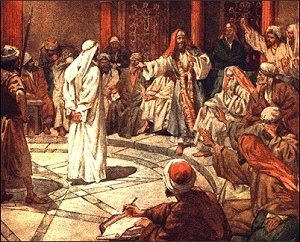
The Trial of Christ
18 chapters English Public domain
About this book
Could Jesus have gotten off on a technicality? Mr. Breed, a Missouri attorney, presents the brief for acquittal, and then withdraws his plea--on the basis that Jesus is fulfilling an ancient prophecy, and must die anyway, to save mankind.
He points out major discrepancies between Jewish and Roman legal procedures and the gospel accounts. For instance, the Sanhedrin, the Jewish supreme court, would never have met on the Sabbath, nor condemned a man to death on the same day as his trial. Roman law also gave defendants many rights we now take for granted, such as the right to a public trial, and to cross-examine witnesses, which were not followed either.
Why care about this, the ultimate moot point? In particular, the actions of the Sanhedrin in the Gospel narratives were used to inflame anti-Semitism for centuries. This toxic stereotype seeped into every aspect of the Jewish-Christian relationship. (see this book). While Mr. Breed does not address this issue directly, it is implicit in his thesis.
Some will say that Breed's conclusion is undermined by his evidence. However, this book demonstrates that a devout Christian can use Biblical criticism to reinforce their faith, and even renew it. Whether you believe that Jesus was completely historical, or a fable based on ancient memes of a dying god, this book will provide much food for thought.
Table of contents
18 chapters
01 Start Reading 02 Page Index 03 Foreword 04 Acknowledgement 05 Table of Contents 06 Chapter I. The Scope of our Study 07 Chapter II. Legal Background and Sources of the Record 08 Chapter III. The Record of the Trials 09 Chapter IV. Reversible Errors 10 Chapter V. Five Courts and Six Trials 11 Chapter VI. Argument As To Jewish Trials 12 Chapter VIII. Errors in the Roman Trials 13 Chapter VIII. A Lesson in Citizenship 14 Epilogue—Our Redeemer 15 Appendix A. Lawyers in the Sanhedrin 16 Appendix B. Bibliography 17 Index 18 Special Pages: Errata
Audiobook
Listen to this edition
Audiobooks are coming soon
Narrated editions will appear here when they are ready to listen.
Membership
Support the archive
$10 / month
Helps fund new texts & growth
Unlimited highlights & annotations
Unlimited bookmarks
Ad free reading experience
Early access to new features
Early access to quality TTS Audiobooks
Priority support & feature requests
4,000 Points monthly for Search usage
Access to point system rewards and value
Cancel anytime. Helps us pay the bills.
Discussion
Community conversation
Discussions are coming soon
Join conversations around this text and its interpretations.
The Trial of Christ
18 chapters English Public domain
About this book
Could Jesus have gotten off on a technicality? Mr. Breed, a Missouri attorney, presents the brief for acquittal, and then withdraws his plea--on the basis that Jesus is fulfilling an ancient prophecy, and must die anyway, to save mankind.
He points out major discrepancies between Jewish and Roman legal procedures and the gospel accounts. For instance, the Sanhedrin, the Jewish supreme court, would never have met on the Sabbath, nor condemned a man to death on the same day as his trial. Roman law also gave defendants many rights we now take for granted, such as the right to a public trial, and to cross-examine witnesses, which were not followed either.
Why care about this, the ultimate moot point? In particular, the actions of the Sanhedrin in the Gospel narratives were used to inflame anti-Semitism for centuries. This toxic stereotype seeped into every aspect of the Jewish-Christian relationship. (see this book). While Mr. Breed does not address this issue directly, it is implicit in his thesis.
Some will say that Breed's conclusion is undermined by his evidence. However, this book demonstrates that a devout Christian can use Biblical criticism to reinforce their faith, and even renew it. Whether you believe that Jesus was completely historical, or a fable based on ancient memes of a dying god, this book will provide much food for thought.
Table of contents
18 chapters
01 Start Reading 02 Page Index 03 Foreword 04 Acknowledgement 05 Table of Contents 06 Chapter I. The Scope of our Study 07 Chapter II. Legal Background and Sources of the Record 08 Chapter III. The Record of the Trials 09 Chapter IV. Reversible Errors 10 Chapter V. Five Courts and Six Trials 11 Chapter VI. Argument As To Jewish Trials 12 Chapter VIII. Errors in the Roman Trials 13 Chapter VIII. A Lesson in Citizenship 14 Epilogue—Our Redeemer 15 Appendix A. Lawyers in the Sanhedrin 16 Appendix B. Bibliography 17 Index 18 Special Pages: Errata
Audiobook
Listen to this edition
Audiobooks are coming soon
Narrated editions will appear here when they are ready to listen.
Membership
Support the archive
$10 / month
Helps fund new texts & growth
Unlimited highlights & annotations
Unlimited bookmarks
Ad free reading experience
Early access to new features
Early access to quality TTS Audiobooks
Priority support & feature requests
4,000 Points monthly for Search usage
Access to point system rewards and value
Cancel anytime. Helps us pay the bills.
Discussion
Community conversation
Discussions are coming soon
Join conversations around this text and its interpretations.

The archive, offline Own the Wisdom of the Ages Every text in the library on a single USB drive. Read offline, cite freely, keep forever. No subscription required.
Get the drive $127.00
The Trial of Christ
18 chapters English Public domain
About this book
Could Jesus have gotten off on a technicality? Mr. Breed, a Missouri attorney, presents the brief for acquittal, and then withdraws his plea--on the basis that Jesus is fulfilling an ancient prophecy, and must die anyway, to save mankind.
He points out major discrepancies between Jewish and Roman legal procedures and the gospel accounts. For instance, the Sanhedrin, the Jewish supreme court, would never have met on the Sabbath, nor condemned a man to death on the same day as his trial. Roman law also gave defendants many rights we now take for granted, such as the right to a public trial, and to cross-examine witnesses, which were not followed either.
Why care about this, the ultimate moot point? In particular, the actions of the Sanhedrin in the Gospel narratives were used to inflame anti-Semitism for centuries. This toxic stereotype seeped into every aspect of the Jewish-Christian relationship. (see this book). While Mr. Breed does not address this issue directly, it is implicit in his thesis.
Some will say that Breed's conclusion is undermined by his evidence. However, this book demonstrates that a devout Christian can use Biblical criticism to reinforce their faith, and even renew it. Whether you believe that Jesus was completely historical, or a fable based on ancient memes of a dying god, this book will provide much food for thought.
Table of contents
18 chapters
01 Start Reading 02 Page Index 03 Foreword 04 Acknowledgement 05 Table of Contents 06 Chapter I. The Scope of our Study 07 Chapter II. Legal Background and Sources of the Record 08 Chapter III. The Record of the Trials 09 Chapter IV. Reversible Errors 10 Chapter V. Five Courts and Six Trials 11 Chapter VI. Argument As To Jewish Trials 12 Chapter VIII. Errors in the Roman Trials 13 Chapter VIII. A Lesson in Citizenship 14 Epilogue—Our Redeemer 15 Appendix A. Lawyers in the Sanhedrin 16 Appendix B. Bibliography 17 Index 18 Special Pages: Errata
Audiobook
Listen to this edition
Audiobooks are coming soon
Narrated editions will appear here when they are ready to listen.
Membership
Support the archive
$10 / month
Helps fund new texts & growth
Unlimited highlights & annotations
Unlimited bookmarks
Ad free reading experience
Early access to new features
Early access to quality TTS Audiobooks
Priority support & feature requests
4,000 Points monthly for Search usage
Access to point system rewards and value
Cancel anytime. Helps us pay the bills.
Discussion
Community conversation
Discussions are coming soon
Join conversations around this text and its interpretations.