

Faith Mind
Inscription
Hsin-hsin Ming
By Third Ch'an Patriarch
Chien-chih Seng-ts'an
Contents
Title of the Text
Author of the Text
Problem of Authorship
Written Sources of the Text
The Hsin-hsin Ming
The Original Text
The Text with Japanese "Current
Characters" (Tõyõ Kanji)
Translation of the Text
Chinese and Japanese Transcriptions of
the Text
An Analysis of the Hsin-hsin Ming
Two Mainstream Translations of the Hsin-hsin
Ming
Another Verse Attributed to Chien-chih
Seng-ts'an
Bibliography
Title of the Text
信心銘
Hsin-hsin Ming (Wade-Giles)
Xinxin Ming (Pinyin) Xin4xin1 Ming2
Shinjinmei (or Shinjin no Mei) (Japanese)
Sinsim Myong (Korean)
Literally, Believing
Heart (Mind) Inscription or Faith-Heart (Mind) Inscription
Various Translations
of the Title
Different Western and
Eastern translators have rendered the title "Hsin-hsin Ming" in different
ways:
1. Trust
Mind Inscription (Hae Kwang)
2. Inscription on Trust in the Mind
(Burton Watson)
3. Inscribed On the Believing Mind
(Daisetsu Teitarõ Suzuki)
4. On Believing in Mind (Daisetsu
Teitarõ Suzuki)
5. Words Inscribed on the Believing
Mind (Heinrich Dumoulin)
6. Verses On the Faith Mind (Richard
B. Clarke)
7. On Faith in Mind (Dusan Pajin)
8. Faith in Mind (Sheng-yen)
9. Trusting
In Mind (Hae Kwang)
10. On Trust in the Heart
(Christmas Humphreys)
11. Trust in the Heart
(Thomas Cleary)
12. Poem on the Trust in
the Heart (Thomas Cleary)
13. Trusting In Mind
(Stanley Lombardo)
14. Song of Trusting the
Heart (translator unknown)
15. A Poetical Manuscript
on Belief in the Mind (Katsuki Sekida)
16. The Mind of Absolute
Trust (Stephen Mitchell)
17. The Mind of Absolute
Trust (Robert F. Olson)
18. The Perfect Way
(translator unknown)
Author of the Text
鑑智僧璨
Chien-chih Seng-ts'an (Wade-Giles)
Jianzhi Sengcan (Pinyin) Jian4zhi4 Seng1can4
Kanchi Sõsan (Japanese)
"Seng-ts'an" is the Buddhist
name of the author of the Hsin-hsin Ming, it means "Jewel of the [Buddhist]
Community." (Lit. "Sangha-jewel.")
"Chien-chih" is an honorary
title given to Seng-ts'an after his death, by Emperor Hsüan-tsung (Gensõ) of the T'ang dynasty. It means
"Mirrorlike Wisdom."
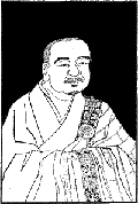
Chien-chih Seng-ts'an, the third Ch'an patriarch in China, is
also known as:
• Ch'an master Seng-ts'an (Seng-ts'an
Ch'an-shih;
Sõsan Zenji
僧璨禪師)
• The third
patriarch Ch'an
master Seng-ts'an
(San-tsu Seng-ts'an Ch'an-shih; Sanso Sõsan Zenji 三祖僧璨禪師)
• Great master Chien-chih (Chien-chih Ta-shih; Kanchi Daishi 鑑智大師)
• The third
patriarch great master Seng-ts'an (San-tsu Seng-ts'an Ta-shih; Sanso Sõsan
Daishi 三祖僧璨大師)
Seng-ts'an is Buddhist name of the
third patriarch, his real name is unknown. The following quotations contain
information about Chien-chih Seng-ts'an, about which very little is known:
 About Seng-ts'an
Sõsan Sêng-ts'an. The third patriarch in
the lineage of the Chinese Zen Sect. In 592 he initiated Tao-hsin (Dõshin) into the profound
doctrines of zen.
He died in 606. After his death, he was given the title of Chien-chih
ch'an-shih
(Kanchi-zenji)
by Emperor Hsüan-tsung (Gensõ) of the T'ang (Tõ) Dynasty. The Hsin-hsin-ming (Shinjimmei) was written by him.
(Japanese-English
Buddhist Dictionary
342)
About Seng-ts'an
We have little
information about the life of the Third Patriarch. His birthplace and birth
date are unknown. According to the Denko-roku ("The Transmission
of the Lamp"), written by Keizan Zenji (1268-1325), he was a layman over
forty years old suffering from leprosy when when he met the Second Patriarch,
Hui-k'o (Jap: Eka), for the first time in 551 c.e. Being deeply impressed with this layman's capacity for
the Dharma, Hui-k'o shaved the Third Patriarch's head and named him Seng-ts'an
(Jewel of the Community). He was gradually cured of his illness and, after they
had been practicing together for two years, Hui-k'o gave him the robe and bowl
signifying the transmission of the Dharma.
Anticipating the
persecution of Buddhists in China prophesied by Bodhidharma, Hui-k'o ordered
his successor to hide in the mountains and not to teach. The Third Patriarch
remained in seclusion at Ch'ung-kung shan and Ssu-k'ung shan for over
twenty-four years. He later met the monk Tao-hsin and transmitted the Dharma to
him. After that, the Third Patriarch moved to Lo-fu shan, located northeast of
Kung-tung (Canton), for three years. Then he returned
to Ch'ung-kung shan and died there in 606 c.e. It is said that he passed away standing
under a big tree with his palms together in gassho.
(The Eye
That Never Sleeps xv-xvi, Introduction of Hakuyu Taizan Maezumi Roshi)
A Brief History of Seng-ts'an
The author of this
Buddhist "hymn," Sengtsan (Sosan), the third (Chinese) Zen patriarch
from Dharma, the first Chinese and the twenty-eighth Indian Zen patriarch,
lived during the sixth century, dying in 606 A.D. His place of origin is
unknown. The conversion of Sengtsan at the hands of Huike (Eka), the Second
Patriarch, is recorded in the "Chuantenglu" ("Dentoroku"),
Part 3:
Sengtsan asked
Huike, saying, "I am diseased: I implore you to cleanse me of my
sin". Huike said, "Bring me your sin and I will cleanse you of
it". Sengtsan thought for awhile; then said, "I cannot get at
it". Huike replied, "Then I have cleansed you of it".
Sengtsan realized,
not simply in his mind, but in every bone of his body, that his sinfulness was
an illusion, one with that of the illusion of self. As soon as we are aware of
our irresponsibility, all the cause of misbehaviour disappears in so far as the
cause, (the illusion of the self) is removed. If we have no self, it cannot
commit sin. Yet, it must be added, "I can't see how you and I, who don't
exist, should get to speaking here, and smoke our pipes, for all the world like
reality". (Stevenson, "Fables")
He became the
disciple of the Second Patriarch and practiced austerities and led a life of
devotion and poverty, receiving the bowl and the robe, insignia of the
transmission through Bodhidharma, the First Patriarch (of China) of the Buddha
Mind. At this time, one of the periodic persecutions of Buddhism broke out.
Sutras and images were burned wholesale; monks and nuns were returned to the
lay life. Sengtsan wandered for fifteen years all over the country, avoiding
persecution. In 592, he met Taohsin (Doshin), who became the Fourth Patriarch.
(R. H. Blyth)
About Seng-ts'an
Seng-ts'an (Jap.
Sõsan), d. 606?; the third patriarch (soshigata) of Ch'an (Zen) in
China; the dharma successor (hossu) of Hui-k'o and the master of Tao-hsin. Hardly
any details are known of the life of the third patriarch. There are, however,
many legends about him and his meeting with Hui-k'o. According to one of these
legends Seng-ts'an was suffering from leprosy when he met the second patriarch.
Hui-k'o is supposed to have encountered him with the words, "You're
suffering from leprosy; what could you want from me?" Seng-ts'an is
supposed to have replied, "Even if my body is sick, the heart-mind (kokoro) of a sick person is no
different from your heart-mind." This convinced Hui-k'o of the spiritual
capacity of Seng-ts'an; he accepted him as a student and later confirmed him as
his dharma successor and the thirtieth patriarch (third Chinese patriarch) in
the lineage of Ch'an (Zen), which begins with Shakyamuni Buddha.
The incident that
marked the "transmission from heart-mind to heart-mind" (ishin-denshin) from Hui-k'o to
Seng-ts'an is given in the Denkõ-roku as follows:
The thirtieth
patriarch Kanchi Daishi [daishi, "great master"] went for
instruction) to the twenty-ninth patriarch and asked, "The body of the
student is possessed by mortal illness. I beg you, master, wipe away my
sins."
The patriarch [Hui-k'o]
said, "Bring me your sins here, and I'll wipe them away for you."
The master
[Seng-ts'an] sat in silence for a while, the said, "Although I've looked
for my sins, I can't find them."
The patriarch said,
"In that case I've already thoroughly wiped away your sins. You should
live in accordance with Buddha, dharma, and sangha" [sambõ].
It is said that
during the Buddhist persecution of the year 574, Seng-ts'an had to feign mental
illness in order to escape execution, and that finally he went into hiding for
ten years on Mount Huan-kung. His mere presence there is said to have pacified
the wild tigers, which until that time had caused great fear among the local
people. The authorship of Hsin-hsin-ming (Jap. Shinjinmei) is attributed to
Seng-ts'an. It is one of the earliest Ch'an writings. It expounds Ch'an basic
principles in poetic form and shows strong Taoist influence. The Hsin-hsin-ming begins with a famous
sentence, which comes up again and again in Ch'an (Zen) literature (for
instance, in example of the Pi-yen-lu): "The venerable way is not difficult at
all; it only abhors picking and choosing." In this early Ch'an poem, the
fusion, typical for later Ch'an (Zen), of the mutually congenial teachings of
Mahâyâna Buddhism and Taoism appears for the first time.
(The Encyclopedia of
Eastern Philosophy and Religion 311)
About Seng-ts'an
Next to Hui-k'ê
came Sêng-ts'an, who succeeded as the third patriarch. The interview
between master and disciple took place in this manner: A layman of forty
troubled with fêng-yang1 according to the Records, came to Hui-k'ê
and asked:
'I am suffering from
fêng-yang; pray cleanse me of my sins.'
'Bring
your sins here,' said Hui-k'ê,
'and I will cleanse you of them.'
The lay-disciple was
silent for a while but finally said, 'As I seek my sins, I find them
unattainable.'
'I have then
finished cleansing you altogether. You should thenceforth take refuge in the
Buddha, Dharma, and Samgha (Brotherhood), and abide therein.'
'As I stand before
you, O master,' asked Sêng-ts'an, 'I know that you belong to the
Brotherhood, but pray tell me what are the Buddha and the Dharma?'
Replied the master:
'Mind is the Buddha, Mind is the Dharma; and the Buddha and the Dharma are not
two. The same is to be said of the Brotherhood (samgha).'
This satisfied the
disciple, who now said, 'Today for the first time I realize that sins are
neither within nor without nor in the middle; just as Mind is, so is the
Buddha, so is the Dharma; they are not two.'2
He was then ordained
by Hui-k'ê as a Buddhist monk, and after this he fled from the world
altogether, and nothing much of his life is known. This was partly due to the
persecution of Buddhism carried on by the Emperor of the Chou dynasty. It was
in the twelfth year of K'ai-huan of the Sui dynasty (a.d. 592), that he found a disciple worthy to be his
sucessor. His name was Tao-hsin. He asked the master:
'Pray show me the
way to deliverance.'
'Who has ever put
you in bondage.'
'Nobody,'
'If so,' said the
master, 'why should you ask for deliverance?'
This put the young
novice on the way to final enlightenment, which he attained after many years'
study under the master. When Sêng-ts'an thought that the time was ripe to
consecrate him as his successor in the faith, he handed him, as the token of the
rightful transmission of the Law, the robe which had come down from
Bodhidharma, the first patriarch of Zen in China. He died in a.d. 606. While much of his life is
obscure, his thought is gleaned from a metrical composition known as Hsin-hsin-ming, or 'Inscribed on the
Believing Mind', which is one of the most valuable contributions by the masters
to the interpretation of Zen teaching.
(Essays in Zen
Buddhism – First Series 195-6)
1 Understood by some to
be leprosy. (Essays in Zen Buddhism – First Series 195 n.1)
2 In the Vimalakîrti, chapter iii, 'The
Disciples', we have the following: 'Do not worry about the sins you have
committed, O monks,' said Vimalakîrti. 'Why?' Because sins are in their
essence neither within nor without nor in the middle. As the Buddha taught us,
all things are defiled when Mind is defiled; all things are pure when Mind is
pure; and Mind is neither within nor without nor in the middle. As is Mind, so
are sins and defilements, so are all things – they never transcend the suchness
of truth.'
(Essays in Zen
Buddhism – First Series 195 n.2)
Seng-ts'an in the Transmission
of the Light
Translation of chapter 31 of the Transmission of the
Light1, by Japanese Zen Master Keizan Jõkin2 (1268-1325):
Sengcan said to the Zen
master Huike, "I am riddled with sickness; please absolve me of my
sin." Huike said, "Bring me your sin and I will absolve you."
After a long pause, Sengcan said, "When I look for my sin I cannot find
it." Huike said, "I have absolved you. You should live by the Buddha,
the Teaching, and the Community."
It is not known
where Sengcan came from. When he visited Zen master Huike, he was a layman over
forty years of age. He did not say his name, but came to the Zen master and
asked for relief from his illness, as told in the story.
When Huike told him
to live by the Buddha, the Teaching, and the Community, Sengcan said, "I
can see you are a monk, a member of the Buddhist community; what are the Buddha
and the Teaching?" Huike said, "This mind is Buddha, this mind is the
Teaching; the Teaching and the Buddha are not separate. This is also true of
the Community."
Sengcan said,
"Today for the first time I have realized that the essence of sin is not
inside, not outside, not in between. So it is also of mind. Buddha and the
Teaching are not separate either." Huike regarded him as having the
capacity for the teching, so he had him ordained as a monk and named him
Sengcan, which means "Light of the Religious Community." After this
his sickness gradually healed.
Sengcan attended Huike
for two years. Then Huike said to him, "The great teacher Bodhidharma came
here to China from India, and gave me both the robe and the teaching. Now I
entrust them to you." He also said, "Although you have attained the
teaching, for the time being you should go into the mountains and not teach
publicly. There will be trouble in this country."
Sengcan said,
"Since you know about this, please give me some instructions." Huike
said. "It is not that I know – this is the prediction given to
Bodhidharma by Prajnatara, who said, 'Inside the heart is auspicious, but
outside is bad luck.' According to my calculations, this prediction refers to
your generation. Think about these words and don't get caught up in worldly
problems."
After that Sengcan
lived in seclusion in the mountains for ten years. This was the time that the
Martial Emperor of the Wei dynasty persecuted the Buddhist religion. Because of
this Sengcan changed his appearance and stayed in the mountains, dwelling in no
fixed place.
While in this condition
Sengcan met the novice Daoxin, who was to become his successor. He said to
Daoxin, "After my teacher transmitted Zen to me, he went to the big city
and spent thirty years there. Now that I have found you, why should I stay
here?" Then we went to another mountain, but later returned to his old
abode. The local people flocked to him and offered support. He gave extensive
explanations of the essence of mind for the people, then at a religious meeting
he died under a tree. His Poem on the Trust in the Heart was recorded and
circulates even today. Later he was given the title Master of Mirrorlike
Knowledge.
The sickness
plaguing him in his first meeting with Huike was leprosy. But as he associated
with the Zen master, his sickness disappeared. There is nothing special about
this story: understanding that the nature of sin is ungraspable, he realized
that the nature of mind is originally pure. Thus he heard that the Buddha and
the Truth are not separate, that mind and reality are thus. When you really know the
original mind, there is no difference in dying in one place and being born in
another – how much less could there be any distinction of sin and virtue
there! Thus the body-mind after all does not exist; we are fundamentally free
from skin, flesh, bones, and marrow. Therefore his disease disappeared and his
original mind appeared.
In expounding the
essence of the teaching, Sengcan said, "The supreme Way is without
difficulty – it is only averse to discrimination." In conclusion he
said, "There is no way to talk about it – it is not of the past,
future, or present." Really there is no inside or outside, no in between
– what would you choose, what reject? You cannot take, you cannot leave.
Once you have no hate or love, you are empty and clear. At no time do you lack,
nothing is extra.
Yet even so,
investigate throughly to reach the point of ungraspability, to arrive at the
realm of ungraspability. Without becoming nihilistic, not being like wood or
stone, you should be able to "strike space and make an echo, tie lightning
to make a form." Carefully observe the realm where there are no tracks or
traces, yet don't hide there. If you can be like this, even though "that is not the present
phenomena, it is not within reach of ear or eye," you should see without hindrance,
you should comprehend without deviation.
Can we add a
discerning word to this story?
Essential
emptiness has no inside or outside –
Sin
and virtue leave no traces there.
Mind
and Buddha are fundamentally thus;
The
Teaching and Community are clear.
(Transmission of
Light
129-131 Sengcan)
Notes
1
Denkõroku
傳光錄
伝光録
2 Keizan Jõkin 瑩山紹瑾
Notes on the Chinese
Names and Terms Used in the Quotations
Chinese ideograms of
some of the Chinese terms used in the above quotations:
1. The second patriarch
Shen-kuang Hui-k'o (Shinkõ Eka, 487-593) (神光慧可).
2. Ching-te Record of
the Transmission of the Lamp (Ching-te Ch'uan-teng Lu, Keitoku
Dentõroku
景德傳燈錄
景徳伝灯録).
3. The meaning of feng-yang (風恙) is not clear. Some authors think that it is leprosy (lepra,
or Hansen's disease). The related
Chinese word feng means paralysis, leprosy, or insanity. (See Ilza Veith,
The Yellow Emperor's Classic of Internal Medicine p. 49
feng 瘋).
4. Tao-hsin (Dõshin
道信).
5. The title, Master of
"Mirrorlike Wisdom" is "Chien-chih" (鑑智).
The Dharma Transmission From Hui-k'o to Seng-ts'an
The incident that marked
the Dharma
transmission from Hui-k'o to Seng-ts'an is related in the chapter 31 of the Transmission of the
Light (Denkõroku), by
Japanese Zen Master Keizan Jõkin (1268-1325), as follows:
[The interview between Seng-ts'an and master Hui-k'o took place in the
following manner:]
弟子身纏風恙、請和尚懺罪。
I am riddled with
sickness; please absolve me of my sin.
將罪來、與汝懺。
Bring me your sin and I
will absolve you.
覓罪不可得。
When I look for my sin I
cannot find it.
與汝懺罪竟。宜依佛法僧住。
I have absolved you. You
should live by the Buddha, the Teaching, and the Community.
Seng-ts'an asked Hui-k'o:
今見和尚、已知是僧。未審何名佛、法。
I can see you are a
monk, a member of the Buddhist community; what are the Buddha and the Teaching?
是心是佛、是心是法、法佛無二、僧寶亦然。
This mind is Buddha,
this mind is the Teaching; the Teaching and the Buddha are not separate. This
is also true of the Community.
今日始知罪性不在内、不在外、不在中間、如其心然、佛法無二也。
Today for the first time
I have realized that the essence of sin is not inside, not outside, not in
between. So it is also of mind. Buddha and the Teaching are not separate
either.
師深器之、即爲剃髪、云、是吾寶也。宜名僧璨。
Hui-k'o saw that Seng-ts'an's understanding is
profound, he shaved his head and said: This is my treasure. I name him Seng-ts'an.
Seng-ts'an attended Hui-k'o for two years. Then Hui-k'o said to him,
菩提達磨遠自竺乾、以正法眼藏并信衣密付於吾、吾今授汝。汝當守護、無令斷絕。
Bodhidharma came here to
China from India, and gave me both the robe and the teaching. Now I entrust
them to you.
Hui-k'o gave him
Bodhidharma's robe and bowl signifying the transmission of the Dharma. He said:
汝受吾教、宜處深山、未可行化、當有國難。
Although you have
attained the teaching, for the time being you should go into the mountains and
not teach publicly. There will be trouble in this country.
Seng-ts'an said:
師既預知、願垂示誨。
Since you know about
this, please give me some instructions.
非吾知也。斯乃達磨傳般若多羅懸記云、「心中雖吉外頭凶」是也。吾校年代、正在于汝。
汝當諦思前言、勿罹世難。然吾亦有宿累、今要酬之。善去善行、俟時傳付。師付囑已、即往鄴都、隨宜説法。
It is not that I know
– this is the prediction given to Bodhidharma by Prajnatara1,
who said, "Inside the heart is auspicious, but outside is bad luck."
According to my calculations, this prediction refers to your generation. Think
about these words and don't get caught up in worldly problems.
1
The 27th Buddhist patriarch in India and Bodhidharma's master Prajnatara, his name means
"Pearl of Wisdom" (般若多羅).
The Dharma Transmission From Seng-ts'an to Tao-hsin
Tao-hsin asked Seng-ts'an:
願和尚慈悲、乞與解脱法門。
Pray show me the way to
deliverance.
誰縛汝。
Who has ever put you in
bondage?
無人縛。
Nobody has put me in
bondage.
更何求解脱。
If so, why should you
ask for deliverance?
With these words, Tao-hsin attained his final
enlightenment.
Problem of Authorship
Although the third
patriarch Seng-ts'an has historically been accepted as the author of the Hsin-hsin
Ming,
contemporary scholarship doubts whether he was in fact the author. There is no
record that Hui-k'o or Seng-ts'an ever wrote anything. The expressions and idioms
used in the work have caused certain scholars to place the date of its
composition in a later year.
Niu-t'ou Fa-jung1
(594-657), a disciple of Tao-hsin, composed a poem called
Mind Inscription2 (Hsin Ming) and the similarity
between the Hsin-hsin Ming and the Hsin Ming has caused scholars to
speculate that Hsin-hsin Ming was actually written after the time of the
sixth patriarch Hui-neng3 (638-713), as an
improved, condensed version of the Mind Inscription.
According to
Japanese scholars Nishitani Keiji and Yanagida Seizan, the Hsin-hsin Ming was composed in the
eighth century, two centuries after Seng-ts'an (see Nishitani Keiji and Yanagida Seizan, eds., Zenke Goroku4 vol.2; Tõkyõ: Chikuma Shobõ, 1974, pp.
105-112). Yanagida Seizan also suspects that the Hsin-hsin Ming is the work of the
fourth patriarch Tao-hsin (580-651). Chinese scholar Yin-shun shares this opinion in
his Chung-kuo Ch'an-tsung Shih5, pp. 52-60.
Some scholars also
believe that the author of the Hsin-hsin Ming was not Seng-ts'an but the fourth Ch'an
patriarch Tao-hsin.
As observed in most religious and spiritual traditions, putting down to writing
what one's master recited was a common practice. It is therefore also possible,
as some scholars suspect, that Seng-ts'an only recited the poem, and it was later
written by one of his disciples.
Notes
1
Niu-t'ou Fa-jung
(Gozu Hõyû 牛頭法融)
2
Hsin Ming
(Shinmei
心銘)
3
Hui-neng Ta-chien
(Enõ Daikan
慧能大鑑)
4
Zenke Goroku
(禅家語録)
5
Chung-kuo Ch'an-tsung Shih (中国禅宗史)
Written Sources of
the Text
There were no separately
published editions of the Hsin-hsin Ming. The classical source of the Hsin-hsin
Ming is
the chapter 30 of the Transmission of the Lamp. Full title of this
work is Ching-te Record of the Transmission of the Lamp1
and it is found in the Japanese canon of Buddhist sûtras titled Taishõ
Daizõkyõ2, vol. 48, No. 2010.
Two Tun-huang manuscripts3
containing the text of the Hsin-hsin Ming were discovered in 1926 (Pelliot 2104,
4638; Stein 4037, 5692). Presently, one of these manuscripts is in Paris and
the other in London. The manuscripts were collated by Kim Ku-Kyông4
in 1931 and later reprinted in the Taishõ Shinshû
Daizõkyõ5, 85.1283-1290. One of the
manuscripts is the Record of the Masters and Disciples of the Lankâ6
which contains historical information about the first Ch'an patriarchs (Pelliot
3436, Stein 2054). There are minor variations between the Taishõ
Daizõkyõ version and the versions in the Tun-huang manuscripts.
In one of the Tun-huang manuscripts, the Hsin-hsin
Ming is
conjoined with another famous Ch'an poem, the Song of Realizing the Way7
of Ch'an master
Yung-chieh Hsüan-chüeh8 (Yõka Genkaku, 655-713). This text
also contains twenty-four verses of the popular
edition of the book published and circulated under
the title Ch'an-men Mi-yao-chüeh9 (Zenmon Hiyõketsu) (Pelliot 2104, 4638;
Stein 4037, 5692). There is also a popular edition of
the poem, with variant characters and verses, titled Faith-Mind
Inscription of the Third Patriarch of Sui Dynasty10.
Notes
1 Ching-te Ch'uan-teng
Lu (Keitoku Dentõroku 景德傳燈錄
景徳伝灯録)
2
Taishõ Daizõkyõ (大正大藏經 大正大蔵経)
3
Tonkõhon
(敦煌本)
4
金九經
5
Taishõ Shinshû Daizõkyõ (大正新修大藏經 大正新修大蔵経)
6
Leng‑chia Shih-tzu Chi (Ryõga
Shijiki 楞伽師資記)
7
Cheng-tao-ko, Shõdõka (證道歌 証道歌)
8
永嘉玄覺
9
Ch'an-men Mi-yao Chüeh (Zenmon
Hiyõketsu
禪門秘要決)
10 Sui-chao San-tsu Hsin-hsin Ming (Zuichõ Sanso
Shinjinmei
隨朝三祖信心銘)

The Hsin-hsin Ming
The title of the Hsin-hsin
Ming
may be explained in the following way:
信
Hsin means
"belief" or "faith." This is not the faith in the ordinary
sense, it is a belief that comes from firsthand experience, a faith which arise
out of supreme knowledge and wisdom of enlightenment. This
"believing" is an affirmation that all existence or reality is
essentially the Buddha mind, which is our true nature. Hsin is the conviction that
at the bottom of all phenomena lies the One Mind, the Buddha mind, which is one
with our real nature, the Buddha-nature.
心
Hsin literally means
"heart." It means mind, not the deluded mind of the ignorant but the
Buddha-mind. Hsin
is the mind that merge with the all-encompassing One Mind.
銘
Ming literally means
"inscription." It means written expression
or record. Ming also means warnings or
admonitions.
Hsin-hsin Ming is one of the earliest
and most influential Zen writings. It is usually referred to as the first Zen
poem. It consists of 146 unrhymed four-character1 verses2
(lines), total 584 characters3. The Hsin-hsin Ming was composed in shih4
form. Shih
was the principal poetic form in use in the early period, it is first used in
the Book of Odes5 (Shih-ching, Shikyõ). Like the early shih, the Hsin-hsin Ming consists of lines that
are 4-characters in length, but contrary to most shih, no end rhyme is
employed in the poem.
As a characteristic
of shih,
one line usually constitutes a single syntactical unit. Since one character
represents one syllable, and since classical Chinese is basically monosyllabic,
this means that there are usually four words to a line. Lines tend to be
end-stopped, with few run-on lines, so that the efffect is of a series of brief
and compact utterances.
This concise form of
four characters a line is shorter than the general run of Chinese verse, which
usually has five or seven characters per line. Economy, even starkness of
expression is a characteristic of the Hsin-hsin Ming. It is more of a verse
than poetry and its brevity is one of the peculiar characteristics of this
famous work. Its contents is closer to the Buddhist sûtras than poems. In fact,
the Hsin-hsin Ming
can be regarded as a sûtra. Many verses are like a short Zen saying and
therefore can be taken as if they are a single-sentence Zen maxim. The original
text was not divided in stanzas. Some translators divided the poem in different
ways, with or without adding numbers to them.
The Hsin-hsin
Ming
has an important place In Ch'an Buddhist tradition. The poem has been very
influential in Zen circles and many important commentaries were written on it.
The opening stanza, "The best way is not difficult. It only excludes
picking and choosing," is quoted by many Zen masters as well as in the
classical Zen works such as the Blue Cliff Records6.
Along with the following influential poems, it is considered as a poem which
reveals the essence of Zen philosophy:
1. Song of Realizing the
Way
Cheng-tao-ko (Shõdõka, 證道歌)
(variant title 証道歌)
by Ch'an master Yung-chieh
Hsüan-chüeh
(Yõka Genkaku, 655-713 永嘉玄覺)
2. Harmony of Difference
and Sameness
Ts'an-t'ung-ch'i (Sandõkai 參同契)
by Ch'an master Shih-t'ou
Hsi-ch'ien (Sekitõ Kisen, 700-790 石頭希遷)
3. Song of Precious Mirror
Samadhi
Pao-ching
San-mei-ko (Hõkyõ
Zanmaika 寶鏡三昧歌)
by Ch'an master Tung-shan Liang-chieh (Tõsan
Ryõkai, 807-869 洞山良价)
4. Mind Inscription
Hsin Ming (Shinmei 心銘)
by Ch'an master Niu‑t'ou
Fa-jung
(Gozu Hõyû, 594-657 牛頭法融)
5. Mind King Inscription
Hsin-wang Ming (Shinnõmei 心王銘)
by Ch'an master Fu-hsi (Fukyû,
?-569 傅翕)
The title of the work
bears resemblance to three previously composed poems:
1. Mind King Inscription
Hsin-wang Ming (Shinnõmei 心王銘)
by Ch'an master Fu-hsi (Fukyû,
?-569 傅翕)
2. Inscription of Stopping
the Mind
Hsi-hsin Ming (Sokushinmei 息心銘)
by Chou dynasty (1050-256 b.c.) Ch'an master Wang-ming (Bõmei 亡名)
3. Enlightenment-Mind
Inscription
Wu-hsin
Ming (Goshinmei 悟心銘)
by Elder Yüan-yin (Yüan-yin Lao-jen; Gen'on
Rõnin 元音老人)
Another important Ch'an
poem Mind Inscription (Hsin Ming; Shinmei 心銘),
bears a similar title and it is influenced by the Hsin-hsin Ming. This poem attributed to Ch'an master Niu‑t'ou Fa-jung7
(Gozu Hõyû) has many points in
common with the Hsin-hsin Ming, their contents as
well as styles are similar.
A unique aspect of
the Hsin-hsin Ming
is the particular Taoist concepts it contains, the poem, therefore, blends
together Buddhist and Taoist teachings. Words of Taoist origin such as non‑action
(wu‑wei8), no‑mind (wu‑hsin9),
one‑mind (i-hsin10), spontaneity (tzu‑jan11),
vacuity (hsü12), and deep meaning (hsüan-chih13)
clearly shows the profound influence that Taoism had on Zen.
Notes
1 Four-character (four-word) (ssu-yen 四言)
2 Verse (kou 句)
3 Character (tzu 字)
4 Shih (詩)
5 Shih-ching (Shikyõ 詩經 詩経)
6 Case 57, Pi-yen Lu (Hekiganroku 碧巖錄 碧巌録)
7 Niu‑t'ou Fa-jung (Gozu Hõyû, 594-657 牛頭法融)
8 無爲
9 無心
10
一心
11
自然
12
虚
13
玄旨
The following quotations
contain further information on the Hsin-hsin Ming:
Hakuyu
Taizan Maezumi Rõshi
The famous Hsin hsin ming (Jap: Shin jin mei) is known as the first
Zen poem. It consists of 146 four-word lines,
directly and vividly expressing the Zen spirit in a simple, compact form. An
outstanding characteristic of the poem is that it is written in genuine Chinese
without using any Sanskrit or Pali Buddhist terms.
The
main themes expressed in the Hsin hsin ming derive from
Two Entries and Four Acts, one of the few authentic writings
of the great Zen Patriarch Bodhidharma, who brought Buddhism from India to
China in the sixth century. The roots of Bodhidharma's work can be traced to
the Vimalakirtinirdesa Sutra, written sometime before the third
century c.e. in India. Even though
authorship of the Hsin
hsin ming
is traditionally attributed to the Third Patriarch, Chien-chih Seng-ts'an (Jap:
Kanchi Sosan),
the idioms employed in the poem have caused some scholars to place the date of
its composition in a later year.
[. . .]
The title Hsin
hsin ming
is translated as Verses on the Faith Mind. The title of a poem is sometimes
likened to the forehead, which expresses a person's unique characteristics. In Hsin
hsin ming,
hsin
is generally understood as "faith." However, the word is also used in
a different sense in the context of the verses, as,
for example, at the very end:
Hsin
hsin pu erh 信心不二
Faith
mind are not two
Pu
erh hsin hsin 不二信心
Nondual
faith mind
The translator renders
these lines as:
To
live in this faith is the road to nonduality
because
the nondual is one with the trusting mind.
In this
context, faith does not have the usual meaning of "having faith in
something," but rather that faith is the very fact of
existence or reality itself. Dogen Zenji says, "Without attaining
Buddhahood, the faith won't manifest. Where the faith manifests, Buddhas and Patriarchs manifest" (Shobogenzo). The Nirvana Sutra
says, "Great faith is no other than Buddha nature." Kozan Garyu says
that "one thousand seven hundred koans are all together the expression of
this mind."
The
word ming means "written expression" and also "warnings or
admonitions," hence the title means "the verbal expression of the
fact that the very nature of existence and of all the phenomenal world are no
other than the faith mind." The Hsin hsin ming declares:
Although
all dualities come from the one
Do
not be attached even to this One.
That is to say,
at the bottom of the two there is one and at the bottom of one there is zero.
And that zero is "just this," the unborn one Mind, which is the faith
mind.
From
the time of its composition up to the present day, the Hsin hsin ming has been published and
translated repeatedly by various scholars and appreciated by different Chinese
and Japanese masters, who have written numerous commentaries on it. The
masters' frequent references to the poem have authenticated it as a genuine
expression of the spirit of Zen.
In the Sung dynasty,
the verse Hsin hsin ming nien-ku of Chen-hsieh Ch'ing-liao (Jap: Shinketsu
Seiryo, 1088-1151) was the first major commentary. Two centuries later, in the
Yuan dynasty, Chung-feng Ming-pen (Jap: Chuho Myohun, 1263-1323) commented on
the Hsin hsin ming.
In 1667, during the Ming dynasty, Wei-lin (Jap: I Rin) wrote Hsin hsin ming
chu-yu
(Jap: Jakugo).
The founder of the
Japanese Soto School, Dogen Zenji (1200-1253), quoted a number of passages from
the Hsin hsin ming
in his Eihei-koroku, written in Chinese. In 1303, Keizan Zenji, the cofounder
of the Japanese Soto School, wrote the most famous Japanese commentaries on the
verse, known as the Hsin hsin ming nentei ("Teisho on the Hsin hsin
ming).
In 1781, during the Edo period, Kozan Garyu wrote a commentary, the Hsin
hsin ming yatosui,
which also contains Chen-hsieh Ch'ing-liao's verse and Keizan's Nentei. Rinzai master Isshi
Benshu (1608-1646) also wrote a major commentary in Japanese entitled the Hsin
hsin ming benchu.
In modern times,
several Japanese commentaries have been written. Among the most famous are the
commentaries by Kodo Sawaki Roshi on Keizan Zenji's Hsin hsin ming nentei and by Kodo Akino Roshi
on Kozan Garyu's Hsin hsin ming yatosui. In addition, Ian Kishizawa Roshi has
written the Hsin hsin ming kattoshu. D.T. Suzuki also gave concise, pithy comments
on the Hsin hsin ming. The most recent commentary was written by Koun Yamada
Roshi. (The Eye That Never Sleeps xv-xviii)
Thomas Cleary
"Huike's
successor Sengcan, is traditionally credited with authorship of 'The Trusting
Heart,' one of the earliest and most enduringly popular works on Zen.
Quotations from this favorite work appear throughout later Zen literature.
Generally speaking, it is a guide to Zen meditation, but the unifying theme is
mental balance. Many of the Zen instructions translated in the present volume
are very much in the spirit of this early Zen classic." (Zen Essence 93)
Heinrich Dumoulin
"a poem attributed
to the Third Patriarch, Seng-ts'an (d. 606), 'Words Inscribed on the Believing
Mind.' Part of the poem reads: 'When the one mind does not arise, the myriad
things (dharma)
are no obstacle./When there is no obstacle, no thing appears./And when no thing
appears, there is no mind.' As D.T. Suzuki makes clear in his English
paraphrase, these verses should not be understood in a nihilistic sense. The
key idea of the poem is the unity of nondualistic reality. For the enlightened
mind, all duality is overcome."
(Zen Buddhism: A History, Japan 280)
Christmas Humphreys
"Here, then, to
conclude, is an extract from the glorius poem of the third Chinese Patriarch
Seng-ts'an which he called 'On Trust in the Heart'. It may be asked why, as it
seems the most simple, it is put at the end of so much harder reading. The
answer is that although it is simple it is at the same time enormously
profound, and until it is realized that these are not moral maxims for the
class-room, but fragments from a vast and deep experience, the quintessence of
all the teaching that has gone before, they will not be appreciated at their
true value." (Zen – A Way of Life 127)
Author Unknown
Suzuki sensei's fine
translation of Seng-ts'an's 'Hsin-hsin-ming' ('On Believing in Mind,' pages
76-82), the very first verse treatise on Zen – which in the original
Chinese takes up just two thirds of a page in the more than 100,000 pages of
'Taisho' – a text which embodies the quintessence of Zen and that
deserves to be far better known.
(From a book review of Manual
of Zen Buddhism
by D.T. Suzuki)
The Original Text
The original text of the
Hsin-hsin Ming
with obsolete Chinese ideograms.
言但若極無十要非一契兩泯一眼夢迷法六不任執大一境無二二前歸多一止莫圓違毫至 三
語能不大在方急思切心既其如若幻生無塵好性之道空由咎由見空根言種動逐同順釐道 祖
道如如同不智相量不平不所體不虚寂異不勞合失體同能無一不轉得多不歸有太相有無 僧
斷是此小在者應處留等成以玄睡華亂法惡神道度寛兩境法有住變旨慮通止縁虚爭差難 璨
非何必不十皆唯識無所一不兀諸何悟妄還何逍必無齊能不一慎皆隨轉兩止勿無是天唯 大
去慮不見方入言情可作何可爾夢勞無自同用遙入易含由生亦莫由照不處更住欠爲地嫌 師
來不須邊目此不難記倶有方忘自把好愛正疏絶邪無萬境不莫追妄失相失彌空無心懸揀 信
今畢守表前宗二測憶息爾比縁除捉惡著覺親惱路難象能心守尋見宗應功動忍餘病隔擇 心
信一有極宗不眞虚狐究止萬心得一將智欲繫放小不欲能一纔不須絶遣唯一良不欲但 銘
心即即小非二如明疑竟動法若失切心者取念之見見知隨心有用臾言有滯種由識得莫
不一是同促皆法自盡窮無齊不是二用無一乖自狐精兩境不是求返絶沒兩平取玄現憎
二切無大延同界照淨極動觀異非邊心爲乘眞然疑麤段滅生非眞照慮有邊懷捨旨前愛
不一無忘一無無不正不動歸萬一良豈愚勿昏體轉寧元境萬紛唯勝無從寧泯所徒莫洞
二切即絶念不他勞信存止復法時由非人惡沉無急有是逐法然須卻處空知然以勞存然
信即是境萬包無心調軌無自一放斟大自六不去轉偏一能無失息前不背一自不念順明
心一有界年容自力直則止然如卻酌錯縛塵好住遲黨空沉咎心見空通空種盡如靜逆白
The Text with
Japanese "Current Characters" (Tõyõ Kanji)
In the following text,
the obsolete characters in the original text are replaced with newer,
simplified characters used in contemporary Japanese. These newer characters are
indicated with gray font color.
言但若極無十要非一契両泯一眼夢迷法六不任執大一境無二二前帰多一止莫円違毫至 三
語能不大在方急思切心既其如若幻生無塵好性之道空由咎由見空根言種動逐同順釐道 祖
道如如同不智相量不平不所体不虚寂異不労合失体同能無一不転得多不帰有太相有無 僧
断是此小在者応処留等成以玄睡華乱法悪神道度寛両境法有住変旨慮通止縁虚争差難 璨
非何必不十皆唯識無所一不兀諸何悟妄還何逍必無斉能不一慎皆随転両止勿無是天唯 大
去慮不見方入言情可作何可爾夢労無自同用遥入易含由生亦莫由照不処更住欠為地嫌 師
來不須辺目此不難記倶有方忘自把好愛正疏絶邪無万境不莫追妄失相失弥空無心懸揀 信
今畢守表前宗二測憶息爾比縁除捉悪著覚親悩路難象能心守尋見宗応功動忍余病隔択 心
信一有極宗不真虚狐究止万心得一将智欲繋放小不欲能一纔不須絶遣唯一良不欲但 銘
心即即小非二如明疑竟動法若失切心者取念之見見知随心有用臾言有滞種由識得莫
不一是同促皆法自尽窮無斉不是二用無一乖自狐精両境不是求返絶没両平取玄現憎
二切無大延同界照浄極動観異非辺心為乘真然疑麁段滅生非真照慮有辺懐捨旨前愛
不一無忘一無無不正不動帰万一良豈愚勿昏体転寧元境萬紛唯勝無従寧泯所徒莫洞
二切即絶念不他労信存止復法時由非人悪沈無急有是逐法然須却処空知然以労存然
信即是境万包無心調軌無自一放斟大自六不去転偏一能無失息前不背一自不念順明
心一有界年容自力直則止然如却酌錯縛塵好住遅党空沈咎心見空通空種尽如静逆白
Translation of the
Text
Translated by Prof.
Dusan Pajin of Belgrade University, Yugoslavia
F 1 唯嫌揀擇 it only excludes picking and choosing. 洞然明白 it will enlighten itself. 天地懸隔 and heaven and earth are set apart. 莫存順逆 do not be for or against. 是爲心病 makes the mind sick. 徒勞念靜 it is useless to quiet thoughts. 無欠無餘 with nothing lacking, nothing in excess. 所以不如 there is no suchness. 1 勿住空忍 do not dwell in emptiness. 泯然自盡 everything will stop by itself. 止更彌動 and rest will move you again. 寧知一種 how will you know oneness? 二處失功 you will miss in two ways. 從空背空 following emptiness you are always behind it. 轉不相應 the more you will go astray. 無處不通
信心銘
Faith-Mind
Inscription
1
至道無難
The best way is
not difficult
但莫憎愛
Once you stop
loving and hating
毫釐有差
Depart for a
hairbreadth
欲得現前
If you want it
to appear
違順相爭
To set longing
against loathing
不識玄旨
Not knowing the
deep meaning (of the way)
圓同太虚
Complete it is
like great vacuity
良由取捨
When you grasp
and reject
2
莫逐有縁
Do not follow
conditions,
一種平懷
Cherishing
oneness in the hearth,
止動歸止
Rest to stop
motion,
唯滯兩邊
If you are
merely in either,
一種不通
Not
understanding oneness
遣有沒有
Expelling being
you will be without it,
多言多慮
The more words
and thoughts
絶言絶慮
and there is nothing you cannot understand. 隨照失宗 following the outcome you lose the source. 勝卻前空 and surpass the emptiness of things. 皆由妄見 all have their cause in ignorance. 1 唯須息見 only abstain from views. 慎勿追尋 be careful not to pursue them. 紛然失心 and mind is lost in confusion. 一亦莫守 however, do not even maintain the one. 萬法無咎 then everything is without blame. 不生不心 no arising, no mind. 境逐能沈 the object is expelled when the subject sinks. 能由境能 the subject is related to the object. 元是一空 their origin is one emptiness. 齊含萬象 evenly containing innumerable forms. 1 寧有偏黨 and you will not be for or against. 無易無難 neither easy nor difficult. 轉急轉遲 now in haste, then too late. 必入邪路
Stop speaking,
stop thinking
歸根得旨
Return to the
root and obtain the purport;
須臾返照
For a moment
turn inward,
前空轉變
Changes that go
on in emptiness
3
不用求眞
Do not seek the
true,
二見不住
Do not dwell in dual views,
纔有是非
The slightest
trace of right and wrong
二由一有
One being is
the source of the two,
一心不正
With one mind
there is no arising,
無咎無法
No blame, no
things;
能隨境滅
The subject
follows when the object ceases
境由能境
The object is
related to the subject
欲知兩段
If you want to
know these two
一空兩同
In one
emptiness both are equal
4
 不見精
不見精
Do not
differentiate coarse and fine
大道體寛
The great way
is all‑embracing
小見狐疑
Small
views are irresolute, full of doubt,
執之失度
and you will go astray. 體無去住 essence neither goes nor abides. 逍遙絶惱 and go free of troubles. 昏沈不好 it darkens, sinks and spoils. 何用疏親 of what use are strange and familiar? 1 勿惡六塵 do not dislike the six sense‑objects. 還同正覺 turns out equal to perfect awakenness. 愚人自縛 the fool ties himself. 妄自愛著 ignorance leads to preference. 豈非大錯 is it not a great mistake? 悟無好惡 awakening negates liking and disliking. 妄自斟酌 lead to absurd consideration. 何勞把捉 why strive to grasp them? 一時放卻 away with this once for all. 諸夢自除 all dreams stop by themselves. 1 萬法一如 all things are of one suchness. 兀爾忘縁 resolutely neglect conditions.
Grasp beyond
measure
放之自然
Letting go
leads to spontaneity,
任性合道
Accord your
nature with the way

念乖眞
Fettered
thinking strays from the real,
不好勞神
To weary the
spirit is not good;
5
欲取一乘
In following
the One vehicle
六塵不惡
Not disliking
the six sense‑objects
智者無爲
The wise
performs through non‑action,
法無異法
Things are not
different,
將心用心
To use the mind
to hold the mind,
迷生寂亂
Out of
confusion arise rest and disturbance;
一切二邊
All opposite
sides
夢幻虚華
Dreams,
illusions, flowers in the air,
得失是非
Profit and
loss, right and wrong;
眼若不睡
If the eyes are
not closed
6
心若不異
If the mind does
not discriminate
一如體玄
In the deep
essence of one suchness
歸復自然 you return again to spontaneity. 不可方比 and nothing can be compared. 動止無止 set rest in motion and there is no resting. 一何有爾 how will one be for you? 不存軌則 and there is no principle or rule retained. 所作倶息 which stops every action. 1 正信調直 true faith is firm and harmonized. 無可記憶 nothing to remember. 不勞心力 power of the mind is not exerted. 識情難測 sense or feeling cannot fathom this. 無他無自 there is neither other nor self. 唯言不二 only express non‑duality. 無不包容 nothing is left out. 皆入此宗 all belong to this teaching. 一念萬年 beyond a moment, or an eon. 十方目前 everywhere in front of the eyes. 忘絶境界 when
boundaries are forgotten.
萬法齊觀
When all things
are beheld as even
泯其所以
Put an end to
the cause
止動無動
Cease movement
and no movement arises;
兩既不成
When both do
not make a whole
究竟窮極
Investigate to
the end
契心平等
Accord the mind
with Impartiality
7
狐疑盡淨
All doubts are
cleared,
一切不留
Nothing is
detained,
虚明自照
Vacuous, enlightened, self‑illumined;
非思量處
Thought is
useless here,
眞如法界
In the real
suchness of the thing‑realm
要急相應
Swiftly to
accord with that
不二皆同
In non-duality
all is equal,
十方智者
The wise from
all directions
宗非促延
This teaching
is not urgent, or extensive,
無在不在
Not here, not
there,
8
極小同大
Very small and
large are equal,
不見邊表 the limits cannot be seen. 無即是有 with non‑being there is being. 必不相守 do not hold on to it. 一切即一 all is one. 何慮不畢 worry not for finality. 不二信心 Non‑duality is faith in mind. 非去來今 with no past, present, future.
極大同小
Very large and small
are equal,
有即是無
With being
there is nonbeing,
若不如此
If not so
–
一即一切
One is all,
但能如是
Merely with
such ability
信心不二
Faith in mind
is non‑dual.
言語道斷
Discourse here
stops –
Chinese and Japanese
Transcriptions of the Text
For those who want to
read the Hsin-hsin Ming in Chinese or Japanese, Chinese and Japanese transcriptions
of the text are given here.
Throughout this
article, the Tun-huang manuscript version of the text is used. As with most
Chinese texts, there are minor differences between various versions of the Hsin-hsin
Ming.
Variant lines and characters in the Taishõ Daizõkyõ (vol.
48, No. 2010) version are indicated in this section.
1 First lines are Chinese
readings (Wade-Giles transcription system).
2 Second lines are
Chinese readings (Pinyin transcription system).
3 Third lines are
Japanese readings (kanbun yomi kudashi) according to Hepburn transcription
system (Hebonshiki).
4 Fourth lines are the
translations of Dusan Pajin.
Variant lines and
characters are indicated on the right side.
When pronunciations or
English translations of the variant characters are the same as the original
characters, no variant pronunciations or translations are given.
1 至道無難 唯嫌揀擇
Chih-tao
wu-nan. Wei hsien chien-tse.
Zhi4dao2 wu2nan2. Wei2 xian2 jian3ze2.
Shidõ
bunan. Tada kenjaku o kirau. (Shidõ bunan. Yui ken kenjaku.)
The
best way is not difficult. It only excludes picking and choosing.
3 但莫憎愛 洞然明白
Tan
mo tseng-ai, tung-jan ming-pai.
Dan4 mo4 zeng1ai4, dong4ran2 ming2bai2.
Tada
zõai nakunba, tõnen to shite meihaku nari.
Once
you stop loving and hating, it will enlighten itself.
5 毫釐有差 天地懸隔
Hao
li yu ch'a, t'ien-ti hsüan ke.
Hao2 li2 you3 cha1, tian1di4 xuan2 ge2.
Gõri
mo sha areba, tenchi haruka ni hedataru.
Depart
for a hairbreadth, and heaven and earth are set apart.
7 欲得現前 莫存順逆
Yü
te hsien-ch'ien, mo ts'un shun-ni.
Yu4 de2 xian4qian2, mo4 cun2 shun4ni4.
Genzen
o en to hosseba, jungyaku o zon suru nakare.
If
you want it to appear, do not be for or against.
9 違順相爭 是爲心病
Wei-shun
hsiang-cheng, shih wei hsin ping.
Wei2shun4 xiang1zheng1, shi4 wei2 xin1 bing4.
Ijun
ai arasou, kore o shinbyõ to nasu.
To
set longing against loathing, makes the mind sick.
11 不識玄旨 徒勞念靜
Pu-shi
hsüan-chi, tu lao nien-ching.
Bu4shi4 xuan2zhi3, tu2 lao2 nian4jing4.
Genshi
o shirazareba, itazura ni nenjõ ni rõ su.
Not
knowing the deep meaning (of the way), it is useless to quiet thoughts.
13 圓同太虚 無欠無餘
Yüan-t'ung
tai-hsü, wu-chien, wu-yü.
Yuan2tong2 tai4xu1, wu2qian4, wu2yu2.
Madoka
naru koto taikyo ni onaji, kakuru koto naku, amaru koto nashi.
Complete
it is like great vacuity, with nothing lacking, nothing in excess.
15 良由取捨 所以不如
Liang
yu ch'u-she, so-i pu-ju.
Liang2 you2 qu3she3, suo3yi3 bu4ru2.
Makoto
ni shusha ni yoru, yue ni funyo nari.
When
you grasp and reject, there is no suchness.
17 莫逐有縁 勿住空忍
Mo
chu yu yüen, wu chu kung jen.
Mo4 zhu2 you3 yuan2, wu4 zhu4 kong1 ren3.
Uen
o ou koto nakare, kûnin ni jû suru koto nakare.
Do not follow
conditions, do not dwell in emptiness.
19 一種平懷 泯然自盡
I-cheng
p'ing huai, ming-jan tzu chin.
Yi1zhong3 ping2 huai2, min3ran2 zi4 jin4.
Isshu
heikai nareba, minnen to shite onozu kara tsuku.
Cherishing
oneness in the hearth, everything will stop by itself.
21 止動歸止 止更彌動
□□□□ 二□□□ erh er4 nisho
Chih
tung kui chih, chih keng mi tung.
Zhi3 dong4 gui1 zhi3, zhi3 geng4 mi2 dong4.
Dõ
o yamete ki ni shi sureba, shi sara ni iyoiyo dõzu.
Rest
to stop motion, and rest will move you again.
23 唯滯兩邊 寧知一種
Wei
chih liang-pien, ning chih i-chung?
Wei2 zhi4 liang3bian1, ning2 zhi1 yi1zhong3?
Tada
ryõhen ni todokooraba, nanzo isshu o shiran ya?
If
you are merely in either, how will you know oneness?
25 一種不通 兩處失功
I-chung
pu-t'ung, liang-ch'u shih kung.
Yi1zhong3 bu4tong1, liang3chu3 shi1 gong1.
Isshu
tsûzezareba, ryõsho ni kõ o shissu.
Not
understanding oneness, you will miss in two ways.
27 遣有沒有 從空背空
Ch'ien
yu mei yu, ts'ung kung pei kung.
Qian3 you3 mei2 you3, cong2 kong1 bei4 kong1.
U
o yareba u o bosshi, kû ni shitagaeba kû ni somuku.
Expelling
being you will be without it, following emptiness you are always behind it.
29 多言多慮 轉不相應
To
yen, to lu chuan pu hsiang-ying.
Duo1 yan2, duo1 lu4 zhuan3 bu4
xiang1ying4.
Tagon,
taryo utata sõõ sezu.
The
more words and thoughts the more you will go astray
31 絶言絶慮 無處不通
Chüeh
yen, chüeh lu wu-ch'u pu-t'ung.
Jue2 yan2, jue2 lu4 wu2chu3 bu4tong1.
Zetsugon,
zetsuryo tokoro to shite tsûzezu to iu koto nashi.
Stop
speaking, stop thinking and there is nothing you cannot understand.
33 歸根得旨 隨照失宗
Kui
ken te chih. Sui chao shih tsung.
Gui1 gen1 de2 zhi3. Sui2 zhao4 shi1 zong1.
Kon
ni ki sureba shi o e. Shõ ni shitagaeba shû o shissu.
Return
to the root and obtain the purport. Following the outcome you lose the source.
35 須臾返照 勝卻前空
Hsü-yü
fan-chao, sheng-ch'üeh ch'ien-kung.
Xu1yu2 fan3zhao4, sheng4que4 qian2kong1.
Shuyu
mo hanshõ sureba, zenkû ni shõkyaku su.
For
a moment turn inward, and surpass the emptiness of things.
37 前空轉變 皆由妄見
Ch'ien-kung
chuan-pien chieh yu wang-chien.
Qian2kong1 zhuan3bian4 jie1 you2 wang4jian4.
Zenkû
no tenpen wa mina mõken ni yoru.
Changes
that go on in emptiness all have their cause in ignorance.
39 不用求眞 唯須息見
Pu-yung
ch'iu chen, wei hsü hsi-chien.
Bu4yong4 qiu2 zhen1, wei2 xu1 xi2jian4.
Shin
o motomuru koto o mochiizare,
tada subekaraku ken o yamu beshi.
□□□□ □勿□□ wu wu4
Do
not seek the true, only abstain from views.
41 二見不住 慎莫追尋
Erh-chien
pu-chu, chen mo chui-hsün.
Er4jian4 bu4zhu4, shen4 mo4 zhui1xun2.
Niken
ni jûsezu, tsutsushinde tsuijin suru koto nakare.
Do
not dwell in dual views, be careful not to pursue them.
43 纔有是非 紛然失心
Ts'ai
yu shih-fei fen-jan shih hsin.
Cai2 you3 shi4fei1 fen1ran2 shi1 xin1.
Wazuka
ni zehi areba funnen to shite shin o shissu.
The
slightest trace of right and wrong and mind is lost in confusion.
45 二由一有 一亦莫守
Erh
yu i yu, i i mo shou.
Er4 you2 yi1 you3, yi1 yi4 mo4 shou3.
Ni
wa itsu ni yotte ari, itsu mo mata mamoru koto nakare.
One
being is the source of the two, however, do not even maintain the one.
47 一心不生 萬法無咎
I-hsin
pu-sheng, wang-fa wu-chiu.
□□□正 □□□□ cheng zheng1
Yi1xin1 bu4sheng1, wan4fa3 wu2jiu4.
Isshin
shõzezareba, manpõ toga nashi.
With
one mind there is no arising, then everything is without blame.
49 無咎無法 不生不心
Wu-chiu,
wu-fa. Pu-sheng, pu-hsin.
Wu2jiu4, wu2fa3. Bu4sheng1, bu4xin1.
Toga
nakereba hõ nashi. Shõzezareba shin narazu.
No
blame, no things. No arising, no mind.
51 能隨境滅 境逐能沈
Neng
sui ching mieh. Ching chu neng shen.
Neng2 sui2 jing4 mie4. Jing4 zhu2 neng2 shen3.
Nõ
wa kyõ ni shitagatte messhi. Kyõ wa nõ o õte
shizumu.
The
subject follows when the object ceases. The object is expelled when the subject
sinks.
53 境由能境 能由境能
Ching
yu neng ching. Neng yu ching neng.
Jing4 you2 neng2 jing4. Neng2 you2 jing4 neng2.
Kyõ
wa nõ ni yotte kyõtari. Nõ wa kyõ no yotte
nõtari.
The
object is related to the subject. The subject is related to the object.
55 欲知兩段 元是一空
□□兩同 □□□像 liang
t'ung liang3 tong2 ryõdõ
Yü
chih liang-tuan, yüen shih i-kung.
Yu4 zhi1 liang3duan4, yuan2 shi4 yi1kong1.
Ryõdan
o shiran to hosseba, moto kore ikkû.
If
you want to know these two, their origin is one emptiness.
57 一空同兩 齊含萬象
I-kung
liang t'ung, ch'i han wan-hsiang.
Yi1kong1 liang3 tong2, qi2 han2 wan4xiang4.
Ikkû
ryõ ni onaji, hitoshiku banzõ o fukumu.
In
one emptiness both are equal, evenly containing innumerable forms.
59 不見精麁 寧有偏黨
Pu-chien
ching-ts'u, ning yu p'ien-tang.
Bu4jian4 jing1cu1, ning2 you3 pian1dang3.
Seiso
o mizareba, izukunzo hentõ aran ya.
Do
not differentiate coarse and fine, and you will not be for or against.
□□□粗 □□□□
61 大道體寛 無易無難
Ta-tao
t'i-k'uan, wu-i, wu-nan.
□□□□ □難□易 wu-nan,
wu-i wu2nan2, wu2yi4 nan naku
i nashi neither difficult nor easy
Da4 dao4 ti3kuan1, wu2yi4, wu2nan2.
□□□□ 心□□□ hsin xin1 shin jaro ni iru and the mind will go astray
Daidõ
taikan nari, i naku nan nashi.
The
great way is all‑embracing, neither easy nor difficult.
63 小見狐疑 轉急轉遲
Hsiao-chien
hu-i, chuan chi, chuan ch'ih.
Xiao3jian4 hu2yi2, zhuan3 ji2,
zhuan3 chi2.
Shõken
wa kogi su, utata kyû nareba, utata ososhi.
Small
views are irresolute, full of doubt, now in haste, then too late.
65 執之失度 必入邪路
Chih
chih shih tu, pi ru hsie-lu.
Zhi2 zhi1 shi1 du4, bi4 ru4 xie2lu4.
Kore
o shû sureba do o shisshi, kanarazu jaro ni iru.
Grasp
beyond measure, and you will go astray.
67 放之自然 體無去住
Fang
chih tzu-jan, t'i wu-ch'ü-chu.
□□□□ 沈昏□□ shen-hun shen3hun1 chinkon sinks, darkens and spoils
Fang4 zhi1 zi4ran2, ti3 wu2qu4zhu4.
Kore
o hanateba jinen nari, tai kyojû nashi.
Letting
go leads to spontaneity, essence neither goes nor abides.
69 任性合道 逍遙絶惱
Jen
hsing ho tao, hsiao-yao chüeh nao.
Ren4 xing4 he2 dao4, xiao1yao2 jue2 nao3.
Shõ
ni ninzureba dõ ni gassu, shõyõ to shite nõ o
zessu.
Accord
your nature with the way, and go free of troubles.
71 繋念乖眞 昏沈不好
Chi-nien
kuai chen, hun-shen pu-hao.
Ji4nian4 guai1 zhen1, hun1shen3 bu4hao3.
Kenen
wa shin ni somuku, konchin
wa fukõ nari.
Fettered
thinking strays from the real, it darkens, sinks and spoils.
73 不好勞神 何用疏親
Pu-hao
lao shen. Ho yung shu-ch'ing?
Bu4hao3 lao2 shen2. He2 yong4 shu1qing4?
Fukõ
nareba shin o rõ su. Nanzo soshin o mochiin?
To
weary the spirit is not good. Of what use are strange and familiar?
□神□□ □□□□ Liu-shen Liu4shen2 □趣□□ □□□□ ts'u cu4 Ichijõ
ni omomukan to hosseba In following the One vehicle
75 欲取一乘 勿惡六塵
Yü
ch'u i-ch'eng, wu eh liu-ch'en.
Yu4 qu3 yi1cheng2, wu4 e4 liu4chen2.
Ichijõ
o toran to hosseba, rokujin o nikumu koto nakare.
In
taking the One vehicle, do not dislike the six sense‑objects.
77 六塵不惡 還同正覺
Liu-ch'en
pu-eh, hai t'ung cheng-chüeh.
Liu4chen2 bu4e4, hai2 tong2
zheng4jue2.
Rokujin
nikumazareba kaette shõgaku ni onaji.
Not
disliking the six sense‑objects turns out equal to perfect awakenness.
79 智者無爲 愚人自縛
Chih-che
wu-wei. Yü-jen tzu fu.
Zhi4zhe3 wu2 wei2. Yu2ren2 zi4 fu2.
Chisha
wa mui nari. Gunin wa jibaku su.
The
wise performs through non‑action. The fool ties himself.
81 法無異法 妄自愛著
Fa
wu-i fa, wang tzu ai-cho.
Fa3 wu2yi4 fa3, wang4 zi4 ai4-zhuo2.
Hõ
ni ihõ nashi, midari ni mizukara aijaku su.
Things
are not different, ignorance leads to preference.
83 將心用心 豈非大錯
Chiang
hsin yung hsin, ch'i fei ta ts'o?
Jiang1 xin1 yong4 xin1, qi3 fei1 da4 cuo4?
Shin
o motte shin o mochiu, ani daijaku ni arazaran ya?
To
use the mind to hold the mind, is it not a great mistake?
85 迷生寂亂 悟無好惡
Mi
sheng chi-luan. Wu wu-hao-eh.
Mi2 sheng1 ji2luan4. Wu4 wu2hao3e4.
Mayoeba
jakuran o shõji. Satoreba kõo nashi.
Out
of confusion arise rest and disturbance. Awakening negates liking and
disliking.
□□□□ 妄自□□ wang tzu wang4 zi4 midari ni mizukara shinshaku su unreasonably lead to absurd
consideration
87 一切二邊 良由斟酌
I-ch'ieh
erh-pien liang
yu chen-cho.
Yi1qie1 er4bian1 liang2 you2 zhen1zhuo2.
Issai
nihen makoto ni shinshaku ni yoru.
All
opposite sides lead to absurd consideration.
□亂空□ □□□□ Meng-lan,
kung-hua Meng4-lan4, kong1hua2 Muran, kûge. Dreams,
confusions, flowers in the air
89 夢幻虚華 何勞把捉
Meng-huan,
hsü-hua. Ho lao pa-cho?
Meng4-huan4, xu1hua2. He2 lao2 ba3zhuo1?
Muran,
kûge. Nanzo hasoku o rõ sen.
Dreams,
illusions, flowers in emptiness. Why strive to grasp them?
91 得失是非 一時放卻
□□□眠 □□□□ pu-mien bu4mian2
Te-shih,
shih-fei, i-shih fang-chüeh.
De2shi1, shi4fei1, yi1shi2 fang4que4.
Tokushitsu,
zehi, ichiji ni hõkyaku seyo.
Profit
and loss, right and wrong, away with this once for all.
□□□□ □□如一 ju i ru2 yi1 manpõ ichi no gotoshi all things are as one
93 眼若不睡 諸夢自除
Yan
jo pu-shui, chu-meng tzu ch'u.
Yan3 ruo4 bu4shui4, zhu1meng4 zi4 chu2.
Manako
moshi nemurazareba, shõmu onozukara nozoku.
If
the eyes are not closed, all dreams stop by themselves.
□□□□ 復歸□□ fu-kui fu4gui1 fukki jinen nari
95 心若不異 萬法一如
Hsin
jo pu-i, wan-fa i-ju.
Xin1 ruo4 bu4yi4, wan4fa3 yi1ru2.
Shin
moshi inarazareba, manpõ ichinyo nari.
If
the mind does not discriminate, all things are of one suchness.
97 一如體玄 兀爾忘縁
I-ju
t'i-hsüan, wu-erh wang yüan.
Yi1ru2 ti3xuan2, wu4er3 wang4 yuan2.
Ichinyo
taigen nareba, gotsuni to shite en o bõzu.
In
the deep essence of one suchness, resolutely neglect conditions.
99 萬法齊觀 歸復自然
Wan-fa
ch'i kuan, kui-fu tzu-jan.
Wan4fa3 qi2 guan1, gui1fu4 zi4ran2.
Manpõ hitoshiku
kanzureba, kifuku jinen nari.
When
all things are beheld as even, you return again to spontaneity.
101 泯其所以 不可方比
Ming
ch'i so-i, pu-k'o fang-pi.
Ming3 qi2 suo3yi3, bu4ke3 fang1bi3.
Sono
yuen o minseba, hõhi subekarazu.
Put
an end to the cause, and nothing can be compared.
103 止動無動 動止無止
Chih
tung wu-tung. Tung chih wu-chih.
Zhi3 dong4 wu2dong4. Dong4 zhi3 wu2zhi3.
Dõ
o yamureba dõ naku, shi o dõzureba shi nashi.
Cease
movement and no movement arises. Set rest in motion and there is no resting.
105 兩既不成 一何有爾
Liang-chi
pu-ch'eng, i ho yu erh?
Liang3 ji4 bu4cheng2, yi1 he2 you3 er3?
Ryõ
sude ni narazu, itsu nanzo shika aran?
When
both do not make a whole, how will one be for you?
107 究竟窮極 不存軌則
Chiu-ching
ch'iung-chi, pu-ts'un kui-tse.
啓□□□ □□□□ Ch'i-hsin Qi3xin1 Kaishin Open your mind to Impartiality
Jiu4jing4 qiong2ji2, bu4cun2 gui3ze2.
□□□□ □□所有 so yu suo3
you3 itsu nanzo shõyû? how will you have one?
Kukyõ
kyûkyoku, kisoku o zon suru koto nakare.
Investigate
to the end, and there is no principle or rule retained.
109 契心平等 所作倶息
Ch'i-hsin
p'ing-teng, so-chuo chü hsi.
Qi4xin1 ping2deng3, suo3zuo4 ju1 xi2.
Kaishin heitõ nareba, shosa tomo ni
yamu.
Accord
the mind with Impartiality, which stops every action.
111 狐疑盡淨 正信調直
Hu-i
chin-ching, chen-hsin tiao-chih.
Hu2yi2 jin4jing4, zheng4xin4 diao4zhi2.
Kogi
jõjin sureba, shõshin chõjiki nari.
All
doubts are cleared, true faith is firm and harmonized.
113 一切不留 無可記憶
I-ch'ieh
pu-liu, wu-k'o chi-i.
Yi1qie1 bu4liu2, wu2ke3 ji4yi4.
Issai
todomarazareba, kioku su beki nashi.
□□□然
or □□□性 tzu-jan
tzu-hsing zi4-ran2
zi4xing4 jinen jishõ spontaneous Empty and enlighten your
self-nature
Nothing
is detained, nothing to remember.
115 虚明自照 不勞心力
Hsü-ming,
tzu-chao, pu-lao hsin-li.
Xu1ming2 zi4zhao4, bu4lao2 xin1li4.
Komei
jishõ nareba, shinriki rõ sezu.
Vacuous,
enlightened, self‑illumined, power of the mind is not exerted.
117 非思量處 識情難測
Fei-ssu-liang
ch'u, shih-ch'ing nan ts'e.
Fei1si1liang4 chu3, shi4qing2 nan2 ce4.
Hishiryõ
no sho, shikijõ hakari gatashi.
Thought
is useless here, sense or feeling cannot fathom this.
119 眞如法界 無他無自
Chen-ju
fa-chieh, wu-t'a, wu-tzu.
Zhen1ru2 fa3jie4, wu2ta1, wu2zi4.
Shinnyo
hokkai wa, ta naku, ji nashi.
In
the real suchness of the thing‑realm, there is neither other nor self.
121 要急相應 唯言不二
Yao
chi hsiang-ying, wei yen pu-erh.
Yao4 ji2 xiang1ying4, wei2 yan2 bu4er4.
Kyû
ni sõõ sen to yõseba, tada funi to iu.
Swiftly
to accord with that, only express non‑duality.
123 不二皆同 無不包容
Pu-erh
chieh t'ung, wu pu-pao-jung.
Bu4er4 jie1 tong2, wu2 bu4bao1rong2.
Funi
nareba mina onaji, hõyõ sezu to iu koto nashi.
In
non-duality all is equal, nothing is left out.
125 十方智者 皆入此宗
Shih-fang
chih-che chieh ju tz'u tsung.
Shi2fang1 zhi4zhe3 jie1 ru4 ci3 zong1.
Jippõ
no chisha, mina kono shû ni iru.
The
wise from all directions all belong to this teaching.
127 宗非促延 一念萬年
Tsung
fei ts'u-yen, i-nien, wan-nien,
Zong1 fei1 cu4yan2, yi1nian4, wan4nian2,
Shû
wa sokuen ni arazu, ichinen, bannen.
This
teaching is not urgent, or extensive, beyond a moment, or an eon,
129 無在不在 十方目前
Wu
tsai pu-tsai, shih-fang mu-ch'ien.
Wu2 zai4 bu4 zai4, shi2fang1 mu4qian2.
Zai
mo fuzai mo naku, jippõ mokuzen.
Not
here, not there, everywhere in front of the eyes.
131 極小同大 忘絶境界
Chi-hsiao
t'ung ta. Wang-chüeh ching-chieh,
Ji2xiao3 tong2 da4. Wang2jue2 jing4jie4,
Gokushõ
wa dai ni onaji. Kyõgai o bõzetsu su.
Very
small and large are equal. When boundaries are forgotten,
133 極大同小 不見邊表
Chi-ta
t'ung hsiao, pu-chien pien-piao.
Ji2da4 tong2 xiao3, bu4jian4 bian1biao3.
Gokudai
wa shõ ni onaji, henpyõ o mizu.
Very
large and small are equal, the limits cannot be seen.
135 有即是無 無即是有
Yu
chi shih wu. Wu chi shih yu.
You3 ji2 shi4 wu2. Wu2 ji2 shi4 you3.
U
wa sunawachi kore mu. Mu wa sunawachi kore u.
With
being there is nonbeing. With non‑being there is being.
□□□□ 妄□□□ Wang-chüeh Wang4jue2 mõzetsu su When boundaries are irrelevant
137 若不如此 必不須守
Jo
pu-ju tz'u – pi pu hsü shou.
□□□是 □□相□ mamoru koto o sõ sezu
Ruo4 bu4ru2 ci3 – bi4 bu4 xu1 shou3.
Moshi
kaku no gotoku narazareba, kanarazu mamoru koto o mochiizare.
If
not so – do not hold on to it.
139 一即一切 一切即一
I
chi i-ch'ieh, i-ch'ieh chi i –
Yi1 ji2 yi1qie1, yi1qie1 ji2 yi1 –
Issoku
issai, issai sokuitsu.
One
is all, all is one –
141 但能如是 何慮不畢
Tan
neng ju shih, ho lu pu-pi.
Dan4 neng2 ru2 shi4, he2 lu4 bu4bi4.
Tada
yoku kaku no gotoku nareba, nanzo fuhitsu o omonpakaran.
Merely
with such ability, worry not for finality.
143 信心不二 不二信心
Hsin-hsin
pu-erh. Pu-erh hsin-hsin.
Xin4xin1 bu4er4. Bu4er4 xin4xin1.
Shinjin
funi. Funi shinjin.
□□□□ □古□□ ku gu3
Faith
in mind is non‑dual. Non‑duality is faith in mind.
145 言語道斷 非去來今
Yen-yü
tao tuan – fei chu lai chin.
Yan2yu3 dao4 duan4 – fei1qu4 lai2 jin1.
Gongo
dõdan – koraikon ni arazu.
Discourse
here stops – with no past, present, future.
An Analysis of the Hsin-hsin
Ming
The following is an
analysis of the Hsin-hsin Ming by Prof. Dusan Pajin of Belgrade University,
Yugoslavia. The article is published in the following resources:
• "On Faith
in Mind". Journal of Oriental Studies, Vol. XXVI, No. 2, Hong Kong 1988,
pp. 270-288.
• "On Faith
in Mind – Hsin Hsin Ming and Early Ch'an". Proceedings of the XXII
International Congress for Asian and North African
Studies, Hamburg; in Zeitschrift
der Deutschen Morgenländischen Gesellschaft, Supplement IX, Stuttgart
1992, p. 344
This article can be also viewed in the
following sites:
https://dekart.f.bg.ac.yu/~dpajin (click
on the link "Articles")
https://home.att.net/~paul.dowling/archive/zen/pajin.htm
This article can be downloaded in
document (.doc) format from:
https://home.att.net/~paul.dowling/archive/zen/pajin.doc
(The article in the above sites do not
contain Chinese characters. The Chinese characters in the footnotes are added
for this web page.)
_____________________________________________________________________________________________________
On Faith in Mind
– Translation and Analysis of the Hsin-hsin Ming
By Prof. Dr. Dusan
Pajin, Belgrade University, Yugoslavia
Since Leng‑chia
Shih‑tzu Chia was discovered,1 Seng‑ts'an's
authorship of the Hsin‑hsin Ming has been doubted, because of the remark
that Seng-ts'an did not put any writings into circulation. Ui 2 proposed that Seng-ts'an, perhaps, only recited
the text, otherwise written by someone else. Nishitani and Yanagida3 added some further
arguments, considering that the text was written in the eighth century, two
centuries after Seng‑ts'an. This was accepted as valid by other authors.4 [a 楞伽師資記]
Contributions of the Hsin-hsin
Ming
Dumoulin5 was among the first to
recognize that in many passages the composition of Hsin‑hsin Ming is akin to the Avatamsaka
Sutra, especially
the closing stanzas (30‑36).
Actually, there is
some resemblance between the concepts of one mind (stanza 123, oneness (stanzas
5,6,7) and one vehicle (stanza 19) in Hsin‑hsin Ming, and equivalent concepts
developed in Hua‑yenb. However, the obviously common subjects of Hsin‑hsin
Ming and
Hua‑yen are relativity and interpenetration of time and space dimensions
(in stanzas 32‑33), equality of things (st. 33) and the famous "one
is all, all is one"c principle (st. 35),
which are explained later in detail (in "Analysis of the Text"
– related to sections VII and VIII of the Hsin-hsin Ming). On such grounds we
can conclude that this text should be – at least partly – related
also with the Hua‑yen tradition (i.e., not exclusively with Ch'an). [b 華嚴 c 一即一切、一切即一]
We can outline two
significant contributions of the Hsin‑hsin ming to the overall tradition
of Chinese Buddhism.
a. The first is "faith
in mind", which could be considered as a "Ch'anist" response to
the Buddhism of faith (Pure Land d), since the object of faith is not Amitabhae, but mind as a means of
awakening. [d 浄土 e 阿弥陀]
b. The second contribution
is the principle of oneness (i‑chungf). It is particularly
mentioned in stanzas 5, 6 and 7. Otherwise, it is the running idea of the whole
text, continually warning against various dualities: liking‑disliking
(stanzas 1, 19, 21), grasping‑rejecting (st. 3), conditions/form‑emptiness
(st. 5, 14), motion‑rest (st. 6, 21, 26), truth‑views (st. 10),
right‑wrong (st. It, 23), things/dharmas‑mind (st. 123, subject‑object
(st. 133), coarse‑fine (st. 15), strange‑familiar (st. 18), sense‑objects/awakeness
(st. 19), things/dharmas‑suchness (st. 24), profit-loss (st. 23) other‑self
(st. 25, 30), moment‑eon (st. 32), here‑there (st. 32), small‑large
(st. 33), one‑all (st. 35). These dualities should be refuted or
transcended with the perspective of one mind – in emptiness and real
suchness. [f 一種]
Broadly speaking, Hsin‑hsin
Ming is
an elegant exposition of prajna (principles), and dhyana (practice). With approximation,
we can say that sections I, V, and VI mostly deal with principles (oneness, one
mind, emptiness, suchness), sections II. III, and IV mostly expose practice,
while sections VII, and VIII describe the results of such practice, and applied
principles.
Problems of
Translating
In translating ancient
religious and philosophical texts, one of the major problems is to decide
– in case it is not a terminus technicus per se – whether a certain word
(in our case, a Chinese character) is used colloquially, or as a terminus
technicus.
On such a decision sometimes depends not only the appropriate translation of a particular word,
but the proper understanding of the whole passage, as well. To decide, we
should know the tradition of the text and have in mind the context, as well as
previous commentaries, if such exist (nevertheless, these can also be
misleading, since in many cases they are comments, not for the sake of
interpreting, but in order to give support and authority of the tradition to
the thoughts of their respective authors).
The second problem
is that the translator uses a language the words of which have the same
ambiguity (colloquial‑technical) as the original language, or a
vocabulary which (itself) lacks the necessary technical terms. This can be
solved by using capitals, italics, etc. Also, one of the solutions for
translating Chinese Buddhist texts was to use the Sanskrit terms as technical,
in the same manner as in European philosophy one would use Greek or Latin,
instead of native words, in order to convey the technical meaning and avoid
ambiguity.
Meaning is developed
through use. For example, for "awakening" or
"enlightenment" no one uses capitals; through lengthy use it is
supposed that these will not be misunderstood (that they will be understood as
technical terms in a Buddhist context, and not in colloquial meaning). But some
terms (One, Way, Void, Suchness) are still written with capitals. For
translations from Chinese it is still customary to use Sanskrit equivalents to
pinpoint the meaning, or when the terms from European languages are not good
enough. For example, Chinese fag is better translated with Sanskrit dharma, than with
"things" (as was done in this translation – but, to use
"dharma" supposes that the reader is more familiar with Sanskrit,
than with the Chinese, which, for the average person is not the case). [g 法]
Wing‑tsit Chan
remarked that "Without adequate tools to help them, many translators have
rendered technical terms in their popular meanings".6 Fortunately, some sixty
years ago, Soothill and Hodous,7 filled the gap for Chinese Buddhist terms with their
dictionary. However, their dictionary was possible thanks to the work done some
1500 years ago, by generations of Chinese Buddhists, who translated Sanskrit
Buddhist texts into Chinese, using and standardizing certain Chinese characters
as technical terms (equivalents) for Sanskrit terms.
In order to proceed
with the analysis of the Hsin‑hsin Ming, and its general meaning
in the context of Chinese Buddhism, particularly Ch'an, we propose a new
translation. Originally, the text, as presented in Taisho (Taisho shinshu
daizokyoh) No. 2010, was not
divided in stanzas. The translators, excepting Suzuki, were faithful to this
form. In the second version of his translation Suzuki has added numbers to the
stanzas, in which he grouped the lines of the poem (his first translation, let
it be remarked, omits four verses of stanza 6).10 In order to make
possible easy reference for the analysis we have also divided the poem in
stanzas, but this "versification" differs from Suzuki's version.
However, in the right hand row we have given the numbers of his stanzas in
brackets (for those who want to compare the translations). For easy reference
we also suggest a division of the text into eight (principal) parts, notated
with Roman numerals (I-VIII). [h 大正新修大藏經 大正新修大蔵経]
Analysis of the Text
Now we shall proceed
with the analysis of the text, section by section (I‑VIII), explaining
technical terms, their meaning in the context of Chinese Buddhism, and the main
ideas of the text. When necessary we shall also reach for the wider context of
Indian Buddhism, in order to explain the history of certain concepts.
I
Hsin‑hsin Ming mentions faith (hsini) in its title and in
the concluding stanza (36). We know that faith (Skt. sraddha) in Buddhism is one of
the five qualities for making progress on the path (Skt. marga). Various texts speak of
faith in Buddha (Tathagataj), the Buddhist doctrine (Dharmak), as well as Buddhist
community, or assembly (Sanghal). In certain Mahayanic texts (Sukhavativyuha, Mahayanasraddhotpada, Amitayurdhyana) faith has been
promoted as a principal quality, and an agent of salvation. K.N. Jayatilleke11 has indicated three
aspects of faith in early Buddhism: affective, conative and cognitive. In later
Buddhism a theistic aspect of faith is introduced, and faith is redefined.
Sakyamuni as a historical person is enveloped by a deified transhistorical
Buddha. The faith that Sakyamuni attained at awakening, (which is – under
certain conditions and precepts – repeatable for other Buddhists), has
been transformed into a faith (related to worship and reverence) that salvation
is based on a transcendental, omnipotent, transhistorical principle
(Adi-Buddha), and bestowed to the faithful, with compassion, as grace from his
emanations (other Buddhas, and bodhisattvas). [i 信 j 如來 k 法 l 僧伽]
With this
background, "faith in mind"m is an original contribution of Hsin‑hsin
Ming. It
introduces the meditative aspect of faith, based on mind-doctrine affirmed in
Ch'an. To have "faith in mind" means to have faith that awakening
will follow when the mind "returns to the root (or source)"n and stops
discriminating (realizes one-ness). It is based on a common denominator present
in all sects of Ch'an tradition: "Mind is the root of the myriad
phenomena... If you can completely comprehend mind, the myriad practices are
completed".12 [m 信心 n 歸根]
In the first stanza
of Hsin‑hsin Ming we encounter the refutation of dualities. Perhaps, the
author—whoever he was—was aware of the paradox, rather common in
Taoism and Ch'an, when he said that the best way is not difficult, under the
condition which is most difficult for humans: to stop loving and hating,
picking and choosing.
The first four
stanzas bear a definitely Taoist influence (compare Lao‑tzu, I). They banish
feelings and duality, connecting the way with vacuity (hsuo) and deep meaning (hsuan
chihp). In relation to
vacuity (hsu)
we should emphasize the difference in meaning between this character in Taoism
and the meaning of emptiness (k'ungq) in Buddhism. Lao‑tzu (Ch. II) proposes
the ideal of a "vacuous" (hsu) heart for man, that is, of peace and
purity of mind, freedom from worry and egoism. To maintain this vacuity
(according to Lao‑tzu, Ch. 15‑16) is to be open for the tao and its way, "open
and broad, like a valley". It means to keep the receptive, feminine aspect
of mind, in order to be able to accord with the tao. Emptiness (k'ung) will be explained later in
relation to stanzas 5, 7, 9 and 14. [o 虚 p 玄旨 q 空]
In the first line
(st. 1) we decided to translate chih‑taor as "the best
way". Blyth13 has suggested
"great way" which is not wrong per se, but since in stanza 15
we already have ta taos, which must be "great tao", it was unreasonable
to use the same word for different characters. In this translation we have
been—as far as possible—faithful to the principle that the same
character should be translated with the same word and vice versa – a different
character with a different word. Other translators decided to use "perfect
way" as equivalent for chih‑tao. This is not wrong, but
"perfect" also denotes something that has been brought to the end,
finished. However, speaking of the way, we have something that has yet to be
threaded. That is why we made an option for the "best way". On the
other hand we have reserved "perfect" as equivalent for chengt, which appears in
stanza 19. We understand that the "way" (which is spoken of in the
first four stanzas) is not the Taoist tao, but the way of Buddhism (Skt. marga). With stanza 4 we
leave the Taoist meanings, since the "great vacuity"u, which is a Taoist
expression, is related to a peculiarly Buddhist term ("suchness"). In
the fourth line of stanza 4 Waley missed the meaning of juv. He takes the colloquial
meaning (so), instead of the technical, Buddhist meaning – suchness,
thatness (Skt. tathata). [r 至道 s 大道 t 正 u 太虚 v 如]
II
Stanza 5, and the last
two lines of stanza 4 are important because they introduce several terms and
ideas of overall importance for the whole text. First is grasping (ch'uw, Skt. upadana).14 With grasping and
rejecting suchness cannot appear. The same goes for the duality of
"following conditions"x and "dwelling in emptiness"y. Conditions (yüanz, Skt. pratyaya), or conditioning
factors, are mental activity and external objects. Not to dwell in emptiness
means that practice of meditation can become one‑sided if attachment is
developed for emptiness, peace and purity of meditative absorption. This is a
recurrent warning, in all schools of Ch'an. That is why our text puts an accent
on oneness (i‑chungaa), which is also the main subject in stanzas 6
and 7. [w 取 x 有縁 y 住空忍 z 縁 aa 一種]
Stanzas 5 and 7 (in
contrast to stanzas 9 and 14) speak about emptiness (k'ungab) in practice of
meditation, which can become a pitfall. In stanzas 9 and 14 emptiness is
considered from the prajna‑perspective, as an essential trait of the
world and connecting principle of all opposites, all dualities. On the other
hand, one should not dwell and abide in emptiness during meditation (stanza 5).
"When working on Zen, the worst thing is to become attached to quietness,
because this will unknowingly cause you to be engrossed in dead stillness. Then
you will develop an inordinate fondness for quietness and at the same time an
aversion for activity of any kind''.15 Stanza 6 accentuates the overcoming of duality
between rest and motion which is a subtle obstacle. "If one abandons
deconcentration in order to seek concentration, what he will attain is the
deconcentration but not concentration. If one turns back on impurity in order
to get purity, he will get impurity but not purity".16 It is interesting to
note the fourth line of stanza 7, which expresses that emptiness (in prajna‑sense) is
definitely out of reach from the dhyana‑perspective. This has to do with
the dynamics of meditation. If one seeks emptiness trying to reach rest, he
always seems one step behind, until he realizes that emptiness is the common
and connecting principle of rest and motion, being and nothingness. [ab 空]
In Hsin‑hsin
Ming there
is no explicit mentioning of meditation. However, sections II and III can be
considered as "meditation sections". They contain admonitions on
correct meditation practice, its possible mistakes and pitfalls. Stanzas 8 and
10 speak of stopping the internal monologue and the related thinking. Returning
to the root and turning inward are related with such stoppage – otherwise
they would just be an introversion.
III
The first two lines of
stanza 10 introduce two important technical characters: chenac (which also appears in
stanza 18), meaning true, real, and chienad, meaning view (Skt. drsti). The course toward
awakening is not related with a mind in search of new truths. Such a search
only multiplies (dual) views, leading to a road without end. That is why the
admonition "abstain from views" is given as one of the main
principles of the meditative via negativa. [ac 眞 ad 見]
Stanzas 11‑14
return to the themes of oneness and duality. The first line of stanza 12
focuses oneness of mind, or one‑mind (i‑hsinae, Skt. eka‑citta). We find that eka‑citta is mentioned back at
the time of Asanga, who speaks about it in the context of the fifth perfection
(dhyana‑paramita) of the paramita‑yana.17 [ae 一心]
One Mind is also
mentioned in the Surangama as a doctrine which enables one to overcome
dualities, understand senses as a part of bodhi, and attain
imperturbability (acala).18 In Chinese
Buddhism the one‑mind concept is exposed by Hui‑ssuaf (sixth century) in
"The Method of Concentration and Insight", which belongs to the T'ien‑t'aiag school: "...All
dharmas are but one mind. Therefore there is no differentiation in itself, for
differentiation is the one mind. As the mind involves all functions, the one
mind is differentiation. They are always the same and always different".19 [af 慧思
ag 天台]
The one mind
doctrine was especially elaborated in the Awakening of Faith in the Mahayana.20 Here, one mind appears
as suchness (tathata), in its pure form, and as samsara when it falls under
conditions. Fa‑tsangah has written a commentary on the Awakening of
Faith.
For him, one mind is the unchanging, undifferentiated, non‑dual basis of
all experience: deluded and awakened. [ah 法藏]
In Hsin‑hsin
Ming
one mind is considered in a meditative context (rather than as a metaphysical
concept). It is a state of mind free of duality.
IV
In the second line21 in stanza 17 we
encounter the character t'iai (essence, substance) which is usually paired
with yungaj (function,
application). It is an important concept in Buddhism, and other schools of
Chinese philosophy. The character yung appears also in our text (in Stanzas 18
and 21), but the context suggests a colloquial rendering: "to use".
Peculiar for our text is that (in stanza 12) it focuses blame (chinak) as a factor that binds
mind to things and arising (chengal). This relatedness of the subject and object is
underlined in verse 13. [ai 體 aj 用 ak 咎 al 正]
In order to avoid
duality, Hsin‑hsin Ming once more (in stanza 14) focuses emptiness as
origin of both. Now comes the second stage of cultivating the mind: it consists
in applying (yung)
which is now changed through this "meeting" with t'i. This means that yung itself would be
different after its "meeting" with t'i (the
"meeting" is expressed by the "one‑mind"). That is, yung is changed when mind
understands its relation with things (faam – Skt. dharma) – how is it
influenced by things, and how it influences things. Then the mind is free from
things, as well as from its previous yung (function, application); it now
functions in the world, but is not influenced and affected by the world. The
new functioning in the world is exposed in part IV (stanzas 15‑18) of the
Hsin‑hsin Ming; there we find what is, and what is not peculiar to such
free functioning. [am 法]
In the third line of
stanza 17 we encounter a Taoist maxim of according with tao, but we should give it
a Buddhist reading: accord your nature with the way (tao), i.e. accord with the
Buddhist path (Skt. marga).
V
The fifth part opens
introducing the One‑vehicle (i‑ch'engan, Skt. eka‑yana).22 [an 一乘]
In China we
encounter the subject of One vehicle (i‑ch'eng) in the Hua‑yenao school. As in other
teachings in that school, it calls upon the authority of the Avatamsaka
Sutra.
However, here we have an interpretation differing from Mahayana. In Fa‑tsang's
Treatise on the Golden Lion we find an exposition of various schools and
Buddhist doctrines in a five‑level gradation. The Hinayana doctrine
includes all Theravada schools, the initial doctrine of Mahayana includes
Madhyamaka and Yogacara, the final doctrine of Mahayana is given by the T'ien‑t'aiap school, the Mahayana
doctrine of sudden awakening is given by Ch'an, and the Yuan (rounded,
complete, all‑inclusive) doctrine (yuan chiaoaq) of the One vehicle is
given by the Hua‑yen school. What is this all‑inclusive teaching of
the One vehicle? "When the feelings have been eliminated and true
substance (t'iar) revealed, all becomes
an undifferentiated mass. Great functions (yungas) arise in abundance,
and whatever it does is real (or absolute, chenat). The myriad
manifestations, despite their variety, interfuse without disarray. The all is
the one, for both are similar, being empty in nature. And the one is the all
for cause and effect clearly take course. In their power and functions each
implies the other. They spread out and roll up freely. This is called the all‑inclusive
doctrine of the One vehicle" (compare slight variations in translations of
this passage—because of its importance it was quoted by various authors).23 [ao 華嚴 ap 天台 aq 圓教 ar 體 as 用 at 眞]
Now, how does this
Hua‑yen understanding of the One vehicle stand in relation to Hsin‑hsin
Ming?
We find this
"one is all, all is one"au principle, and the Hua‑yen teaching of
mutual penetration and identity, in stanzas 33, 34, and 35. Therefore, the One
vehicle in Hsin‑hsin Ming is open toward six sense‑objects (lu chanav, Skt. sad guna), six qualities (or
"six dusts"), that appear in the conjunction of objects and sense
organs, including reason. Perhaps, it is the "dust" which was
supposed to be wiped from the "bright mirror of the mind" in the
verse by Shen‑hsiuaw (composed in
competition for the successor of the fifth patriarch of the Ch'an school),
while Hui‑nengax said that Buddha‑nature
is forever pure and cannot be defiled by "dust". [au 一即一切、一切即一 av 六塵 aw 神秀 ax 慧能]
The integrative,
monistic standpoint—similar to Hua‑yen—is obvious from the
third and fourth lines of stanza 19. This is where the One vehicle and the one
mind doctrine meet, because one mind has two aspects: one is suchness (seen in
perfect awakeness), the other is origination and cessation with six sense‑objects.
Stanza 21 speaks of
possible mistakes related with meditative practice. One can find similar
instructions in earlier texts, as in the Surangama Sutra. Surangama and Hsin‑hsin
Ming are
cautious and give warnings against the possible misuse of meditative process.
With the first two lines of stanza 21 compare two lines from Surangama:
If
mind be set on searching for the mind, that which
At
heart is not illusion, becomes illusory.24
This subtle obstacle was
a matter of special attention in Buddhism, especially Ch'an. For example, a
text with a similar title (Hsin Ming), attributed to Fa-jung ay,25 besides other points in
common with the Hsin‑hsin Ming, has an admonition similar to stanza 21. [ay 法融、心銘]
If
you wish to attain purity of mind,
then
make effort (in the context of) no‑mind (...)
To
maintain tranquillity with the mind is
still
not to transcend the illness (of ignorance)".26
It is worth mentioning
that in Hsin‑hsin Ming we do not find one of the common technical terms
of Ch'an—especially of the Southern school—namely, wu‑hsinaz (no-mind). The author of our text
had much more affinity for one‑mind (i-hsinba), and wu‑weibb (non‑action
– in stanza 20), which is part of the Taoist legacy ("no mind",
which is found in stanza 12, is actually pu‑hsinbc). With respect to the
Taoist legacy we should say that besides the general influence felt in part I
of the poem, it is also present in using the typical Taoist term: non‑action
(wu‑weibb). We also find tzu‑janbd (spontaneity) in stanza
17 (which has a completely Taoist meaning), and in stanza 25. This is in line
with the Ch'an principle, developed under the Taoist influence – to
stress spontaneity, at the expense of rules, or discipline. [az 無心 ba 一心 bb 無爲 bc 不心 bd 自然]
In Hsin‑hsin
Ming we
cannot find any trace of the debate between the concepts of gradual and sudden
awakening. We know that the concept of sudden awakening was already present in
Indian Buddhism – "one-moment" (eka-kshana) awakening. However it
seems that this concept was not concurrent, or opposed, to the idea of
gradualness in Indian Buddhism.27 In China the debate lasted several centuries
– from the beginning of the fifth, until the end of the eighth century,
with certain lapses. It started before Ch'an was recognized as a separate
school but was most fervently pursued in Ch'an, especially after the division
between the Northern and the Southern schools.
The first person in
Ch'an who confronted sudden with gradual awakening, was Tao‑shengbe (ca. 360‑434).28 This aroused the
opposition of Hui‑kuanbf, who, like Tao‑sheng, was also a disciple
of Kumarajiva. The debate continued through the fifth century. We will skip
over the fine arguments of this debate and pay attention to only one remark,
relevant for our inquiry. That is the difference between faith and
understanding, in terms of "gradual" and "sudden". One of
the arguments in favor of the doctrine of sudden awakening was as follows:
"Enlightenment (mingbg) is not to be gradually reached, whereas faith
(hsinbh) arises (gradually)
from instruction. What do I mean by this? Faith arises and is strengthened in
daily progress, but enlightenment is not gradual" (The Discussion of
Essentials).29 [be 道生 bf 慧觀 bg 明 bh 信]
The fundamental and
obvious argument in favor of suddenness is that the awakening is one: non‑dual
and non‑divisible. This would mean that faith‑in‑mind (hsin‑hsinbi), appearing in stanza
36 as non‑dual, is not the same as divisible (and gradual) faith mentioned
in this debate (the character hsin is the same). Hsin‑hsin Ming mentions neither sudden
awakening (tun‑wubj), nor gradual awakening (chien‑wubk), which were already in
use at the time of Tao‑sheng (i.e. three centuries before the supposed
time of Hsin‑hsin Ming). Its author deemed as unnecessary to specify
(in terms of gradual or sudden) complete awakenness (cheng‑chüehbl), and awakening (wubm). [bi 信心 bj 頓悟 bk 漸悟 bl 正覺 bm 悟]
The sixth century
was an intermezzo. In the seventh century the debate between the doctrines of
gradual and sudden awakening burst with new strength in an encounter between
Shen‑hsiubn and Hui‑nengbo, and in the division of
Ch'an (into Northern and Southern sects). [bn 神秀 bo 慧能]
By the end of the
eighth century, in 794 A.D., there was also a recorded debate on the
international level (held in Tibet), between Kamalasila from India, who was
representing the orthodox gradual doctrine, and the exponents of Ch'an from
China, who argued in favor of the doctrine of sudden enlightenment.30
It should be noted
that in Hsin‑hsin Ming we find altogether two terms related with awakening
– cheng-chüehbp (stanza 19) and wubq (stanza 21). In Chinese
Buddhism mingbr (enlightenment) was
used at least from the time of Tao‑sheng (c. 400 A.D.), as a synonym for wu. This means that during
the Indian history of Buddhism the basic term was "awakening" (Skt. bodhi), and that Chinese
Buddhism introduced the term "enlightenment" (mingbr)31 into Buddhism (one
should not be confused with the fact that, for separate reasons, in western
writings the term "enlightenment" was used more often – it is
more popular – then "awakening"). We also encounter this
character (mingbr) in Hsin‑hsin
Ming,
although not in a noun‑sense (enlightenment). In stanza 1 (fourth line)
it is used as a verb (enlighten), and in stanza 29 as an attribute
(enlightened) – "ming" bs appearing in the tittle of the text is a
different character, which means "inscription." [bp 正覺 bq 悟 br 明 bs 銘]
Chüehbt means "to
awaken," "completely understand", or "awakenness" as a
permanent accomplishment, while wubu means "awakening". It is obvious that
these two were used as technical terms – cheng‑chüehbv meaning "perfect
awakenness" (Skt. sambodhi), and wu, meaning "awakening" (bodhi). Concerning these
matters, Garma C.C. Chang remarks that wu "as shown in the Zen tradition,
to denote the inner experience of the awakening to the prajna‑truth (the truth
realized through transcendental wisdom), is not the same as that of cheng‑teng‑chüehbw (Skt. samyaksambodhi), which is the final and
perfect Enlightenment of Buddhahood. Ch'an Buddhists seldom talk of cheng‑chüeh
(sambodhi), or
speak of their Ch'an experience as chüeh (bodhi). Although chüeh and wu are very close, a difference still exists
between them. Wu
refers more to the awakening experience in its immediate sense, while chüeh denotes permanent and
complete Enlightenment (...). However, these experiences are different only in
degree of profundity, not in essence, or in basic principle".32 [bt 覺 bu 悟 bv 正覺 bw 正等覺]
It is also worth
noting that in Hsuan‑tsang'sbx doctrine of Mere Ideation (seventh century), in
Fa‑tsang's Hua‑yen, and in T'ien‑t'ai we find chüeh rather than wu.33 [bx 玄奘]
VI
In stanza 24 we
encounter two important terms—one suchness (i‑juby) and conditions (yüanbz). We have already
mentioned the second term, which is also found in stanza 5 with the same
meaning (Skt. pratyaya; Pali, paccaya — root‑conditions: greed, hate,
delusion, etc.). Concerning suchness, we find altogether three variations of
this term in Hsin‑hsin Ming. In stanza 4 we find "suchness" (juca), in stanza 24
"one suchness", and in stanza 30 "real suchness" (chen‑jucb –
Skt. bhutatathata).
The first and the third are well known in Mahayana tradition, but the second
seems to be an innovation of the author of Hsin‑hsin Ming. [by 一如 bz 縁 ca 如 cb 眞如]
VII
Stanzas 28‑29 can
be compared with Seng‑chao: "Sage harbors (no desires, his mind is
like an) empty hole: there are no perceptions nor thoughts. Indeed, though
living in the midst of our ever‑changing world, he remains completely
detached..."
34
In the first line of
stanza 30 we find two technical terms: real suchness (chen‑jucc), and thing‑realm,
or totality of dharmas, fa chiehcd (Skt. dharma-dhatu). These concepts have been
used in Mahayana, and also in the Mind‑only school, T'ien‑t'ai, and
Hua‑yen. In Ch'eng Wei‑shih Lun Hsuan‑tsang gives
the following definitions. "Chence means genuine and real. It indicates that it is
not baseless and false. Jucf means constantly thus. The meaning is that this
genuine reality remains, under all conditions, constantly thus in its
nature".35 [cc 眞如 cd 法界 ce 眞 cf 如]
The T'ien‑t'ai
school gives a slightly different meaning: "Further as to chen‑ju:
it is
that of all things which, being genuinely and really thus, consists of the
single mind only. This single mind is therefore called chen‑ju (genuinely thus).
Anything external to it is neither genuine nor thus,: but consists only of
false and: diverse appearances".36 [cg 眞如]
In stanza 30 and the
first two lines of stanza 31, we find the relation between real suchness (chen‑juch), non‑duality (pu‑erhci), equality (t'ungcj),37 and totality (nothing
is left out) of the thing (dharmack) realm (fa chiehcl). The connecting experience
between the "meditative" (dhyana) and "wisdom" (prajna) aspects is the
negation of the difference between "other" (t'acm) and "self" (tzucn). In meditation this is
the experience of non‑obstruction between ego and non‑ego, when
"all is free of marks" – and therefore,
"not-different" (in a Buddhist context it would not be consistent to
say that the ego has become all‑inclusive with the falling off of the ego
boundaries, because ego is also without marks). In the "wisdom" sense
this means that in real suchness it is not possible to make any distinction
– therefore, the realm of things (fa chiehcl), where nothing is left
out, is experienced as non‑distinctive totality, or oneness. This can
remind someone of postmodern debate on "difference", and
"other", but this is a different context, and should not be meddled
with postmodern debate. [ch 眞如 ci 不二 cj 同 ck 法 cl 法界 cm 他 cn 自]
Stanza 32 expands
(makes explicit) this experience with interpenetration (and transcendence) of
time (urgent, moment, eon) and space dimensions (extensive, here, there,
nowhere, everywhere). This has also been explained by Fa‑tsang in Hua‑yen
Yi‑hai Pai‑menco: "Since a single moment has no substance
of its own it becomes interchangeable with the great eons. Because the great
eons have no substance they also embrace the single moment".38 [co 華嚴經義海百門]
Non‑duality (pu‑erhcp) deserves separate
comment. We find it in several stanzas (30, 31 and 36). It is also related to
oneness (i‑chungcq—one kind), in stanzas 5, 6 and 7. Non‑duality
(Skt. advaya,
advaita)
was the favorite principle in many schools of Indian philosophy, including
Buddhism. In Buddhism this has been exposed in various texts, mostly of
Mahayanic origin. [cp 不二 cq 一種]
In Ashtasahasrika-prajnaparamita (Ch. XVI) it is said
that the "suchness of the Tathagata and of all dharmas is one suchness,
non‑dual (advaya), not divided (advaidhikara)".
In Abhisamayalamkara
(Ch.
VII) we find the: "momentary intuition of non‑duality". The
commentary says: "This form of momentary intuition represents the state
when the bodhisattva, having during a long period of time made it his habit to
negate the double aspect of the elements (as subjective and objective), has this
double representation completely removed".39
In Gandavyuha, when Sudhana reaches
Maitreya, he is introduced to a dwelling place of those who delight in
emptiness and in experiencing: the interpenetration of all the ages of the
universe; the entrance (anupravesa) of one into all, and all into one; the non‑obstruction
(anavarana)
of all phenomena; the non‑duality (advaya) of all Buddhas.
At the climax of Vimalikirtinirdesa
Sutra,
thirty‑two bodhisattvas explain in words the principle of non‑duality,
each one setting forth the solution of a pair of opposites ("coming" and
"going", purity and impurity, samsara and nirvana). Finally, Manjusri
states that non‑duality can be entered only by abstaining from words
and thoughts, and the same advice is given in Hsin-hsin Ming, in stanza 8.
VIII
Stanza 33 extends the
principle of non‑duality to large and small. On this subject Fa‑tsang
says in Hua‑yen Huan‑yüan Kuan: "When we see, for
example, the height and width of a mountain, it is mind that manifests this
largeness; there is no largeness apart (from mind). Or when we see the utter
tinynes of a
particle of matter (guna), here again it is mind that manifests this
tinyness..." 40
With regards to
influences between Hua‑yen and Ch'an, Suzuki has long ago remarked:
"While scholars of the Avatamsaka school (Hua‑yen, D.P.) were making
use of the intuitions of Zen in their own way, the Zen masters were drawn
towards the philosophy of Identity and Interpenetration, advocated by the
Avatamsaka, and attempted to incorporate it into their own discourses. (...)
The influence of Avatamsaka philosophy on Zen masters grew more and more
pronounced as time went on, and reached its climax in the tenth century after
the passing of Tsung‑micr, the fifth patriarch of the Avatamsaka school
in China".41 [cr 宗密]
In Hsin‑hsin
Ming we
can also find traces of this syncretism, especially in the last seven stanzas.
The relationship between Hua‑yen and Ch'an has been sensed by
contemporary authors like Gimello, who remarks: "One frequently encounters
in Hua‑yen thought difficult issues which might better be understood if
only one knew their true relationship to meditative cultivation".42 The same remark stands
for many stanzas in the Hsin‑hsin Ming. In our opinion, the
following stanzas are especially related to meditative cultivation: 6, 8, 10,
12; 13, 19, 21, 24, 25, 26, 28, 29, 30, 33, 35.
In Ta‑ch'eng
Chih‑kuan Fa‑mencs of the T'ien‑t'ai school we can find
similar ideas on large and small as in stanza 33. "The mind, being single,
has neither largeness nor smallness. The hair‑pore and the city both
embody the single total mind as their substance. From this we should realize
that the hair‑pore and the city are integrated in substance and
everywhere the same. For this reason the small admits of the large; thus there
is nothing large that is not small. The large integrates the small: thus there
is nothing small that is not large. Because there is nothing small that is not
large, the large may enter the small, yet is not diminished. Because there is
nothing large that is not small, the small may contain the large, yet is not
increased".43 [cs 大乘止觀法門]
However, the idea of
relativity of small and large has been introduced to the context of Chinese
philosophy some thousand years before, by Chuang‑tzuct and Hui‑shihcu. Chuang‑tzu (in
ch. XVII, "Autumn Floods"cv) observes that "From the point of view of
differences, if we regard a thing as big because there is a bigness to it, then
among all the ten thousand things there are none that are not big. If we regard
a thing as small because there is a certain smallness to it, then among the ten
thousand things there are none that are not small".44 [ct 莊子 cu 惠施 cv 秋水]
The other concept
that connects Hsin‑hsin Ming and Chuang‑tzu is equality (t'ungcw). Chuang‑tzu
speaks of equality of things in ch. II: "Whether you point to a little
stalk or a great pillar, a leper or the beautiful Hsi‑shih, things ribald
and shady, or things grotesque and strange, the Way makes them all into one.
Their dividedness is their completeness, their completeness is their
impairment. No thing is either complete or impaired, but all are made into one
again".45 And then he adds:
"There is nothing in the world bigger than the tip of an autumn hair, and
Mount T'ai is tiny. No one has lived longer than a dead child, and P'eng‑tsu
died young".46 [cw 同]
Nevertheless, we
should note the difference between Chuang‑tzu and Hsin‑hsin Ming. For Chuang‑tzu
everything is equal, because: (a) tao is the equalizer of everything, and (b)
everything is appropriate in relation to its kind, environment and context. In Hsin‑hsin
Ming
everything is equal because of emptiness and suchness.
In stanzas 34 and 35
Hsin‑hsin Ming exposes
the interpenetration of being (yucx) and non‑being (wucy),47 of one (icx) and all (i‑chiencz). [cx 一 cy 有 cz 無 da 一切]
With stanza 36 the
discourse is brought to the end, because the subject is pronounced as beyond
time (past, present, or future 去來今).
Notes
1. Leng‑chia
Shih-tzu Chidb is one of the Tun Huangdc manuscripts (Pelliot
3436, and Stein 2054). It was discovered in 1926, and later included in Taisho, 85. 1283-1290. Seizan
Yanagida has published a critically edited version with a Japanese translation
in Shoki no Zenshi I, Zen no Goroku, 2 (Tokyo, 1971) pp. 49‑326. [db 楞伽師資記 dc 敦煌]
2. H. Ui, Zenshushi
Kenkyu,
I (Tokyo, 1939), p. 71.
3. Keiji Nishitani and
Seizan Yanagida, Zenke Goroku, II (Tokyo: Chikuma Shobo, 1974), pp. 105‑112.
4. David W. Chappell,
"The Teachings of the Fourth Ch'an Patriarch Tao-hsin (580‑651)",
in Early Ch'an in China and Tibet ed. by W. Lai and L.R Lancaster (Berkeley:
Berkeley Buddhist Studies Series, 1983), p. 89.
5. Heinrich Dumoulin, A
History of Zen Buddhism (London: Faber and Faber, 1963). p. 76.
6. Wing‑tsit Chan, A
Source Book in Chinese Philosophy (Princeton: Princeton University Press, 1972),
p. XI.
7. William W. Soothill and
Lewis Hodous, A Dictionary of Chinese Buddhist Terms (Delhi: M. Banarsidass,
1977). First edition: London, 1937.
8. To our knowledge, there
already exist five translations of the Hsin‑hsin Ming in English. The first
translator, D.T. Suzuki, has published two versions of his
translation—one in D.T. Suzuki, Essays in Zen Buddhism, First series (London:
Rider, 1970), pp. 196‑201, and the other in Buddhist Scriptures, trans. and ed. by
Edward Conze (Harmondsworth: Penguin, 1969), pp. 171‑175. His first
translation was published in 1949. The second translation was done by A. Waley,
in Buddhist Texts Through the Ages (Oxford: Bruno Cassirer, 1954), pp. 295‑8.
The third is by R. H. Blyth, Zen and Zen Classics, Vol. I, (Tokyo: The
Hokuseido Press, 1960), pp. 5~99. The fourth is by Lu K'uan Yu, Practical
Buddhism
(London: Rider, 1971), pp. 34‑8. The fifth, anonymous translation, can be
found in a manual, Daily Chants (Rochester: Zen Center, 1985).
At first it seemed
that we could use one of these as the basis for a new analysis of the poem, but
after closer scrutiny it was obvious that none of the existing translations
were adequate for the purpose. The fifth translation is a rather free rendering
made for immediate purposes in a Zen Center. Of the other four, some are
inconsistent in translating Buddhist technical terms (translations by Blyth and
Yu, while Suzuki's translation occasionally introduces terms which seem to be
part of a technical vocabulary (Absolute Reason), but actually belong to
Hegelian philosophy, rather than Chinese Buddhism. Waley's translation is
faithful except in technical terms. Perhaps he lacked the knowledge of Buddhist
tradition and therefore translated technical terms as quasi‑technical (in
stanza 19, True Perception, instead of perfect awakeness; in stanza 21, Wisdom instead of awakening).
9. Buddhist Scriptures, pp. 171‑5.
10. Essays in Zen
Buddhism,
r, p. 197.
11. K N. Jayatilleke, Early
Buddhist Theory of Knowledge (London: Allen and Unwin, 1963), p. 389.
12. Zen Dawn, Early
Texts from Tun Huang;
trans. by J.C. Cleary (Boston and London: Shambhala, 1986), p. 81.
13. Blyth, Zen, 1, p. 53.
14. Ch'udd is a technical term for
grasping, clinging or attachment; which is understood as a more intensive form
of thirst, or craving (Skt. tanha). [dd 取]
15. Po Shan, in Garma C.C.
Chang, The Practice of Zen (New York: Harper and Row, 1970), p. 95.
16. Jan Yun‑hua,
"Seng‑ch'ou Method of Dhyana", in Early Ch'an in China and
Tibet,
Lai and Lancaster, eds. p.57.
17. D.T. Suzuki, Outlines
of Mahayana Buddhism
(New York: Schoken, 1970), p. 70.
18. The Surangama Sutra, trans. by Lu K'uan Yu
(London: Rider, 1969), p. 54 and 125.
19. Chan, A Source Book, p. 403.
20. Ta‑ch'eng ch'i‑hsin, Awakening of Faith
in the Mahayana,
trans. by D.T. Suzuki, "Chicago: Open Court, 1900).
21. In the second line of
stanza 17 we also find the character chu, which is a technical term for stages
(Skt. bhumi)
on the bodhisattva path. If we read it in this sense it would mean that the
essence is not related to stages, and that is in accordance with the concept of
awakening which refutes stages. However, since Hsin‑hsin Ming gives no special
attention to sudden awakening, we have chosen a colloquial reading to abide,
dwell. Blyth (Zen
p. 79) has misunderstood the second line of stanza 17, translating t'i as activity.
22. One vehicle has an
interesting history in Indian Mahayana, which has been lately exposed by D.S.
Ruegg in "The gotra, ekayana and tathagatagarbha theories of the
Prajnaparamita according to Dharmamitra and Abhyakaragupta", and A. Kunst
in "Some Aspects of the Ekayana" – both papers published in Prajnaparamita
and Related Systems,
ed. by L. Lancaster (Berkeley Buddhist Studies Series), 1977.
In various Mahayana
texts the subject of One vehicle is interpreted differently. In Sri‑Mala (The Lion's Roar of
Queen Srimala),
trans. by Wayman, A. and H., (New York: Columbia University Press, 1974), and
the Lotus Sutra,
Ekayana is identified with Mahayana as a vehicle (yana) that incorporates all
vehicles. It also takes tathagatagarbha as an explanation for the thesis of One
vehicle: an embryo of the Tathagata is present in every sentient being, and
(potentially) they are all Buddhas, which means that tathagatagarbha is the basis of only one
vehicle—the vehicle of the tathagatas. Finally, samyaksambodhi is one, not various, or
different, in relation to various vehicles – yana-s.
The gist of the
interpretation in various sutras or their commentaries is that the three yanas, pertaining to sravakas, pratyekabuddhas and bodhisattvas is fundamentally Eka‑yana
pertaining to Buddhahood. The basis for this is that all‑aspiring
Buddhists are of one gotra (lineage), and all have tathagatagarbha (embryo of tathagatha). "No system
postulating (different) vehicles indeed exists (in a certain meaning): I teach
that the vehicle is one (ultimately). [But] in order to attract the childish I
speak of different vehicles" (Lankavatara Sutra, cf. Ruegg, in
Lancaster, Prajnaparamita, p. 295).
One vehicle doctrine
in the context of Japanese Buddhist thought was reviewed by M. Kiyota,
"The presupposition to the understanding of Japanese Buddhist
thought", Monumenta Nipponica vol. X~11, no. 34 pp. 251‑9, 1967.
23. Fung Yu‑Lan, A History
of Chinese Philosophy,
11 (Princeton: Princeton University Press, 1983), p. 347; Chan, A Source
Book in Chinese Philosophy, p. 410; Chang, The Practice of Zen, p. 227.
24. Surangama, p. 117.
25. For John R McRae, Hsin
Ming is
falsely attributed to Fa-jung. See his article, "The Ox‑head School
of Chinese Ch'an Buddhism", eds., R. N. Gimello and P.N. Gregory, Studies
in Ch'an and Hua‑yen (Honolulu: University of Hawaii Press, 1986), p. 208. On
the other hand, Henrik H. Sorensen, commenting on the authorship and contents
of the Hsin Ming,
says: "All in all, we must conclude that there are a number of important
points such as style, and contents which clearly allow us to associate the text
with Fa-jung and the Niu‑t'ou School... Interestingly, the 'Hsin‑hsin
Ming'... has many points in common with the 'Hsin‑ming', both as regards
contents and style", H.H. Sorensen, "The 'Hsin‑ming' attributed
to Niu‑t'ou Fa-jung", Journal of Chinese Philosophy, 13: 105 (1986).
26. Sorensen, "The
'Hsin‑ming' attributed to Niu‑t'ou Fa-jung", p. 106.
27. We know that Indian
Buddhism has elaborated a broad spectrum of ideas on these matters. We find
altogether some six Sanskrit terms related to this subject.
(a) Bodhi‑citta designates the
cognition of the necessity to step on the path (marga) and the decision/will
to tread it. It is the power needed to tread the path, whether it is defined in
terms of an arhat
or a bodhisattva.
However, these are supposed to differ—the first one is bent on attaining
an awakening for himself, while the other is supposed to attain it in order to
lead others to the path, and awakening.
(b) Bodhi is awakening. It means the
full understanding (what was previously an aspiration) of the Buddhist truths
(whether in Theravada, Mahayana or Tantrayana tradition), inner transformation
of cognitive, emotional and volitional faculties, and a transition to
unconditioned (not bound by karma) existence. It is sometimes described as
"reaching the other shore", or "turning about in the deepest
seat of consciousness", or "breaking through" the bondage of
ignorance and karma. Bodhi is derived from the root budh, which means to awake;
therefore it is correct to translate it as awakening, and less correct as
enlightenment. However, light is related with awakening in some sutras and
tantras, principally in two forms. First is the light of the all‑powerful!
Buddha, which enlightens and awakes sentient beings. Second is the individual,
inner light of the mind. Under delusion it appears as false thinking, but after
awakening it turns into the true light, radiant wisdom.
(c) Sambodhi (supposedly) means
complete awakening.
(d) Samyak‑sambodhi is "right complete
awakening".
(e) Anuttara‑samyak‑sambodhi is "ultimate right
complete awakening".
However, these terms
were not used consistently. For example, (b) and (c) were sometimes used as
synonyms, as well as (d) and (e). Perhaps we can better understand this from
the point of actual practice of meditation. There existed a practical need for
terms which would designate experiences of various quality. Besides, it was
supposed that the awakening of a Buddha is somewhat different in relation to
the awakening of aspirants (Arahants, Bodhisattvas). For example, samyak‑sambodhi (Pali, samma‑sambodhi) was in Theravada a
designation for the awakening of a Buddha; later it was anuttara‑samyak‑sambodhi. In Mahayana there was
a tendency to use different terms for awakening of a Sravaka, Pratyekabuddha,
Bodhisattva and Buddha, in order to underline the supposed difference in kind
and quality.
However, divisions
of the path, meditation, insight and of awakening, provoked a reaction, which
derived its reasons partly from theory, and partly from practice. From the
theoretical standpoint it was considered that awakening – after all
– must be "in one piece", apart from the preceding "not
yet complete" forms; otherwise, it would fall under ordinary undertakings,
which are conditioned, relative, and a matter of accumulation. From the
practical point it seemed that the practicing Buddhist is lost in a complex
maze of an endless accumulation of merits, insights, wisdoms, samadhis and
awakenings. One could expect a reaction to this in order to put things back in
pristine simplicity and proclaim that there is, after all, an only One vehicle
(Eka‑yana),
one germ of the thus‑come (tathagata‑garbha), one nirvana, and one
awakening, which is spontaneous, instant and sudden. As Lankavatara puts it: "It is
reached suddenly and intuitively as the 'turning about' in the deepest seat of
consciousness; it neither enters, nor goes out—it is like moon seen in
water".
Thus, sudden
awakening, that caused so much turbulence in Ch'an, was already at stake in
Indian Buddhism (see: L.O. Gomez, "Indian Materials on the Doctrine of
Sudden Enlightenment," in Lai and Lancaster, Early Ch'an in China and
Tibet).
The Sanskrit term, introduced in Abhisamayalamkara, was eka‑ksana‑abhisambodha – "complete‑awakening‑in‑one‑moment",
a final removal of even the subtlest defilement and ignorance, attained in a
thunderbolt‑like (vajropama) samadhi (E. Obermiller, "The Doctrine of
Prajnaparamita as Exposed in the Abhisamayalamkara of Maitreya", Acta Orientalia, XI, 1933, p. 44). This momentary intuition
is said to be the end of the bodhisattva path. It is an intuition of ultimate
non‑duality (advaya). It is supposed to be the end of a progressive
(gradual) process of intuition (anupurva‑abhisamaya). In such a context "gradualness"
and "suddenness" were not concurrent, but compatible parts of the
same (and one) process. The final realization is a matter of moment, but this
moment and suddenness have to be prepared through a gradual building up. This
can be seen even in Ch'an of the Southern school. Sometimes, decades of
training were necessary for "sudden attainment", and integrating t'i (essence) with yung (function) –
which followed "sudden attainment" in everyday life and experience
– was (for the most part) a gradual process.
28. That is one of the
reasons for Fung Yu‑Lan to say: "Ideologically speaking, the origin
of the Ch'an school goes back to Tao‑sheng" – A History of
Chinese Philosophy,
II, 388.
29. Compare the translation
of this passage from Pieh Tsung Lun in Walter Liebenthal, The Book of Chao – Peking: The Catholic
University 1948 p. 187; also, Fung Yu‑Lan, A History of Chinese
Philosophy,
II, p. 278.
30. L.O. Gomez,
"Indian Materials on the Doctrine of Sudden Enlightenment", pp. 393-405.
31. This character (ming) has a long history in
Chinese philosophy. It was introduced back at the time of Lao tzu: "All
things, howsoever they flourish, return to their root. This return to the root
is called quiescence, which is called the invariable. To know this invariable
is called enlightenment (ming)" – Tao Te Ching, XVI.
32. Chang, The Practice
of Zen,
p. 162‑3.
33. See Fung Yu‑Lan,
A History of Chinese Philosophy, II, pp. 337, 356 and 381. In time, Chinese
Buddhism developed the whole specter of technical equivalents for Sanskrit
terms (either in meaning, or as transliterations). For example, for bodhi, beside wu, and chüeh, we find a
transliteration p'u-t'ide. For sambodhi, beside cheng‑chüeh, we find a
transliteration san-p'u-t'idf. For samyak‑sambodhi we find teng cheng‑chüehdg, and for anuttara‑samyak‑sambodhi, there is cheng-teng
cheng‑chüehdh. [de 菩提 df 三菩提 dg 等正覺 dh 正等正覺]
34. The Book of Chao, p. 109.
35. Fung yu‑Lan, A History
of Chinese Philosophy,
II, p. 331.
36. Ibid. p. 361.
37. Equality, or sameness (t'ung – Skt. samata), of all things is one
of the favorite subjects in Hsin‑hsin Ming. Some authors observed
that equality of things was attained in Indian Buddhism primarily by reducing
all things to the common level of insignificance, and in Hua‑yen by
raising all things to the common level of supreme value. We cannot say that Hsin‑hsin
Ming
applies either of these standpoints. In stanza 14 we see that dualities are
equal on the basis of emptiness, which is their common "ground". In
stanzas 30-31 equality is based on suchness and non‑duality. In stanza 33
equality appears when boundaries and limits are seen as conventions. Thus,
equality is here neither equality in insignificance, nor in value.
38. Garma C.C. Chang, The
Buddhist Teaching of Totality (London: Allen and Unwin, 1972), p. 160.
39. Obermiller, "The
Doctrine of Prajnaparamita as Exposed in the Abhisamayalamkara of Maitreya", p.
83.
40. Fung Yu‑Lan, A History
of Chinese Philosophy,
II, p. 348.
41. Suzuki, Essays in
Zen Buddhism,
Third Series, pp. 19‑20.
42. R. M. Gimmello,
"Early Hua‑yen, Meditation, and Early Ch'an: Some Preliminary
Remarks", Early Ch'an in China and Tibet, p. 155.
43. Fung Yu‑Lan, A History
of Chinese Philosophy,
II, p. 372.
44. The Complete Works
of Chuang Tzu,
trans. by Burton Watson (New York: Columbia University Press, 1968).
45. Ibid. pp. 40‑1.
46. Ibid. p. 43
47. Compare Hsin Mingdi: "If one puts an
end to the two extremes (of being and not being), then one will be both bright
and clear"dj (Sorensen, "The
'Hsin‑ming'...", p. 107). [di 心銘 dj 雙泯對治湛然明淨]
_____________________________________________________________________________________________________
Two Mainstream
Translations of the Hsin-hsin Ming
Two popular translations
of the Hsin-hsin Ming are presented here. D.T. Suzuki has two translations
published in his Essays in Zen Buddhism and Manual of Zen Buddhism, respectively. The
translations are presented side by side; only the variant lines of the second
translation are given, the identical lines are omitted. The other translation
is that of Richard B. Clarke.
On Believing in MindI Except that it refuses to make preferences;I If you wish to
see it before your own eyes,I Have no fixed thoughts
either for or against it.I Peace of mind is disturbed to
no purpose.I Be
serene in the oneness of things,I And
[dualism] vanishes by itself.I The denying of reality is the asserting of it,I And the asserting of emptiness is the denying
of it.I
Inscribed
On the Believing Mind
Translated by Daisetsu Teitarõ Suzuki
至道無難 The Perfect Way knows no difficulties
唯嫌揀擇 Except that it refuses to make
preference:
但莫憎愛 Only when freed from hate and love,
洞然明白 It reveals itself fully and without
disguise.
毫釐有差 A tenth of an inch's difference,
天地懸隔 And heaven and earth are set apart:
欲得現前 If you want to see it manifest,
莫存順逆 Take no thought either for or against
it.
違順相爭 To set up what you like against what
you dislike –
是爲心病 This is the disease of the mind:
不識玄旨 When the deep meaning [of the Way] is
not understood
徒勞念靜 Peace of mind is disturbed and nothing
is gained.
圓同太虚 [The Way is] perfect
like unto vast space,
無欠無餘 With nothing wanting, nothing
superfluous:
良由取捨 It is indeed due to making choice
所以不如 That its suchness is lost sight of.
莫逐有縁 Pursue not the outer entanglements,
勿住空忍 Dwell not in the inner void;
一種平懷 When the mind rests serene in the
oneness of things,
泯然自盡 The dualism vanishes by itself.
止動歸止 When you strive to gain quiescence by
stopping motion,
止更彌動 The quiescence thus gained is ever in
motion;
唯滯兩邊 As long as you tarry in the dualism,
寧知一種 How can you realize oneness?
一種不通 And when oneness is not thoroughly
understood,
兩處失功 In two ways loss is sustained –
遣有沒有 The denial of reality may lead to its
absolute negation,
從空背空 While the upholding of the void may
result in contradicting itself.
多言多慮 Wordiness and intellection –
轉不相應 The more with them the further astray
we go;
絶言絶慮 Away therefore with wordiness and
intellection,
無處不通 And there is no place where we cannot
pass freely.
歸根得旨 When we return to the root, we gain the
meaning;
隨照失宗 When we pursue external objects, we
lose the reason.
須臾返照 The moment we are enlightened within,
Abide
not with dualism,I Confusion ensues, and Mind
is lost.I The two exist because of the One,I But hold not even to this One;I When a mind is not
disturbed,I No offence offered, and no ten
thousand things;I No disturbance going, and no mind set up to
work:I The subject is quieted when
the object ceases,I The object ceases when
the subject is quieted.I The subject is a subject for the
object:I Rests ultimately on one
Emptiness.I In one Emptiness the two
are not distinguished,I And each contains in itself all the ten thousand thingsI The Great Way is calm and large-hearted,I For it,
nothing is easy, nothing is hard;I Clinging is never kept
within bounds,I--- Quit it,
and things follow their own courses,I While the Essence
neither departs nor abides.I
勝卻前空 We go beyond the voidness of a world
confronting us.
前空轉變 Transformations going on in an empty
world which confronts us,
皆由妄見 Appear real all because of Ignorance:
不用求眞 Try not to seek after the true,
唯須息見 Only cease to cherish opinions.
二見不住 Tarry not with dualism,
慎莫追尋 Carefully avoid pursuing it;
纔有是非 As soon as you have right and wrong,
紛然失心 Confusion ensues, and mind is lost.
二由一有 The two exist because of the one,
一亦莫守 But hold not even to this one;
一心不生 When the one mind is not disturbed,
萬法無咎 The ten thousand things offer no
offence.
無咎無法 When no offence is offered by them,
they are as if not existing;
不生不心 When the mind is not disturbed, it is
as if there is no mind.
能隨境滅 The subject is quieted as the object
ceases,
境逐能沈 The object ceases as the subject is
quieted.
境由能境 The object is an object for the
subject,
能由境能 The subject is a subject for an object:
欲知兩段 Know that the relativity of the two
元是一空 Rests ultimately on the oneness of the
void.
一空同兩 In the oneness of the void the two are
one,
齊含萬象 And each of the two contains in itself
all the ten thousand things:
不見精麁 When no discrimination is made between
this and that,
寧有偏黨 How can a one-sided and prejudiced view
arise?
大道體寛 The Great Way is calm and large-minded,
無易無難 Nothing is easy, nothing is hard:
小見狐疑 Small views are irresolute,
轉急轉遲 The more in haste the tardier they go.
執之失度 Clinging never keeps itself within
bounds,
必入邪路 It is sure to go the wrong way:
放之自然 Let go loose, and things are as they
may be,
體無去住 While the essence neither departs nor
abides.
任性合道 Obey the nature of things, and you are
in concord with the Way,
逍遙絶惱 Calm and easy and free from annoyance;
繋念乖眞 But when your thoughts are tied, you
turn away from the truth,
昏沈不好 They grow heavier and duller and are
not at all sound.
When they are not sound, the spirit
is troubled;I You are then one with the Enlightenment;I Is this not the greatest of all
self-contradictions?I The ignorant cherish the idea of rest and unrest,I Are contrived by the ignorant
themselves.I If the Mind retains its absoluteness,I The ten thousand things are of one Suchness.I When the deep mystery of one Suchness
is fathomed,I We return to the origin and remain where we ever have been.I Movement stopped and there
is no movement,I Rest set in motion and there
is no rest;I Oneness itself abides not.I In
the Mind harmonious [with the Way] we have the principle ofI In which we find all strivings
quieted;I
不好勞神 When they are not sound, the soul is
troubled;
何用疏親 What is the use of being partial and
one-sided then?
欲取一乘 If you want to walk the course of the
One Vehicle,
勿惡六塵 Be not prejudiced against the six
sense-objects.
六塵不惡 When you are not prejudiced against the
six sense-objects,
還同正覺 You in turn identify yourself with
Enlightenment;
智者無爲 The wise are non-active,
愚人自縛 While the ignorant bind themselves up;
法無異法 While in the Dharma itself there is no
individuation,
妄自愛著 They ignorantly attach themselves
to particular objects.
將心用心 It is their own mind that creates
illusions –
豈非大錯 Is this not the greatest of
self-contradictions?
迷生寂亂 Ignorance begets the dualism of rest
and unrest,
悟無好惡 The enlightened have no likes and
dislikes:
一切二邊 All forms of dualism
妄自斟酌 Are ignorantly contrived by the
mind itself.
夢幻虚華 They are like unto visions and flowers
in the air:
何勞把捉 Why should we trouble ourselves to take
hold of them?
得失是非 Gain and loss, right and wrong –
一時放卻 Away with them once for all!
眼若不睡 If an eye never falls asleep,
諸夢自除 All dreams will by themselves
cease:
心若不異 If the mind retains its oneness,
萬法一如 The ten thousand things are of one
suchness.
一如體玄 When the deep mystery of one suchness
is fathomed,
兀爾忘虚 All of a sudden we forget the external
entanglements:
萬法齊觀 When the ten thousand things are viewed
in their oneness,
歸復自然 We return to the origin and remain what
we are.
泯其所以 Forget the wherefore of things,
不可方比 And we attain to a state beyond
analogy:
止動無動 Movement stopped is no movement,
動止無止 And rest set in motion is no rest.
兩既不成 When dualism does no more obtain,
一何有爾 Even oneness itself remains not as
such.
究竟窮極 The ultimate end of things where they
cannot go any further,
不存軌則 Is not bound by rules and measures:
契心平等 The mind in harmony [with the Way] is
the principle of identity identity
所作倶息 In which we find all doings in a
quiescent state;
Doubts and irresolutions are completely done away with,I And the right faith is straightened;I There is
nothing left behind,I There is
nothing retained,I There is no exertion, no
waste of energyI In the higher realm of true
SuchnessI There is neither "self"
nor "other":I When direct identification is sought,I In being "not two"
all is the same,I They all enter into this Absolute
Reason.I This Absolute
Reason is beyond quickening [time] and extending
[space],I For it
one instant is ten thousand years;I Whether we see it or not,I It is manifest everywhere in
all the ten quarters.I Infinitely small things are
as large as large things can be,I For here no external conditions obtain;I Infinitely large things are
as small as small things can be,I For
objective limits are here of no consideration.I What is is the same as what is
not,I What is not is
the same as what is:I Indeed, no tarrying there.I One in All,I All in One –I Where Mind and each believing mind are not divided,I And undivided are each
believing mind and Mind,I For it is
not of the past, present, and future.I
狐疑盡淨 Irresolutions are completely done away
with,
正信調直 And the right faith is restored to its
native straightness;
一切不留 Nothing is retained now,
無可記憶 Nothing is to be memorized,
虚明自照 All is void, lucid, and
self-illuminating,
不勞心力 There is no stain, no exertion, no
wasting of energy –
非思量處 This is where thinking never attains,
識情難測 This is where the imagination fails to
measure.
眞如法界 In the higher realm of True Suchness
無他無自 There is neither 'other' nor self':
要急相應 When a direct identification is asked
for,
唯言不二 We can only say, 'Not two.'
不二皆同 In being not two all is the same,
無不包容 All that is is comprehended in it:
十方智者 The wise in the ten quarters,
皆入此宗 They all enter into this absolute
faith.
宗非促延 This absolute faith is beyond
quickening [time] and extension [space].
一念萬年 One instant is ten thousand years;
無在不在 No matter how things are conditioned,
whether with 'to be' or 'not to be',
十方目前 It is manifest everywhere before you
極小同大 The infinitely small is as large as
large can be,
忘絶境界 When external conditions are forgotten;
極大同小 The infinitely large is as small as
small can be,
不見邊表 When objective limits are put out of
sight.
有即是無 What is is the same with what is not,
無即是有 What is not is the same with what is:
若不如此 Where this state of things fails to
obtain,
必不相守 Be sure not to tarry.
一即一切 One in all,
一切即一 All in one –
但能如是 If only this is realized;
何慮不畢 No more worry about your not being
perfect!
信心不二 The believing mind is not divided,
不二信心 And undivided is the believing mind
–
言語道斷 This is where words fail,
非去來今 For it is not of the past, future, or
present.
(Manual of Zen Buddhism 91-7)I
(Essays
in Zen Buddhism – First Series 196-201)
Verses On the Faith Mind
Translated by Richard B. Clarke
至道無難 The Great Way is not difficult
唯嫌揀擇 for those who have no preferences.
但莫憎愛 When love and hate are both absent
洞然明白 everything becomes clear and
undisguised.
毫釐有差 Make the smallest distinction, however
天地懸隔 and heaven and earth are set infinitely
apart.
欲得現前 If you wish to see the truth
莫存順逆 then hold no opinions for or against
anything.
違順相爭 To set up what you like against what
you dislike
是爲心病 is the disease of the mind.
不識玄旨 When the deep meaning of things is not
understood
徒勞念靜 the mind's essential peace is disturbed
to no avail.
圓同太虚 The Way is perfect like
vast space
無欠無餘 where nothing is lacking and nothing is
in excess.
良由取捨 Indeed, it is due to our choosing to
accept or reject
所以不如 that we do not see the true nature of
things.
莫逐有縁 Live neither in the entanglements of
outer things,
勿住空忍 nor in inner feelings of emptiness.
一種平懷 Be serene in the oneness of things
泯然自盡 and such erroneous views will disappear
by themselves.
止動歸止 When you try to stop activity to
achieve passivity
止更彌動 your very effort fills you with
activity.
唯滯兩邊 As long as you remain in one extreme or
the other
寧知一種 you will never know Oneness.
一種不通 Those who do not live in the single Way
兩處失功 fail in both activity and passivity,
遣有沒有 assertion and denial. To deny the
reality of things
從空背空 to assert the emptiness of things is to
miss their reality.
多言多慮 The more you talk and think about it,
轉不相應 the further astray you wander from the
truth.
絶言絶慮 Stop talking and thinking,
無處不通 and there is nothing you will not be
able to know.
歸根得旨 To return to the root is to find the
meaning,
隨照失宗 but to pursue appearances is to miss
the source.
須臾返照 At the moment of inner enlightenment
勝卻前空 there is a going beyond appearance and
emptiness.
前空轉變 The changes that appear to occur in the
empty world
皆由妄見 we call real only because of our
ignorance.
不用求眞 Do not search for the truth;
唯須息見 only cease to cherish opinions.
二見不住 Do not remain in the dualistic state
慎莫追尋 avoid such pursuits carefully.
纔有是非 If there is even a trace of this and
that, of right and wrong,
紛然失心 the Mind-essence will be lost in
confusion.
二由一有 Although all dualities come from the
One,
一亦莫守 do not be attached even to this One.
一心不生 When the mind exists undisturbed in the
Way,
萬法無咎 nothing in the world can offend,
無咎無法 and when a thing can no longer offend, it
ceases to exist in the old way.
不生不心 When no discriminating thoughts arise, the
old mind ceases to exist.
能隨境滅 When thought objects vanish, the
thinking-subject vanishes,
境逐能沈 as when the mind vanishes, objects
vanish.
境由能境 Things are objects because of the
subject (mind);
能由境能 the mind (subject) is such because of
things (object).
欲知兩段 Understand the relativity of these two
元是一空 and the basic reality: the unity of
emptiness.
一空同兩 In this Emptiness the two are
indistinguishable
齊含萬象 and each contains in itself the whole
world.
不見精麁 If you do not discriminate between
coarse and fine
寧有偏黨 you will not be tempted to prejudice
and opinion.
大道體寛 To live in the Great Way
無易無難 is neither easy nor difficult,
小見狐疑 but those with limited views
轉急轉遲 and fearful and irresolute: the faster
they hurry, the slower they go,
執之失度 and clinging (attachment) cannot be
limited;
必入邪路 even to be attached to the idea of
enlightenment is to go astray.
放之自然 Just let things be in their own way
體無去住 and there will be neither coming nor
going.
任性合道 Obey the nature of things (your own
nature),
逍遙絶惱 and you will walk freely and
undisturbed.
繋念乖眞 When thought is in bondage the truth is
hidden,
昏沈不好 for everything is murky and unclear,
不好勞神 and the burdensome practice of judging brings
annoyance and weariness.
何用疏親 What benefit can be derived from
distinctions and separations?
欲取一乘 If you wish to move in the One Way
勿惡六塵 do not dislike even the world of senses
and ideas.
六塵不惡 Indeed, to accept them fully
還同正覺 is identical with true Enlightenment.
智者無爲 The wise man strives to no goals
愚人自縛 but the foolish man fetters himself.
法無異法 This is one Dharma, not many: distinctions
arise
妄自愛著 from the clinging needs of the
ignorant.
將心用心 To seek Mind with the (discriminating)
mind
豈非大錯 is the greatest of all mistakes.
迷生寂亂 Rest and unrest derive from illusion;
悟無好惡 with enlightenment there is no liking
and disliking.
一切二邊 All dualities come from
妄自斟酌 ignorant inference.
夢幻虚華 They are like dreams of flowers in the
air:
何勞把捉 foolish to try to grasp them.
得失是非 Gain and loss, right and wrong:
一時放卻 such thoughts must finally be abolished
at once.
眼若不睡 If the eye never sleeps,
諸夢自除 all dreams will naturally cease.
心若不異 If the mind makes no discriminations,
萬法一如 the ten thousand things are as they
are, of single essence.
一如體玄 To understand the mystery of this One-essence
兀爾忘虚 is to be release from all
entanglements.
萬法齊觀 When all things are seen equally
歸復自然 the timeless Self-essence is reached.
泯其所以 No comparisons or analogies are
possible
不可方比 in this causeless, relationless state.
止動無動 Consider movement stationary and the
stationary in motion,
動止無止 both movement and rest disappear.
兩既不成 When such dualities cease to exist
一何有爾 Oneness itself cannot exist.
究竟窮極 To this ultimate finality
不存軌則 no law or description applies.
契心平等 For the unified mind in accord with the
Way
所作倶息 all self-centered straining ceases.
狐疑盡淨 Doubts and irresolution's vanish
正信調直 and life in true faith is possible.
一切不留 With a single stroke we are freed from
bondage;
無可記憶 nothing clings to us and we hold to
nothing.
虚明自照 All is empty , clear,
self-illuminating,
不勞心力 with no exertion of the mind's power.
非思量處 Here thought, feeling, knowledge, and
imagination
識情難測 are of no value.
眞如法界 In this world of Suchness
無他無自 there is neither self nor
other-than-self
要急相應 To come directly into harmony with this
reality
唯言不二 just simply say when doubt arises, 'Not
two.'
不二皆同 In this 'no two' nothing is separate,
無不包容 nothing excluded.
十方智者 No matter when or where,
皆入此宗 enlightenment means entering this
truth.
宗非促延 And this truth is beyond extension or diminution
in time or space;
一念萬年 in it a single thought is ten thousand
years.
無在不在 Emptiness here, Emptiness there,
十方目前 but the infinite universe stands always
before your eyes.
極小同大 Infinitely large and infinitely small;
忘絶境界 no difference, for definitions have
vanished
極大同小
不見邊表 and no boundaries are seen.
有即是無 So too with Being
無即是有 and non-Being.
若不如此 Don't waste time in doubts and
arguments
必不相守 that have nothing to do with this.
一即一切 One thing, all things:
一切即一 move among and intermingle, without
distinction.
但能如是 To live in this realization
何慮不畢 is to be without anxiety about
non-perfection.
信心不二 To live in this faith is the road to
non-duality,
不二信心 Because the non-dual is one with the
trusting mind.
言語道斷 Words! The Way is beyond language,
非去來今 for in it there is
no
yesterday
no
tomorrow
no
today.
Another Verse
Attributed to Chien-chih Seng-ts'an
Another poetical
composition attributed to Chien-chih Seng-ts'an is found in The
Masters and Disciples of the Lanka (Leng‑chia Shih-tzu Chi, Ryõga Shijiki). This is a
poem on "The Mysterious."
One
Reality only –
How
deep and far-reaching!
The
ten thousand things –
How
confusingly multifarious!
The
true and the conventional are indeed intermingling,
But
essentially of the same substance they are.
The
wise and the unenlightened are indeed distinguishable,
But
in the Way they are united as one.
Desirest
thou to find its limits?
How
broadly expanding! It is limitless!
How
vaguely it vanishes away! Its ends are never reached!
It
originates in beginningless time, it terminates in endless time.
Translated
by D.T. Suzuki (Manual of Zen Buddhism)
_____________________________________________________________________________________________________
A Note on the Chinese
Characters Used in the Texts
Three Chinese ideograms
used in the article are incorrect. Due to problems with encoding systems, they
are replaced with similar ideograms. The correct forms are given here using
both traditional Chinese encoding system (Big-5, Unicode) and pictures. The
text in The Original Text section is entirely correct, there are no false or
replacement characters.
1. Stanza 13 line 1
ideogram 8 correct
ideogram 沉 
能隨境滅、境逐能沈
The subject follows when
the object ceases, the object is expelled when the subject sinks.
2. Stanza 15 line 1
ideogram 4 correct
ideogram 麤 
不見精麁、寧有偏黨
Do not differentiate coarse and fine, and you will not be for or against.
3. Stanza 18 line 1
ideogram 5 correct
ideogram 沉 
ideogram 1
correct ideogram 繫

繋念乖眞、昏沈不好
Fettered thinking strays from
the real, it darkens, sinks and spoils.
4. "Ts'an" of
Seng-ts'an ideogram 璨

_____________________________________________________________________________________________________
Bibliography
The Columbia Book of Chinese Poetry. Ed. and trans. by Burton Watson.
Columbia University Press. New York, 1984.
The Development of Chinese Zen After
the Sixth Patriarch. Heinrich Dumoulin. SMC Publishing, Inc. Taipei, n.d..
A Dictionary of Chinese Buddhist Terms. Ed. by Lewis Hodous and William E.
Soothill. South Asia Books, London, 2000.
Early Ch'an in China and Tibet. Ed. by W. Lai and L.R Lancaster.
Berkeley Buddhist Studies Series. Asian Humanities Press. Berkeley, 1983. David
W. Chappell "The Teachings of the Fourth Ch'an Patriarch Tao-hsin (580‑651)",
pp. 89-129.
The Encyclopedia of Eastern Philosophy
and Religion. Ingrid
Fischer-Schreiber, et al. Shambhala Publications. New York, 1994.
Essays in Zen Buddhism, 3 vols. Daisetsu Teitaro Suzuki. Rider
and Company. London, 1949-53.
The Eye That Never Sleeps. Dennis Genpo Merzel. Shambhala
Publications. Boston, 1991.
Japanese-English Buddhist Dictionary. Daitõ Shuppansha.
Tõkyõ, 1991.
Manual of Zen Buddhism. Ed. by Daisetsu Teitarõ Suzuki.
Kyõto, 1935.
Transmission of Light: Zen in the Art
of Enlightenment. Ed. and trans. by Thomas
Cleary. Weatherhill. New York, 1992.
The Yellow Emperor's Classic of
Internal Medicine. Ed. and trans. by Ilza Veith. University of California Press. Berkeley, 2002.
Zen: A Way of Life. Christmas Humphreys. Hodder and
Stoughton, Suffolk, 1985.
Zen Buddhism: A History, Vol. 2. Heinrich Dumoulin.
Macmillan. New York, 1990.
Zen Essence: The Science
of Freedom.
Ed. and trans. by Thomas
Cleary. Shambhala Publications. New York, 1989.